Bespoke Upholstered Furniture
Handmade seating & soft furnishings
Upholstered furniture is furniture built on a frame and padded with a filling, then covered in fabric or leather — sofas, armchairs, dining chairs, headboards, banquettes and ottomans. Make Bespoke Studio makes all of these to order in our upholstery workshop, including banquette seating and beds. Frames are solid hardwood, jointed and glued for longevity, with legs carved or turned to the design requirement.
For how fabric, leather and frame construction are specified, read the upholstered furniture guide.
We work with the full range of performance and luxury fabrics, from the leading European fabric houses, as well as full-hide leather in any colour. COM (Customer's Own Material) is welcomed. For hospitality and contract projects, fabrics are fire-treated to Crib 5 or an FR inter-liner is fitted to meet specification without affecting the surface finish.
Seat construction is specified to the application. Residential seating uses coil springs over jute or elastic webbing, with medium-density foam (2.5–5 PCF) for seat cushions and lower-density foam or feather for backs. High-use commercial and hospitality seating is built with high-density foam (6–15 PCF) for durability under continuous load. Outdoor pieces use open-cell reticulated foam, which drains water through its structure and resists mould and mildew.
Finishing detail options include single or double piping matched or contrasted to the primary fabric, button tufting, decorative studding along seat edges, and show wood detailing where the frame is left exposed. Each decision is made at design stage and reflected in technical drawings before production begins.
The pieces we make
- Bespoke sofas – from compact two-seaters to room-length corner sofas, curved sofas and fixed-back designs, built UK-made on hardwood frames to any dimension. Sofa beds are engineered around proper mechanisms rather than compromised cushioning.
- Armchairs and occasional chairs – custom armchairs, club chairs, tub chairs, barrel chairs and swivel chairs, each developed from a designer’s sketch or an existing reference piece.
- Slipper and wingback chairs – statement accent chairs: the armless slipper chair for bedrooms and dressing rooms, the high-backed wing chair where a room needs a presence.
- Dining and desk chairs – sets built for daily service, with show-wood frames polished or lacquered to match the wider scheme.
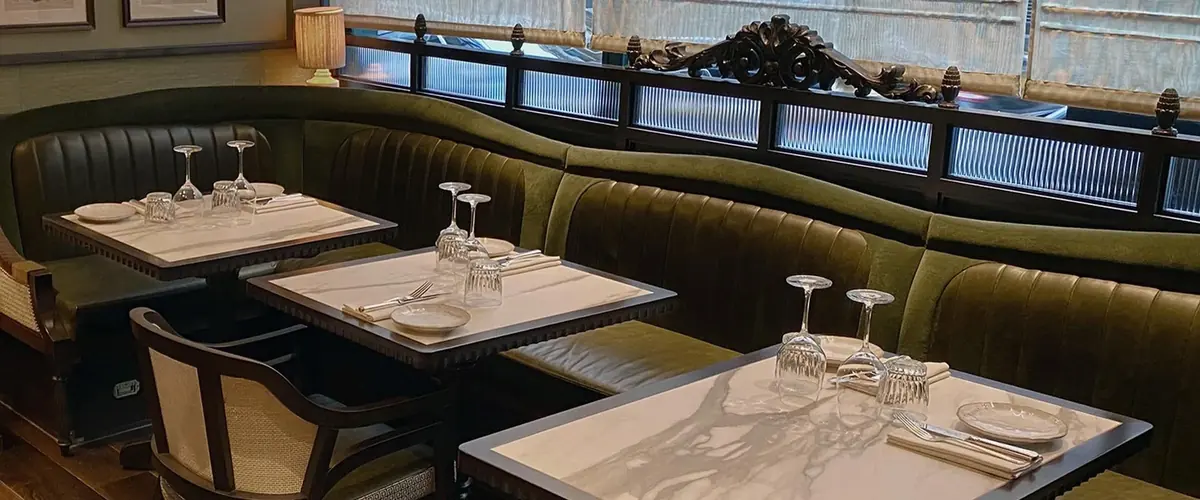
- Banquette seating – fixed seating for kitchens, bay windows and restaurants, covered in detail under banquette seating.
- Ottomans, benches and beds – upholstered headboards and bed surrounds coordinated with bedroom joinery.
Inside the upholstery
What separates bespoke upholstered furniture from retail product is invisible: the frame and the build-up. Our frames are kiln-dried European beech as standard, jointed with mortise, dowel or screw-and-glue construction depending on the load path, with corner blocks where legs meet rails. Frames are dried to 10–12% moisture content before cutting so the piece stays dimensionally stable through the seasons. Where the design calls for metalwork — tubular steel, blackened or polished brass, bronze bases — the frame comes from our metalwork shop fully prepared, ready to be upholstered onto the bench.
Seat suspension is specified to the form. Traditional pieces — club chairs, English sofas, wingbacks — use heavy steel coiled springs tied eight-way with twisted Italian hemp twine: each spring anchored to its four neighbours and to the four corners of the frame, so the spring set deflects evenly under load rather than tilting forward. Eight-way hand-tied stays tied for decades and is the basis for the long, slow recovery that signs a properly-engineered seat. Where the design calls for a low seat profile or a more contemporary build, sinuous (S-shaped) springs are clipped under the rails and give a flatter, slightly springier base at a lower build height. Both are correct for their application; the choice is set at design.
Cushion fills are the decision that most changes how a seat feels in service. 100% down sinks deepest and asks for daily plumping. Feather-and-down blends — 80/20 and 60/40 — give the soft tailored look of a feather cushion with structure beneath. Foam-cored cushions wrapped in feather are the residential standard: soft first touch, holds shape between dressings. Foam-cored cushions wrapped in synthetic fibre are the feather-free equivalent. Solid foam — in CMHR or high-density grades — is specified for contract use where the seat must recover under continuous load. The full range is set out on the upholstery fills page, with a separate technical guide to foam grades. Every piece is built to be re-covered: the investment is the frame, and it outlives its first fabric several times over.
The details that sign the work
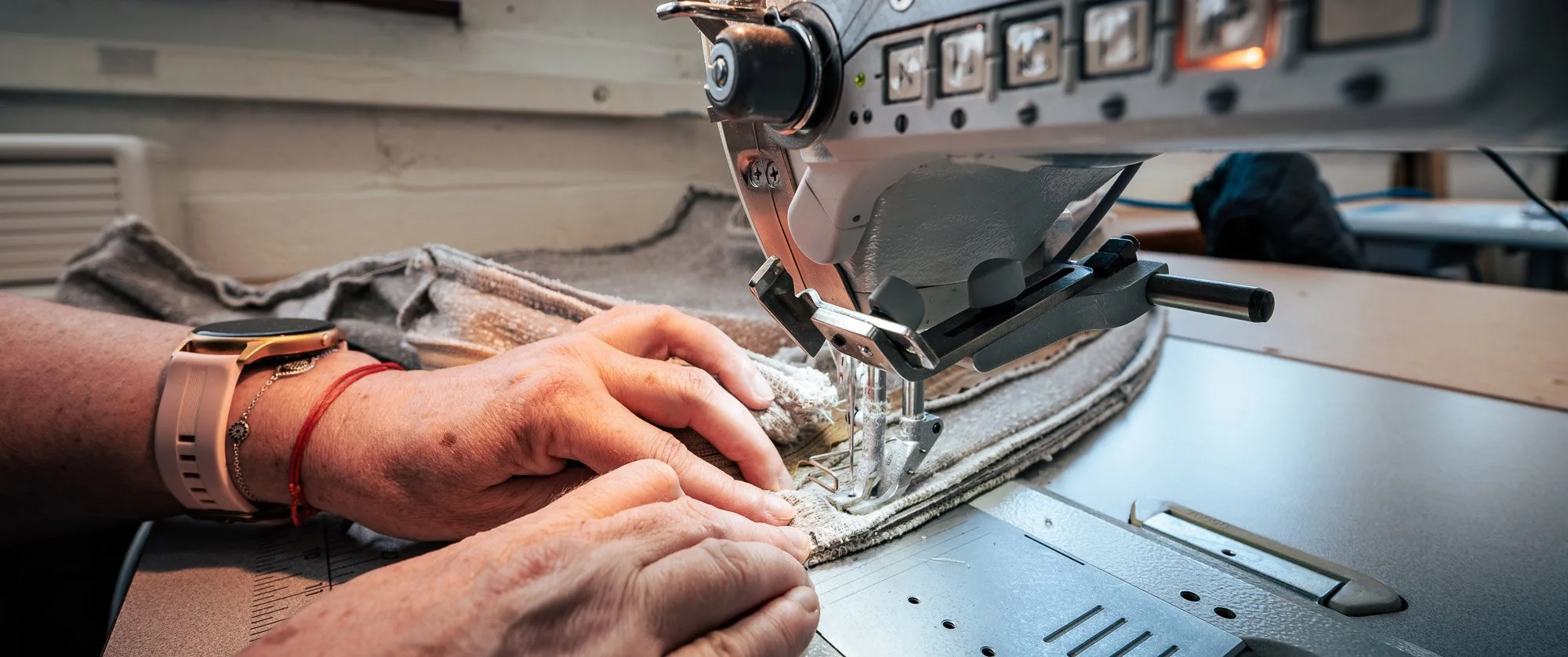
The signature of bespoke upholstery is in its edges. Piping — single or double, in the cover fabric or a contrast — is cut on the bias so it bends through curves without puckering. Hand-stitched edges on traditional pieces build firm, formed rolls from layered horsehair before any sewing machine touches the work. Deep buttoning on a Chesterfield or club chair is laid out to an approved diagram with the diamond pattern landing where it should; the buttons anchor through the padding to twine drawn from the back of the frame. Channelling and fluting on chair backs are stitched continuously top to bottom so the lines stay straight. Studding is laid in a regular line that flows around curves, polished brass or blackened steel finished to the room’s wider metalwork. These decisions are drawn, sampled and approved before the first cover is cut.
Fabric, leather and COM
We upholster in the full range of luxury and performance textiles from the leading European fabric houses, and full-hide leather in any colour and finish. Fabric is quoted on a 137 cm-wide cloth with pattern repeats up to 4 cm; narrower fabrics or larger repeats revise the metreage and are resolved at the quotation stage. Customer’s Own Material (COM) is welcomed, with the cloth arriving 2–3 weeks before production. Leather is calculated per frame from standard hides at 50–55 sq ft yield, with curved leather work cut around the hide’s natural geometry rather than against it. For contract work, fabrics meet Crib 5 (BS 5852) — either passing the flame test untreated or with an FR interliner fitted — without compromising the cloth’s hand. Compliance documentation is supplied with every commercial order. The fabric families — wools, linens, velvets, mohair, bouclé, leather alternatives, performance fabrics — are detailed on the fabrics page with Martindale ratings, FR routes, and care guidance. For how hides differ, see leather in bespoke furniture.
Residential and contract
The same engineering builds a single reading chair for a private client and a hundred dining chairs for a hotel restaurant — the difference is specification, not standard. Residential lead times run typically 8–14 weeks from approved drawings, depending on frame complexity, fabric availability and the seasonal load on the workshops. Contract lead times are programmed against the opening date, with prototypes built and signed off early so production can run at full pace from approval.
Recent and ongoing contract programmes include guestroom, dining and bar seating across the wider Maybourne portfolio, banquette and bar seating at 77 London (interiors by Concrete Amsterdam), and contract work at The BoTree, Marylebone and LAVO London. For hospitality work, seating is prototyped, tested in service and rolled out against the opening programme; cushion specifications are signed off in writing against the operator’s expected daily use cycles before the run starts.
Where the build comes together
Every piece is built by specialist upholstery workshops — makers who work in bespoke seating and nothing else. We hold relationships with several and match each commission to the right bench: workshops set up for one-off pieces commissioned by private clients, and others geared to contract projects at volume, all working to the same frame engineering and hand-finishing. Capacity for contract work is held against the opening programme; residential commissions are scheduled alongside, with lead times agreed at the quotation stage and not extended without written notice. The piece-types we build, from sofas to ottomans, are set out in the catalogue below.