The art of veneer matching
Wood veneer laid with precision, grain, figure and tone balanced across every surface.
Veneer matching is the process of selecting and arranging consecutive wood veneer leaves so that grain, figure and colour flow across panels, doors and furniture in a controlled, intentional way. When done well, it is invisible, a seamless continuation of nature.
Make Bespoke Studio sources book-matched, slip-matched and quarter-matched veneers from our suppliers at Tabu and from exotic species worldwide. Leaves are laid on a light table, assessed for figure and tone, then sequenced before bonding to substrate.
The technique is used across casegoods, fitted joinery, wall panelling and bespoke furniture, anywhere a continuous timber surface is desired. The quality of the match defines the quality of the piece.
Book matching opens two consecutive leaves like a book and joins them on the centre line, producing a symmetrical mirror image of the grain figure. Slip matching slides consecutive leaves in sequence without mirroring, producing a repeating pattern. Quarter matching assembles four leaves to meet at the centre of a panel, producing four-way symmetry — typically used on cabinet door sets and wall panel features. The choice of match type is made at the design stage, before the veneer is cut.
Species with strong figure — figured walnut, ripple sycamore, burr oak, pommele sapele — suit book matching, where the reflected grain becomes a deliberate decorative effect. Plain-sawn species with consistent grain suit slip matching across large panel runs, where too much symmetry would read as artificial. Flitch width and length limit what is achievable — species and flitch are selected together, not independently.
Get in touch if you’d like to elevate your project with a considered veneer match.
Tell us about the surface and the timber you are considering.
How the work is done
Reviewing consecutive veneer leaves for grain consistency, figure and tonal match.
Arranging leaves on a light table, book-matching or slip-matching as specified.
Precision cutting at the join line so leaves meet without visible seam.
Press-bonded to substrate under controlled temperature and pressure.
Ways of matching a leaf
Each leaf varies slightly but belongs to a family sliced in sequence from one log. The gradual change of grain through the tree is what gives veneer its subtle variation — and what makes matching a highly skilled act. These are the matches we work with most.
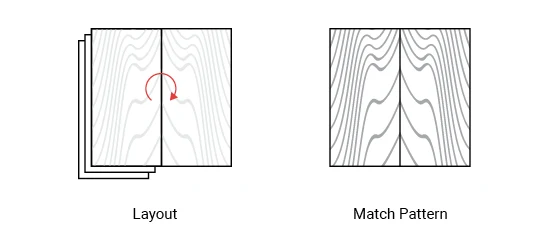
Book matching
Consecutive leaves are folded out with their mirror image, like the centre pages of a book. Because adjoining surfaces come from the same slice of wood, they read almost identically but mirrored — the most common and recognisable decorative match.
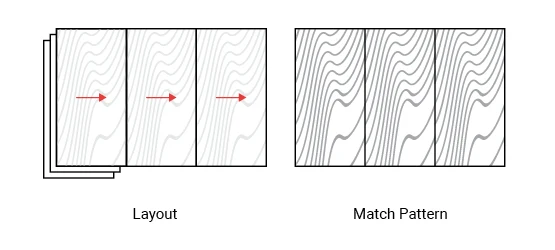
Slip matching
Leaves are laid face up, side by side, in sequence. The grain figure repeats at the width of each leaf across the layout: a continuous, uniform rhythm where the joints do not mirror. The quiet, contemporary choice, especially for quartered veneers.
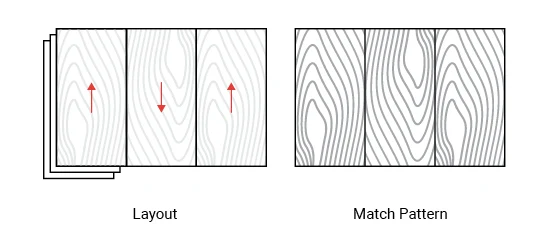
Reverse slip matching
Leaves are slip matched, then every alternate leaf is turned end for end to balance the crowns of the grain. Specified for boat-shaped tables and curved forms, where a round edge would otherwise cut across the grain in awkward ways.
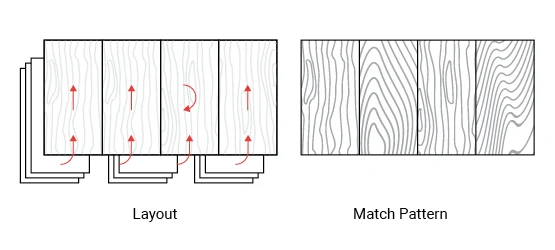
Random matching
Also called mismatched — leaves are placed in random order and orientation and spliced edge to edge, producing a board-by-board effect. The result is deliberately rustic, as though individual boards from a stack had been laid up side by side.
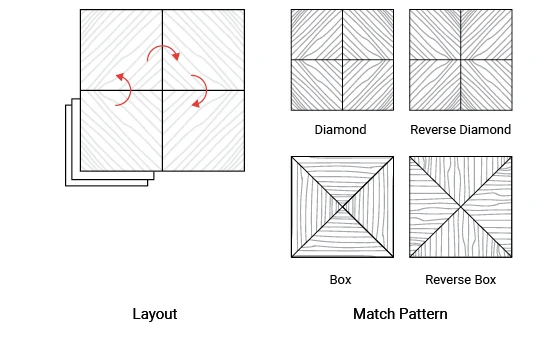
Quarter matching
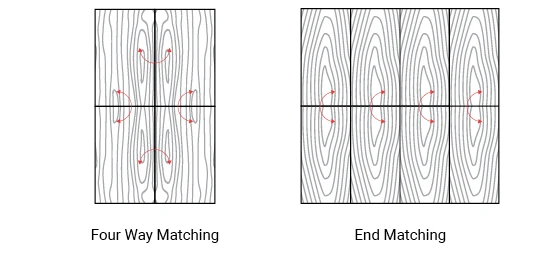
Four leaves are book matched both side to side and top to bottom, mirroring the figure across two axes from a central point. The classic way to build up larger panels — desks, table tops and door fronts — with the figure radiating symmetrically.
Joining & end matching
Grain patterns are joined up to form larger compositions and solve dimensional problems. Burr veneers are continued in matched sequence until the panel size is reached; where a leaf is too short for the panel height, vertical butt joins and horizontal book matches extend it seamlessly.
Speciality matching
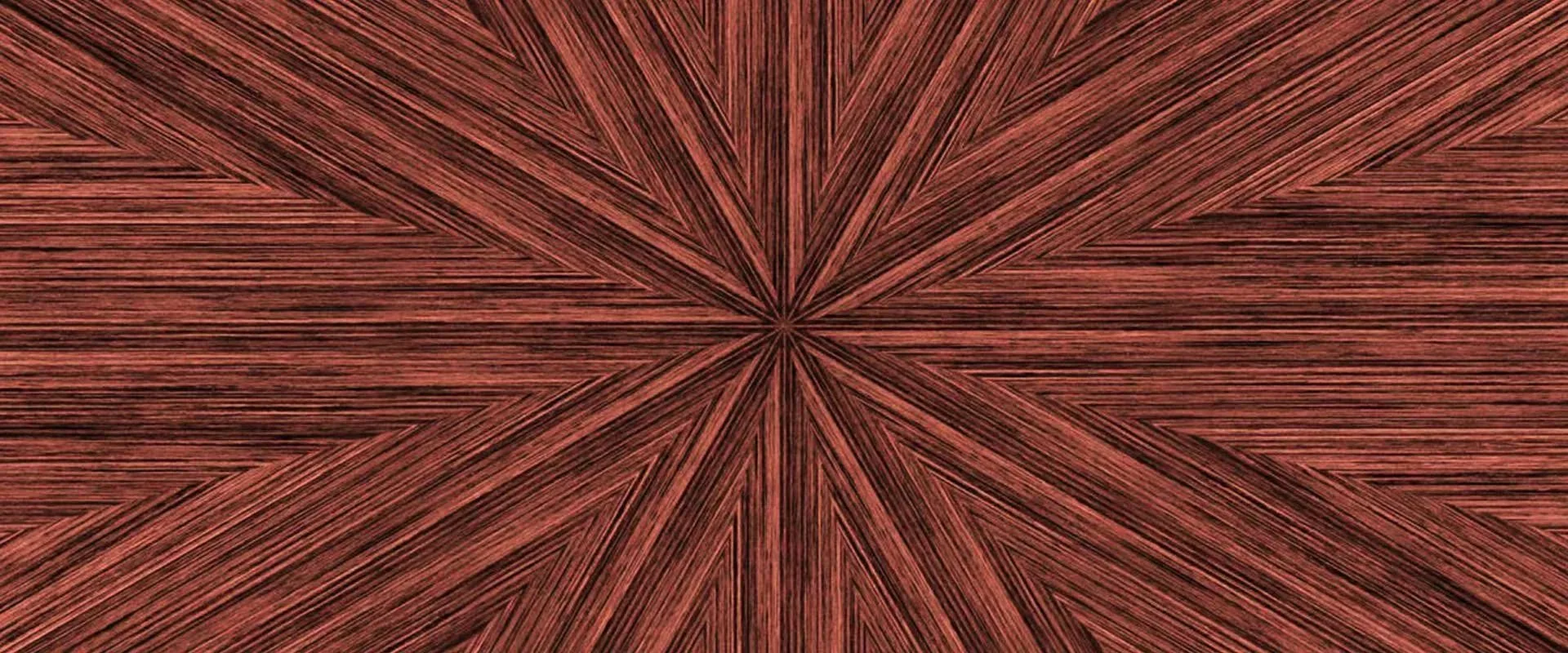
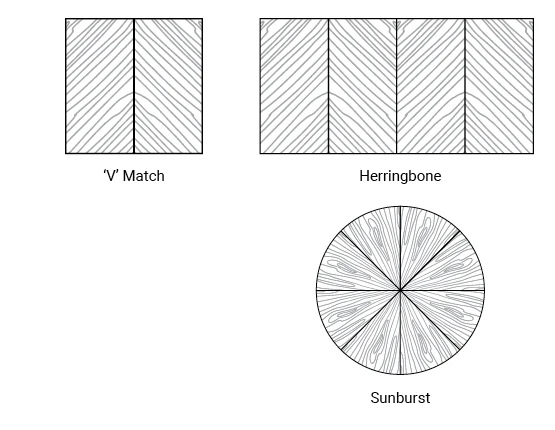
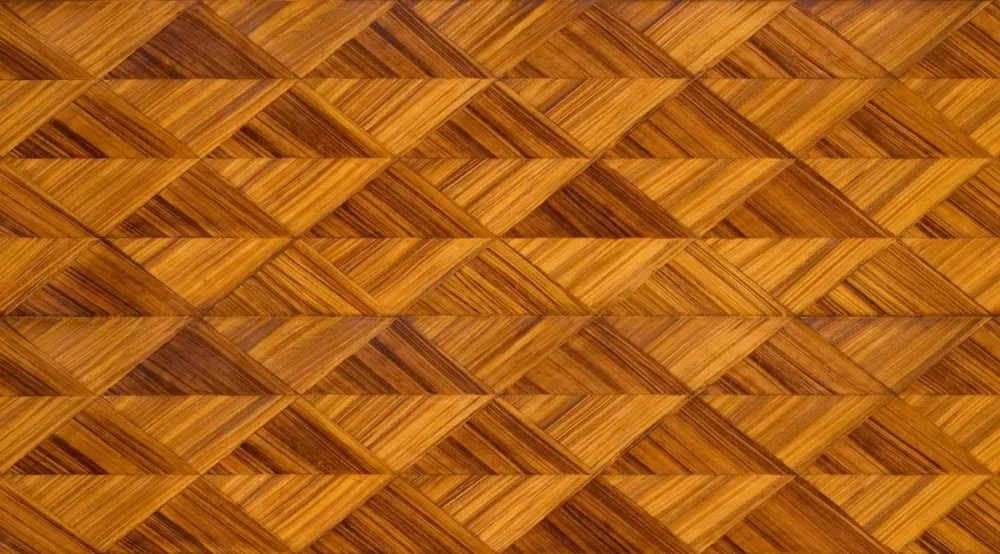
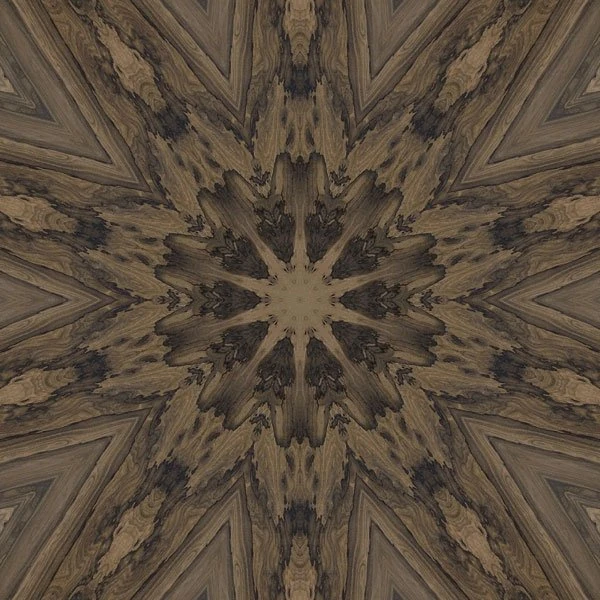
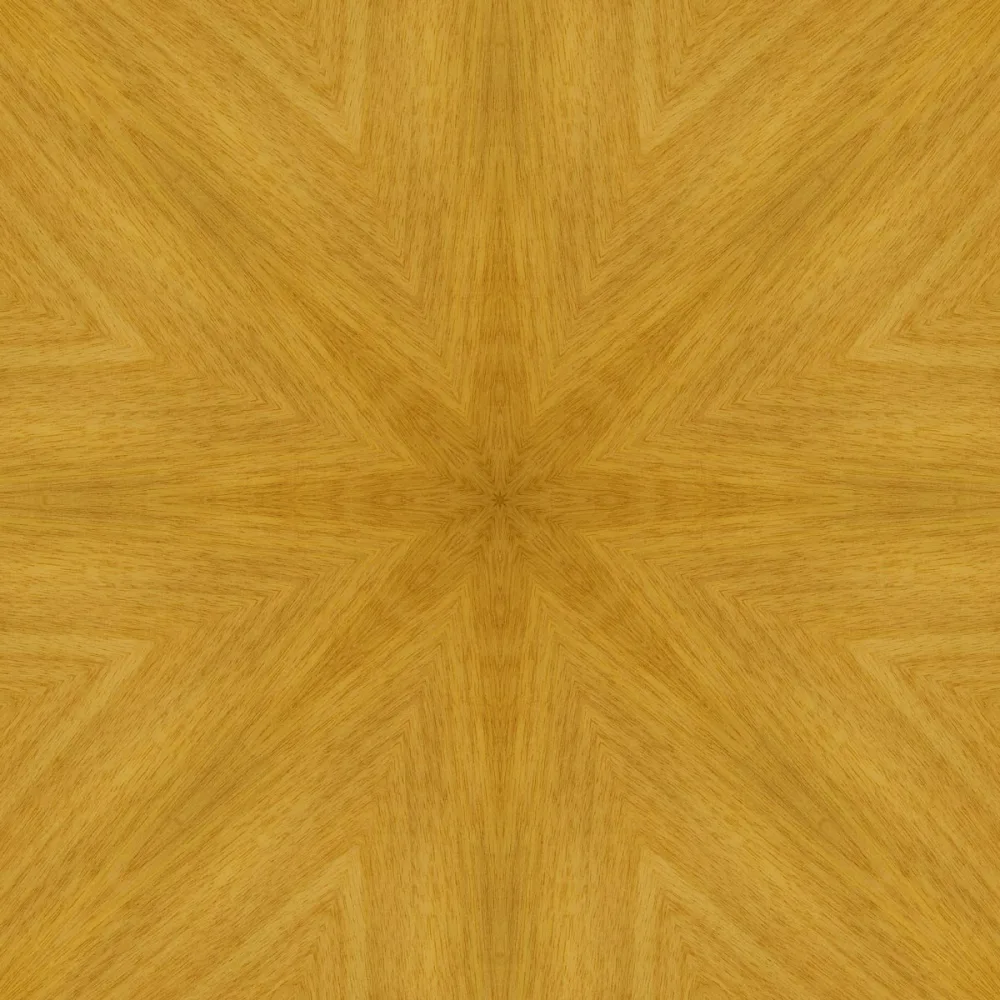
Natural grain is composed into distinct patterns — herringbone, V-matches and radiating sunburst figures. The most demanding work, requiring specialist skill and a precise eye to cut and fit each tapered segment so the figure resolves cleanly at the centre.
The lay-on
Once the match is decided, the individual leaves are jointed together into a single matched sheet — the lay-on. This is the finished face of the design, the full composition assembled and edge-jointed, ready to be applied to a substrate. Everything described above — the book matches, the sunbursts, the quarter-matched panels — arrives at this point as one continuous, intentional surface.
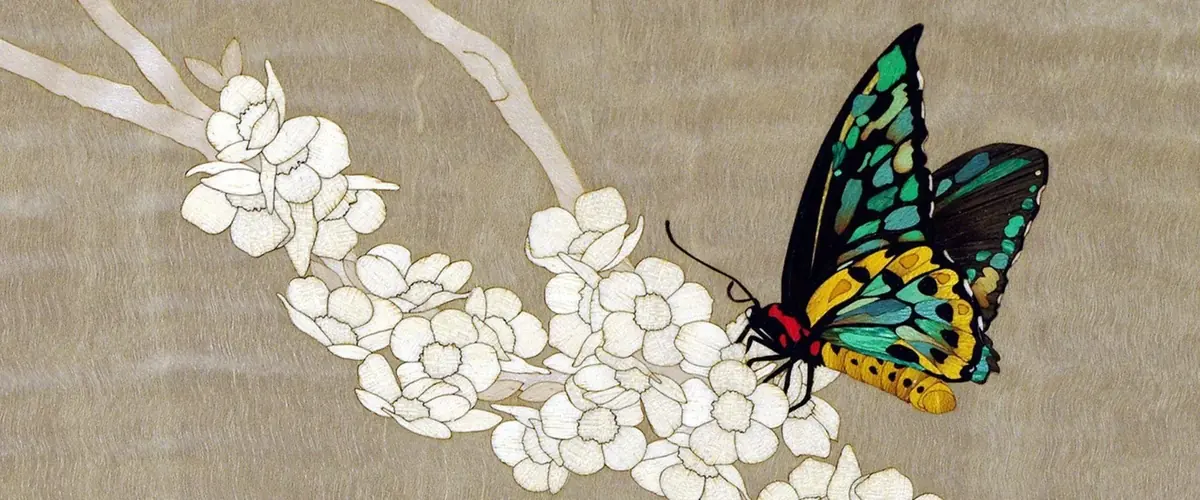
Our marquetry panels are supplied as lay-ons in exactly this way: the inlaid composition assembled as a complete face, ready to take its place in a piece of furniture or joinery.
How it can be supplied
A matched lay-on can be delivered at whatever stage suits the project and the maker handling it:
- Veneer only – the matched lay-on on its own, for makers who will press and finish it themselves.
- Backed to a substrate – pressed onto MDF, plywood or aluminium, depending on whether the priority is stability, weight, or a board ready to cut and fit. Aluminium-backed panels suit curved and lightweight applications; ply and MDF the flat work of cabinetry and panelling.
- Backed and finished – pressed, sanded flush and finished in lacquer or oil, delivered ready to install.
- Backed, natural – pressed and sanded but left unfinished, so the surface can be sealed or coloured to match the wider scheme at a later stage.
We advise on the right format for each commission — a flexible aluminium-backed lay-on for a curved reception desk reads very differently in production from a finished MDF-backed panel arriving ready to hang. Samples and matched lay-ons are prepared through our sampling and development process.
Where this technique is applied
- Casegoods and drawer fronts
- Wall panelling
- Bespoke joinery doors
- Fitted wardrobes and dressing rooms
- Reception desk fascias
- Hotel headboards and bed surrounds
- Library shelving and bookcases