Bespoke Casegoods
Handcrafted cabinet furniture
Casegoods are the fixed points of a furniture scheme — chests, credenzas, console tables, cabinets, sideboards and display pieces built to specific dimensions and finished to match or lead the wider palette. As a bespoke casegood manufacturer, Make Bespoke Studio produces all case goods in our workshops, using solid wood frames, hand-matched veneers and precision-fitted metalwork. For how the category is made, see how bespoke casegoods are made.
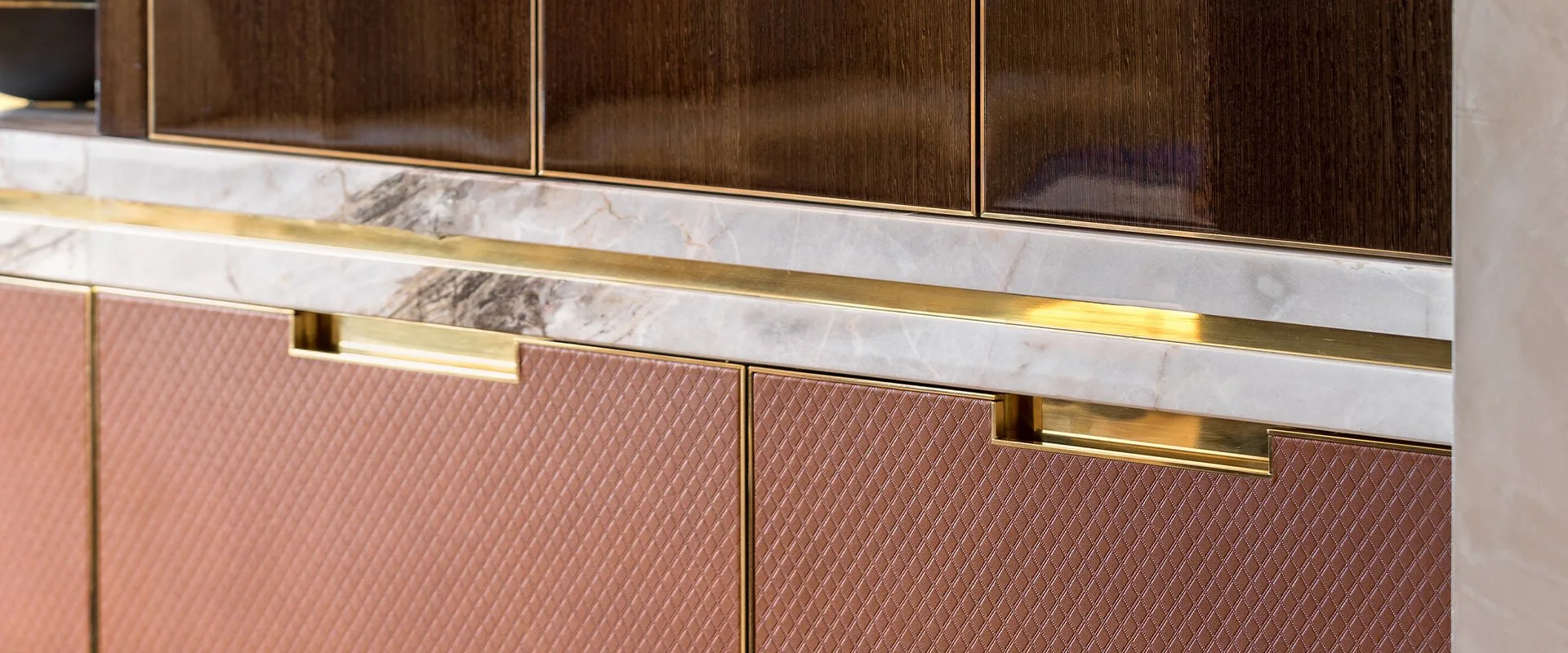
Material combinations are often what distinguish a casegood commission. We mix wood veneer with metal frames and hardware, pair stone tops with lacquered or upholstered panels, and incorporate marble and quartzite surfaces where a stronger material statement is required. Lacquer is available in any RAL or NCS sheen level; veneer selection spans European and exotic species, hand-matched and laid to specification.
Surface detail is available across the full range of decorative craft: marquetry and parquetry in contrasting veneers, straw marquetry, hard carving, shagreen panels and verre églomisé — metal leaf applied to the reverse face of glass. These techniques are integrated at the design stage and executed in our workshops or by specialist craftspeople working within our production process.
The casegoods catalogue
- Credenzas and sideboards – dining room sideboards, tall credenzas and media credenzas with ventilated equipment housing, in veneer, lacquer and mixed materials.
- Drinks cabinets – mirrored, lit and fitted interiors for glassware and bottles; the freestanding cousins of our home bar joinery.
- Tables – dining tables, coffee and cocktail tables, sofa side tables and console tables, from single slabs to marquetry tops.
- Conference and boardroom tables – marble, veneer and leather-topped conference tables engineered for cable management, power and video integration at sizes freight cannot deliver assembled — built in sections, joined invisibly on site.
- Bedside tables and chests – bespoke bedside tables matched in pairs and runs for residential and hotel guestroom schemes.
- Desks and dressing tables – writing desks, vanities and dressing tables with fitted interiors.
Construction and materials
Casegoods are cabinet-making at the precision end of the trade. The carcass is built from kiln-dried hardwood or panel substrate, with joints mortised, dowelled or screw-and-glued depending on the load path. Drawer construction is dovetailed — hand-cut or machine-cut to a hand quality — and runs on hand-fitted hardwood runners on traditional pieces or premium soft-close hardware on modern ones. Doors are hinged or pivoted on ironmongery sized to carry their weight for decades; soft-close mechanisms are standard on residential pieces, fully-concealed Euro-style hinges on contemporary work.
Surfaces are decided at design and drawn from the full materials library. Veneer fronts are book-matched or slip-matched across the carcass to a continuous grain; sourced veneer sheets are laid out, marked and cut to the technical drawing before pressing. Lacquer fronts are sprayed in our spraywork facility in any RAL or NCS colour with the gloss level signed off against a controlled sample. Stone tops — marble, travertine, onyx, quartzite — are templated from the cabinet, fitted with hidden brackets, and finished with polished or honed edges per the brief. Leather inlay, liquid metal panels, shagreen and mixed-material fronts are integrated by craftspeople working within our production process, scheduled into the build at the right stage rather than treated as afterthoughts.
Hardware — pulls, knobs, hinges, lockplates — is finished to the scheme’s wider metalwork. Brass, bronze, polished steel, blackened steel, antiqued and patinated finishes are all standard. Where the project carries existing metalwork by another supplier or by our metalwork shop, finishes are matched and signed off against a control sample before the casegood is dispatched.
Hospitality casegoods and contract programmes
A significant share of casegoods leaves the workshop into hospitality projects: bedside tables in pairs and runs for hotel guestrooms, credenzas and console tables for hotel lobbies and lounges, drinks cabinets for hotel bars and members’ clubs, full conference and boardroom table programmes for corporate offices. Recent and ongoing commissions include guestroom and amenity casegoods at The BoTree, Marylebone, contract work for LAVO London, and full hospitality furniture programmes across the wider Maybourne portfolio.
Hospitality casegoods are specified for use that residential pieces never see. Drawers open and close thousands of times per year rather than hundreds. Top surfaces see daily food, drink and lighting equipment contact. Cabinetry behind doors holds AV equipment that needs ventilation, cabling and serviceable access. These constraints are decided at design and reflected in the technical drawing: sealed-stone tops where required, ventilation grilles where AV is housed, accessible service panels behind decorative doors, hardware rated for the cycle counts hospitality demands.
One-offs, editions and runs
Most residential commissions are single pieces designed for one room. Hospitality and developer commissions usually run as editions: a bedside table design repeated across forty guestrooms; a console family carried through a hotel’s public spaces with proportional variations; a credenza pattern carried through a residential development’s apartments at three different sizes. Editioned work is prototyped once, signed off by the design team and the operator, then produced with the consistency of pattern-book making. The prototype lives on the workshop floor through the production run as the reference standard.
Production capacity for editioned work is significant: a run of forty bedside cabinets for a guestroom programme can ship in five batches of eight across the opening schedule, with the operator’s programme driving the dispatch timetable rather than the workshop’s. For developments and hotels with longer programmes, continuity supply is held against the original sign-off: a casegood discontinued in residential but still required for hotel replacements can be re-run from the original drawings and the prototype, indefinitely.
Surface decoration and applied craft
The crafts that decorate casegoods are part of what distinguishes a luxury commission from a high-street piece. Marquetry is the inlay of contrasting veneers into a pattern cut to a drawing: geometric bandings around a tabletop, sunburst medallions on a credenza front, full pictorial scenes on a museum-grade door panel. Parquetry is geometric marquetry — chevron, herringbone, diamond — cut into a continuous patterned surface. Straw marquetry uses split and flattened straw inlaid into the surface for a metallic, light-catching finish; a French speciality covered in detail on our straw marquetry page. Shagreen is ray skin, used in inlaid panels for its hard, pebbled surface and its association with Art Deco luxury. Verre églomisé is metal leaf applied to the reverse face of glass with a painted bole behind, producing a luminous, almost-living finish that has been used on cabinetry since the 18th century. Each technique is specified at design, sampled before commitment, and integrated into the production schedule with the appropriate craftspeople.
Sizes, freight and on-site assembly
Most casegoods ship complete. Conference tables, long sideboards, large boardroom and dining tables exceed the freight limits and are built in sections that join invisibly on site. The joins are positioned at design stage to align with cabling runs, structural members or the lighting plan; they are not afterthoughts. Site assembly takes one day per join for table work, and is scheduled around the wider fit-out programme so the casegood lands at the right point in the build rather than being stored on a wrapping pallet against a wall.
Lead times
Residential casegoods run typically 10–16 weeks from approved drawings. Sourced veneers, applied marquetry, leather inlay and stone tops can extend the schedule depending on the brief; sourced timber slabs in particular are programmed against the supply rather than the workshop. Hospitality programmes run against the opening date: prototypes built and signed off early, then production at the operator’s pace. Boardroom and conference tables run 16–22 weeks because of the cable management integration and the section-joining engineering. Every quotation states the lead time from approved drawings, and dispatch schedules are agreed against the project programme rather than the workshop diary.