Casegoods is the trade's word for the furniture that stores and displays: cabinets, sideboards, credenzas, bookcases and vitrines, the most architectural pieces in a room, where carcass, doors, drawers, surface and hardware must all be right at once.
Push a well-made drawer home and it doesn't slam. It slows of its own accord in the last inch, draws a soft, slow breath of air, and settles flush without a sound — a small, exact moment that tells you the whole cabinet is expensive while you are still working out quite how. That quiet is the point. “Casegoods” is the trade's word for the furniture that stores and displays — cabinets, sideboards, credenzas, bookcases, dressers and vitrines. They are, in a sense, the most architectural furniture: boxes whose proportion, surface and detail set the tone of a room. A bespoke cabinet or sideboard is also where the most furniture-making skill is concentrated — carcass, doors, drawers, surface and hardware all have to be right at once.
The carcass
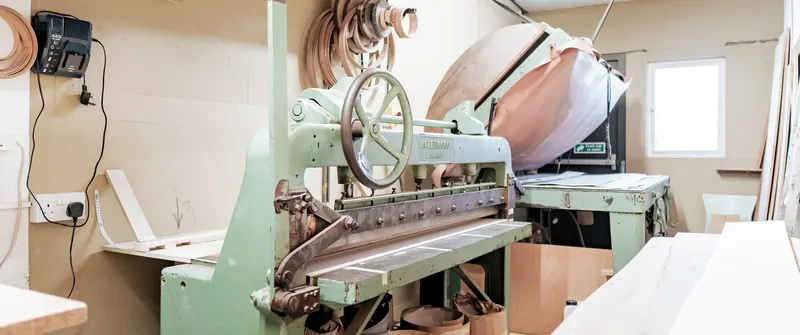
Everything starts with the carcass — the box itself, the part no one ever sees and the part everything else depends on. A quality carcass is built in our woodwork workshop from stable, engineered cores, chosen for flatness and to resist the slow seasonal movement of timber, then faced in veneer or solid timber, jointed and braced so it stays square under load and over the years. Shelves are engineered not to bow under the weight of books or glass; backs are let into grooves rather than pinned on, so the box holds its shape rather than relying on the wall behind it. The carcass is the part you judge without realising, by opening and closing the doors a decade later: a good one still shuts true, with the same quiet authority it had on the day it was hung.
Veneer and surface
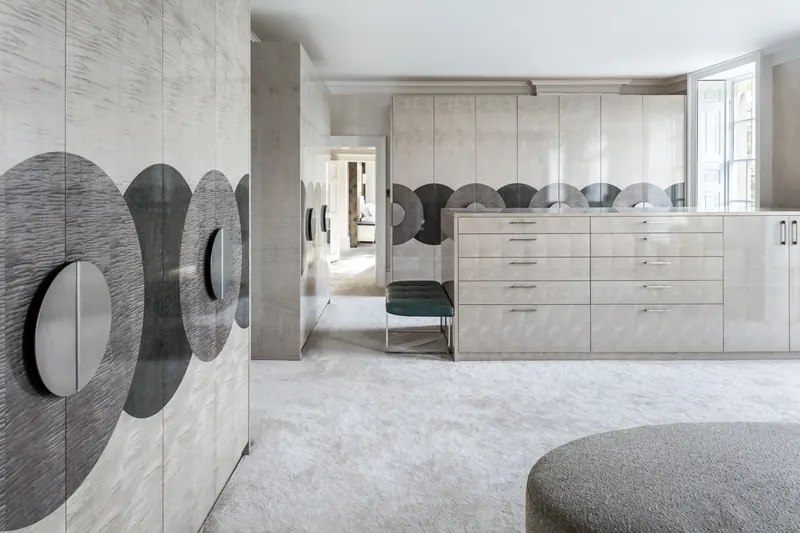
The face of a cabinet is usually veneer, and on a fine piece the veneer is not just applied but composed. Leaves are selected and sequenced so the grain flows and mirrors across doors and drawer fronts — the craft we cover in veneer and book-matching. A run of cabinetry should read as one continuous surface, the figure carrying across every joint as though the timber had grown that way; the eye should glide over the doors and never catch on a seam. Lacquer, oil, or specialist finishes complete the surface, chosen for the look and the wear the piece will take — the deep, glassy build of a hand-polished lacquer asks for different care than an oil you can feel the grain through.
Doors, drawers and movement
The parts that move are where quality is felt every day, by hand rather than by eye. Drawers run on precision runners or traditional timber-on-timber slides, soft-closing and self-aligning; doors hang on concealed, adjustable hinges and sit with consistent, hairline shadow gaps you could lay a banknote into. Getting the gaps even and the movement effortless across a whole piece is painstaking, slow work — a fraction of a millimetre out on one door and the whole front loses its calm. It is exactly what separates bespoke cabinetry from flat-pack: the latter never quite lines up, and never gets better. The good piece does the opposite, settling into itself as it is used.
Internal fit-out and hardware
Inside, a bespoke cabinet earns its keep: drawers divided and lined for what they hold, integrated lighting, cable management for AV credenzas, pull-out trays, and timber chosen to look and smell right when opened — that first warm note of cedar or oak when a client lifts a lid is a detail we'll always sweat over, even though no photograph will ever catch it. The hardware — handles, knobs, pulls — is the jewellery, often made bespoke in brass or bronze to match the scheme. These details are small individually and, together, the difference between furniture and joinery that simply works and furniture that delights every time a hand reaches for it.
Freestanding or fitted
Casegoods come in two broad forms, and the choice shapes the whole commission. Freestanding pieces — a sideboard, a drinks cabinet, a bookcase — are objects in their own right, finished on all sides, able to move with you between homes and read as furniture. Fitted casegoods are a form of bespoke joinery, built into the architecture: alcove cabinetry, media walls, a run of storage that meets the ceiling and scribes to an uneven wall, designed to look original to the building. Each demands different detailing — a freestanding piece needs a considered back and a base that lifts it off the floor; a fitted run needs precise scribing and shadow gaps so it sits seamlessly in the space, as though the house had been built around it. We make both, and part of the early conversation is simply sitting with a room and deciding which it actually wants.
Built for the room and the years
Because casegoods are so architectural, bespoke is often the only way to get a piece that fits the wall, the proportion and the function exactly — and that is made well enough to be worth fitting. Built around your space, veneered to read as one surface, and detailed to open and close beautifully for decades, a bespoke cabinet is a quietly serious investment — the kind of thing that outlasts the room it was made for, and gets handed on. If you have a wall, an alcove or a function looking for the right piece, we would be glad to design it.