-1200w.webp)
Bespoke hospitality furniture and FF&E is a scheme specified down to the last detail and made to fit a room, rather than chosen from a catalogue: furniture that looks considered, survives constant use and meets public-space safety standards.
You feel it before you can name it. You step through the door of a hotel that has been done properly, and the room seems to have been waiting for you: the reception desk meets you at exactly the right height, the banquette curves to follow the wall as though it grew there, the light falls warm on timber that someone chose and someone finished by hand. Nothing announces itself. Every piece was made for this room and no other, and the effect is a quiet sense of having arrived somewhere considered. That feeling is the whole point of bespoke furniture and FF&E in hospitality: a scheme specified down to the last detail and made to fit, rather than chosen from a catalogue and made to do. Hospitality interiors ask more of their furniture than almost any other setting. A hotel lobby, a restaurant banquette or a bar front has to look considered, survive constant use, and meet the safety standards that public spaces require, all while carrying the identity of the brand it serves. This guide explains what hospitality work demands, how bespoke compares with standard contract furniture, the categories that make up a fit-out, the compliance standards behind contract environments, and how a commission is specified, budgeted, manufactured and installed.
What is hospitality FF&E?
FF&E stands for furniture, fixtures and equipment: the layer of a scheme that is not part of the building's structure but defines how it looks and works. In hospitality it covers loose and fixed furniture, joinery, upholstery, lighting, mirrors, decorative surfaces and the case goods in every guestroom. It is usually specified by the interior designer, costed and bought by a procurement team, and signed off by the operator. The FF&E package is often the single largest line in a fit-out after the base build, and it is where the character of a venue is decided. Strip a room back to its bare walls and services and it is the FF&E that turns it from a space into a place.
Within that package, items are bought along a spectrum. At one end is standard contract furniture, chosen from a manufacturer's range. At the other is fully bespoke work, designed for this project alone and made to the drawings. In between sits made-to-order: a stock design altered in size, finish or fabric. Knowing where each item should sit on that spectrum is the core of a good specification, and it is worth understanding the difference between bespoke furniture and adapted stock before the budget is set. Bespoke is not the right answer for every line, and we say so when it isn't. It is the right answer where fit, identity or an unusual requirement makes a catalogue piece a compromise.
It helps to separate the FF&E package from the two layers either side of it. Below it is the base build and the mechanical, electrical and plumbing services, which are fixed before furniture is placed. Above it, in the language some operators use, sits OS&E: the operating supplies and equipment such as linen, glassware and tableware that are bought close to opening. Bespoke furniture and FF&E sit in the middle, and they are the layer with the longest lead times and the greatest effect on how a venue feels. That is why they are specified early and managed closely throughout the programme.
What hospitality furniture has to do
A piece for a hotel or restaurant works harder than the same piece at home. Think of a corner banquette on a Saturday night: shuffled into, slid along, set down on and wiped clean, then again the next service, and the one after that, for years. Hospitality furniture has to hold up to all of it without ever looking tired, which means contract-grade construction, hard-wearing finishes and upholstery rated for commercial use.
Public spaces also carry obligations the home does not. Seating and soft furnishings are specified to meet the relevant fire-safety standards for contract environments, and pieces are built to take the loads and wear of constant service. Getting this right is part of the brief from the first conversation, not an afterthought bolted on at the end.
Scale matters too. A guestroom design might be repeated across a hundred rooms, so the hundredth headboard has to match the first exactly: the same line, the same depth of colour, the same hush as a drawer closes. A restaurant fit-out, meanwhile, has to be ready for a fixed opening date that will not move for anyone. Both reward a maker with the capacity to produce at volume without losing the standard of a single commission.
What is the difference between bespoke and contract furniture?
Most hospitality furniture is bought as contract furniture: ranges built in volume to fixed designs, chosen for durability and price. It is a sound choice for a fit-out on a tight budget or timescale. What it cannot do is fit a particular scheme exactly, or carry a detail that belongs only to that venue.
Bespoke furniture is designed once and made to the project. It lets the designer set the proportions, materials, finish and detail, so the banquette, the bar and the reception desk read as one idea rather than a set of separate purchases. The useful comparison is not bespoke against flat-pack, but bespoke against other routes to a contract-grade result. Our aim is to offer the standard of a top London workshop with the capacity of a manufacturer, which usually means a bespoke result at a sensible price for the level of finish.
There is also a practical reason bespoke earns its place in hospitality. Venues are rarely built to standard dimensions. A banquette has to follow the line of a structural wall that is anything but straight, a bar has to swallow a run of specified equipment to the millimetre, a reception desk has to suit the height of the people who will stand behind it for a full shift. Catalogue pieces force the room to bend around them, and you can always see where it has happened — a packed-out gap here, an awkward return there. Bespoke lets the furniture follow the room, and follow the brand.
The categories of a hospitality fit-out
A hospitality package is easier to plan when it is broken into the kinds of work it contains. Each has its own construction logic, its own lead time and its own compliance considerations.
Casegoods. The fixed and loose storage pieces that fill guestrooms and back-of-house: wardrobes, minibar units, desks, luggage benches, vanity units and headboards. Casegoods are usually the most repeated items in a hotel, so they are designed for consistency and for assembly on site. Finishes have to survive cleaning, the scuff of a wheeled suitcase against a plinth, and years of daily handling.
Seating. Loose chairs, lounge chairs, stools and sofas, all upholstered and built to contract standards. Frames are specified for the loads of constant use, foams for resilience and recovery, and fabrics for rub count and cleanability.
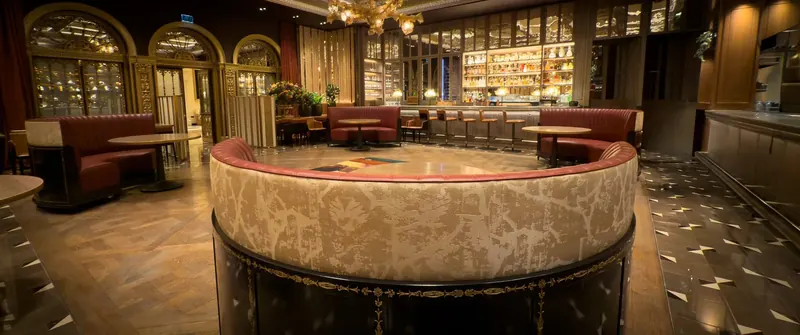
Banquettes. The fixed upholstered seating that defines most restaurants and bars. Banquettes are bespoke almost by definition, because they follow the plan of the room. They combine joinery carcassing, upholstery and often integrated services such as power or heating, and they set the rhythm of a dining room — the gentle geometry that tells a guest where to settle.
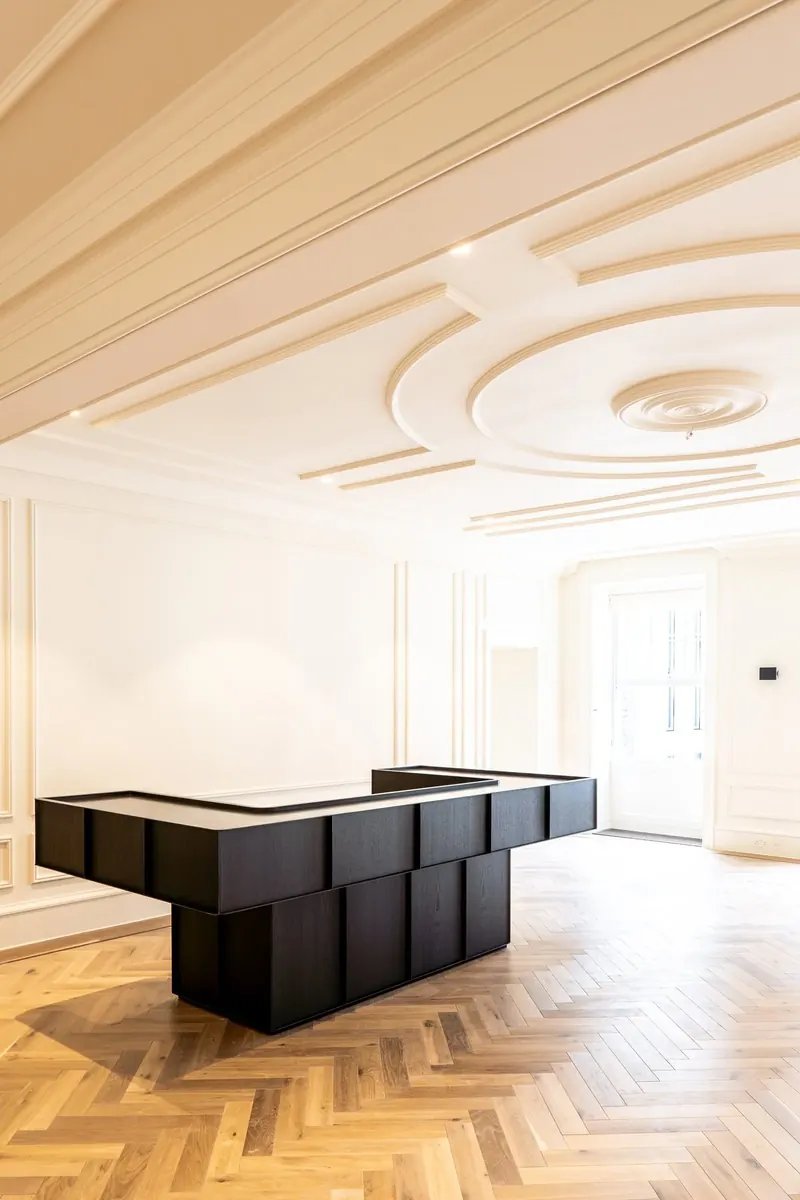
Joinery. The fixed timber and panel work: bars, back-bars, reception desks, panelling, screens and fitted units. This is where much of a venue's identity lives, and where the standard of a workshop shows most clearly — in a mitre that stays tight, a veneer matched so the grain runs unbroken across a whole wall. Our work here draws on the same disciplines we describe in our guide to bespoke joinery for high-end interiors.
Lighting. Decorative and architectural lighting, from pendants and wall lights to integrated joinery lighting and feature pieces. Bespoke lighting lets a scheme carry a signature element and meet the exact light levels a space needs; our guide to bespoke lighting covers the considerations in more detail.
Decorative work. The surfaces and finishes that lift a scheme above the ordinary: marquetry, lacquer, metalwork, glass and applied detail. These are usually reserved for the spaces that carry the most weight, such as a lobby, a feature bar or a destination restaurant. A decorative element is often what a guest remembers and what photographs carry, so it tends to be specified to the full standard even where the budget elsewhere is restrained. It is also where the longest lead times sit, because the work is slow and made by hand — and we have learned to agree and start these pieces first, before anything else, because there is no rushing a gilder or a marqueteur without it showing.
Tables sit across two of these categories at once. A loose dining table is a seating-adjacent item, while a fixed or built-in table is closer to joinery. Either way, the top has to take heat, moisture and constant cleaning, and the base has to be stable under load and easy to move around for service. In practice tables are one of the items that most reward bespoke specification, because standard heights and sizes rarely suit a particular room or a particular cover layout.
Durability and compliance for contract environments
Specification in hospitality is governed as much by standards as by taste. The brief has to satisfy the operator's facilities team and the building's regulations, and those requirements shape construction from the first drawing. None of it is glamorous, but it is the discipline that lets the beautiful part survive contact with real service.
Fire performance. Upholstered furniture and soft furnishings in public and sleeping accommodation are specified to the relevant contract fire-safety standards, which are more demanding than the domestic equivalents. This affects the choice of fabric, the foam beneath it and the interliners used in construction. It is settled at specification stage, recorded on the schedule, and certified on delivery.
Wear and loading. Contract furniture is built and tested for heavier and more frequent use than domestic pieces. Frames, joints and mechanisms are specified to take the loads of constant service, and fabrics are chosen by rub count and resistance to abrasion so that a banquette still looks considered after years of covers.
Cleaning and maintenance. Hospitality surfaces are cleaned often and aggressively. Finishes are specified to resist staining, moisture and the cleaning regimes a venue actually uses, and upholstery is chosen so that it can be cleaned in place. A finish that looks beautiful on the sample board but cannot survive a wipe-down at the end of service has no place in a working restaurant.
Accessibility and ergonomics. Dimensions are set against the people who use the furniture, from seat heights and table clearances to the working height of a reception desk. Getting this right is part of meeting the building's obligations as well as making a space comfortable to use.
The specification and procurement workflow
A hospitality commission follows a recognisable path from drawing to delivery. Understanding it helps a design or procurement team plan a programme that holds.
It begins with the designer's drawings and a sample scheme. We review the package, advise on construction, materials and compliance, and quote the work itemised so that every line can be costed and value-engineered against the budget. Once an item is approved we prepare prototypes and samples for sign-off, then move into manufacture, with quality checks through production. Finished pieces are protected, scheduled and delivered to programme, then installed and snagged on site. Because the work is made across our workshop network, a large package can be produced in parallel rather than in sequence and delivered to a single opening date. The full step-by-step is set out in our guide to how to commission bespoke furniture.
A few practical points keep this workflow running smoothly. The first is a clear FF&E schedule, the document that lists every item, its specification, its finish and its location, against which quotes, samples and deliveries are all checked. The second is disciplined sign-off: prototypes and samples are approved in writing before manufacture begins, so that there is one agreed reference for the finished work. The third is a single point of responsibility for each package, so that the designer and the procurement team have one party accountable for buildability, compliance, programme and delivery rather than chasing several. Where a project runs through a main contractor, the same information flows into their programme, and the furniture is delivered to suit the state of the site rather than an abstract date.
Working to a design intent package
Most hospitality work begins not with finished drawings but with a design intent package: the designer's drawings, references, finish schedules and sample boards that describe the result without resolving every junction. Our job is to take that intent and develop it into something that can be made, certified and installed, without losing the idea behind it.
In practice that means producing manufacturing drawings from the design intent, proposing the construction that will deliver the look and meet the standards, and flagging anything that needs a decision before it becomes a problem on site. The designer keeps control of the appearance; we take responsibility for buildability, compliance and fit. The clearer the intent package, the faster this stage runs, but a good maker can hold the design's integrity even where the package leaves room for interpretation.
Samples are central to this stage. A finish that reads one way on a mood board can read quite differently at full scale and under the actual lighting of a room — a veneer that looked honey-warm in the studio turning cool and grey under a restaurant's low evening light. So we make physical samples and, for the items that carry the most weight, full prototypes. Seeing a banquette section or a panel of the chosen veneer in the hand, turning it to catch the light, settles questions that drawings never can, and it gives the designer and the operator a single agreed reference to approve. Once that reference exists, the rest of the run can be made to match it with confidence.
How is hospitality FF&E budgeted?
Few hospitality schemes are delivered without a conversation about cost. The discipline that keeps a project on budget without hollowing out the design is value engineering: finding where the brief can be met more efficiently, and protecting the elements that carry the scheme. Done badly it strips the character out of a venue, leaving a room that is technically complete and somehow lifeless. Done well it is invisible, and the published budget is met.
An itemised quote is what makes this possible, because it shows where money is going line by line. From there, choices can be made with intent: a feature bar built to the full specification while back-of-house casegoods are simplified, or a hero material reserved for the surfaces a guest touches and a sympathetic alternative used elsewhere. We approach this as a design problem rather than a cutting exercise, and our broader thinking is set out in our guide to value engineering in interior design.
The most effective value engineering happens early, while the design is still flexible, rather than late as a reaction to a quote that has come in high. Brought in at the right moment, a maker can suggest a construction or a material that meets the intent for less, before drawings are fixed and lead times committed. Left until the end, the only levers left are blunt ones, and that is when character is lost. The aim throughout is simple to state and harder to do well: spend the budget where a guest will touch it, see it, remember it — and save it where they never will.
What are typical hospitality FF&E lead times?
Lead time is the constraint that shapes most hospitality programmes. A bespoke piece needs time for drawings, sample approval, manufacture and finishing, and that time has to be planned backwards from a fixed opening date that rarely moves — the invitations are printed, the press is booked, and the room has to be ready.
On a large project the answer is rarely a single delivery. Production is phased so that long-lead items such as bespoke lighting and feature joinery are started early, while repeated casegoods are programmed to arrive in line with the floors that are ready to receive them. Manufacturing across a workshop network means several categories can be in production at once rather than queuing behind one another. The earlier a maker is brought into the programme, the more the schedule can absorb the inevitable changes that come with a live fit-out — and there are always changes.
Phasing also protects the budget and the standard of the work. A long-lead item that is rushed because it was specified late is the most likely place for cost to rise and quality to slip. By contrast, a piece that is drawn, prototyped and approved in good time can be made calmly and checked properly, with the bench-hands given room to do their best work rather than their fastest. On a hotel of any size, the guestroom casegoods are often the critical path, because there are so many of them and they have to land floor by floor; getting their drawings and samples signed off early is usually the single most useful thing a programme can do.
Installation and snagging on site
The work is not finished when it leaves the workshop. Hospitality delivery happens into a live site — dust in the air, painters on ladders, a dozen trades working to the same deadline — often against a handover date that has no give in it, so installation is planned rather than improvised. Pieces are wrapped and protected in transit, sequenced to suit site access and the state of the floors, and fitted by teams who understand how the work was made and how it is meant to sit.
Snagging is the final discipline: a methodical check of every item against the specification, with any defect recorded and resolved before handover. On a fit-out delivered to a single opening date this stage is unforgiving, which is why it is built into the programme from the start rather than left to the last week. A venue opens once. There is no second night to get it right, and the furniture has to be right on that day.
What we make for hospitality
- Reception and front desks, in joinery, stone, metal and leather.
- Banquette and loose seating, upholstered to contract standards.
- Bars and back-bar joinery, with integrated lighting and services.
- Restaurant and lounge tables, in solid timber, veneer, stone and metal.
- Guestroom and suite joinery, including wardrobes, headboards and vanity units.
- Wall panelling, screens and decorative surfaces, in veneer, lacquer, marquetry and metal.
- Bespoke lighting and coordinated FF&E packages, specified across a whole scheme.
Working with designers and operators
We work with interior designers, architects, procurement teams and operators, supplying directly to the scheme. Whether the brief is a single restaurant or a multi-room hotel, we quote itemised and manage production end to end. Our hospitality work spans London hotels, restaurants and members' clubs, including pieces for venues such as The Ned, Claridge's, The Lanesborough, Nobu Hotel, The Beaumont, Gleneagles, 45 Park Lane, Gymkhana, The Ivy, Holborn Dining Room and 14 Hills. What stays with us is not the list of names but the moment a finished room first fills with people — the banquette taking its first guests, the bar catching the light, the whole scheme quietly doing the job it was made to do. That is the part you cannot photograph, and it is the reason the work is worth getting right. You can see examples across our projects. See the full range of hospitality furniture and FF&E we make, or how we work with practices on our page for the trade.
Common questions
What is the difference between contract furniture and bespoke FF&E? Contract furniture is built in volume to fixed designs and chosen for durability and price. Bespoke FF&E is designed for a single project and made to its drawings, so it fits the room exactly and carries the venue's identity. Both can meet contract-grade standards; the difference is fit, character and control over detail.
How far in advance should a maker be involved? As early as the design intent package allows. Bringing a maker in early means long-lead items can be started in good time, the programme can be phased around the opening date, and buildability and compliance questions are resolved before they reach site. Late involvement compresses every stage and leaves less room for the changes a live fit-out brings.
Can bespoke work be delivered to a fixed opening date? Yes. The programme is planned backwards from the opening date, production is phased across categories, and manufacturing across a workshop network lets several lines run in parallel. Installation and snagging are built into the schedule so that the venue is ready on the day it opens.