.jpg)
Commissioning bespoke furniture follows five steps: an initial brief, design development and drawings, material selection, manufacture in the workshop, then white-glove delivery and installation, beginning with a simple conversation.
Most people arrive at their first commission a little unsure of how to begin. There is no catalogue to leaf through, no price ticket, no specification waiting to be ticked off — just an idea, sometimes only half-formed, and the question of what happens next. The honest answer is that it begins with a conversation, and that a good piece grows out of that conversation as much as out of the workshop. What follows is exactly how the process unfolds when you commission with us, set out so that none of it feels like a leap of faith.
Every commission begins with a conversation. It might be a phone call, a meeting at your studio, or a walk around the room the piece is destined for — whatever is most useful at this stage. We are trying to understand a few simple things: what the piece is, where it is going, what it needs to do, how it should look, and what your programme and budget allow. None of these questions has a wrong answer.
You do not need to have resolved every detail before you speak to us. A sketch on the back of an envelope, a mood board, a single photograph you keep returning to, a set of room plans — any one of these gives us enough to begin. Some of the pieces we are most proud of started life as a scribble and a sentence that began “I'm not sure if this is possible, but…” We ask plenty of questions and we listen closely, because everything that follows is built on what we learn here.
From the brief we develop technical drawings. For furniture, this usually means plan, elevation and section drawings showing exact dimensions, with the smaller details drawn out at a larger scale so nothing is left to guesswork. For joinery, the drawings go further still, showing fixing methods, material transitions and the order in which things are built.
These come back to you for review and approval, and this is the moment we ask you to be exacting. A change made on paper is a pencil line and costs nothing; the same change made in solid timber is slow and expensive. We would always rather spend an extra afternoon here than discover something on the workshop floor, so we put real care into this phase — it is where most problems are quietly solved before they ever become problems.
For more ambitious pieces — a staircase, a large fitted library, a hotel reception desk — we may also build a pilot section or a full prototype for you to sign off before we commit to production. There is nothing quite like standing in front of the real thing, at full size, to confirm that a decision is right.
Choosing materials runs alongside the drawing work. We send you samples of the timber veneers, lacquer colours, leathers, fabrics, hardware and ironmongery in question, so that every choice can be made with the thing in your hand — turned towards the window, held against the wall, seen in the actual light of the room. A colour on a screen will tell you very little; the same colour laid against a sample tells you everything.
If you arrive with a material already in mind — a particular leather from a named tannery, a veneer specified elsewhere in the scheme — we will track it down. If you would rather be guided, we will lay out the options and advise you honestly on what suits the piece and how it will wear over the years it spends in use.
Once the drawings and materials are signed off, the making begins. The workshops we manufacture through run CNC routing, panel sawing, veneering presses, spray lacquering and full upholstery departments. We use the same partners project after project rather than putting each job out to whoever is cheapest that month, so the people building your piece already know how we detail and finish. The people who draw your piece are the people who build it.
We share production milestones along the way, so you always know where your commission sits in the programme rather than wondering. For hospitality and commercial projects we work to the main contractor's programme and coordinate delivery dates directly with the site team.
Quality control is woven into the making, not bolted on at the end: dimensional checks while components are still loose, a lacquer sign-off before anything is assembled, and a full inspection before any piece is allowed to leave the building. Nothing goes out of our doors that we would not be happy to receive ourselves.
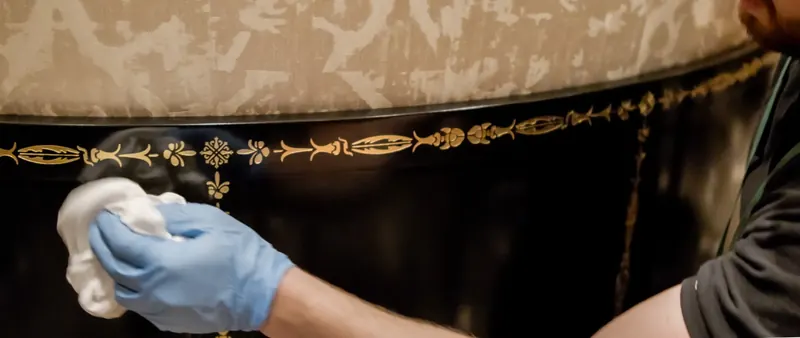
We deliver and install with our teams. Each piece travels in a custom-made transit case, blanket-wrapped and padded, treated on the road with the same care it was given on the bench. Installation is carried out by experienced fixers who know how to move through a finished interior without leaving a mark on floors, walls or anything standing nearby — the final hours of a project are often the most delicate, and we treat them that way.
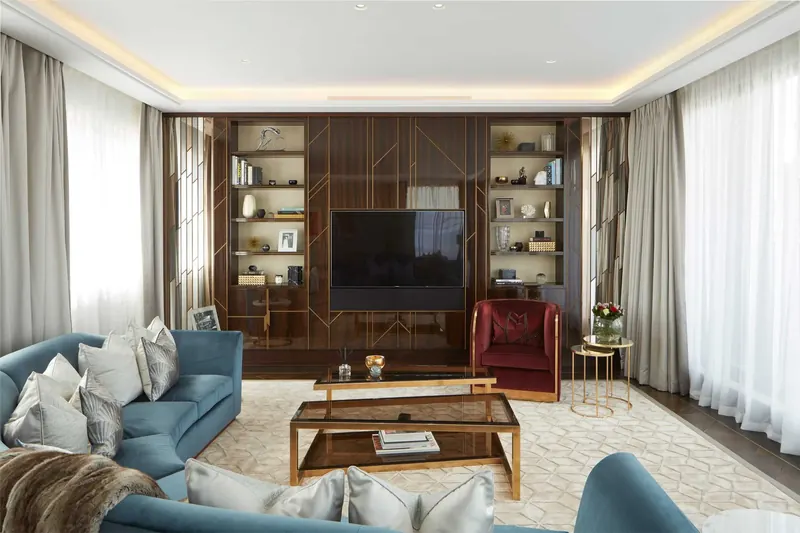
For fitted joinery — wardrobes, kitchens, panelling — installation includes all the fixing, scribing and patient final adjustment that makes the difference between something that fits and something that was clearly made for the room. We hand over ready for snagging, not waiting on remedial work by others.
What to prepare before you contact us
- Dimensions of the space or the piece (approximate is perfectly fine at enquiry stage)
- Any reference images or drawings that express the aesthetic direction
- An indication of budget and programme
- Whether you are a designer or architect, or a private client
Please do not wait until you have all of these in hand. We are well used to working from incomplete briefs — that is simply the nature of a project at the early stage, and it is no obstacle at all. What matters far more is starting the conversation early enough that we can shape the design with you, rather than being handed a finished specification that looks resolved on paper but cannot quite be built as drawn.
If you are ready to talk through a commission, contact us here. We will come back to you within one working day — and the first conversation, as ever, is simply that: a conversation.