Verre églomisé is the art of decorating glass from the back, painting, gilding or etching the reverse face so the design is seen through the glass, which acts as a lens and gives the gold an inner glow.
Walk past a panel of it at the wrong moment and you might miss it entirely — then the light shifts, and the surface seems to ignite from somewhere behind the glass, gold pooling and pulling apart as you move. A mirror bordered this way looks, for a second, as though someone has lit a lamp inside it. That is verre églomisé: the art of decorating glass from the back — painting, gilding or etching on the reverse face, so that the design is only ever seen through the glass itself. The glass becomes a kind of lens. It gives the image a depth and an inner light that no decoration laid on top of a surface can imitate. The gold glows from within; the painted colours carry a jewel-like intensity; the whole effect belongs to nothing else.
It is an ancient craft, practised in one form or another since Roman times, carried through medieval icon painting, and given its modern name in 18th-century France. Today it survives in the hands of a small number of deeply specialised artisans. To commission it is to work at the seam between fine art and furniture-making — which, in our experience, is exactly where the most quietly remarkable interiors come from.
The name and its origin
The name verre églomisé comes from the French art dealer and framer Jean-Baptiste Glomy (1711–1786), who revived and popularised reverse-painted glass with gold and black borders for picture frames in 18th-century Paris. Ever since, the technique has carried his name — literally "Glomy's glass" — even though the practice itself runs centuries deeper than the man it is named for.
The earliest surviving pieces are Roman: small gilded glass medallions from the 2nd to 4th centuries AD, scattered across the old Empire, with portraits and religious scenes painted in gold leaf on the back of glass discs. Hold one of those to the light and the impulse is immediately legible — the wish to trap brilliance under something clear and permanent. The technique was taken up again in Byzantine icon painting, used widely across medieval Europe for reliquary panels and manuscript illustrations, and reached its full sophistication in 18th-century Europe, when reverse-glass panels began appearing on furniture, mirrors and clock faces from France to Italy to Germany.
How verre églomisé is made
Gold leaf application
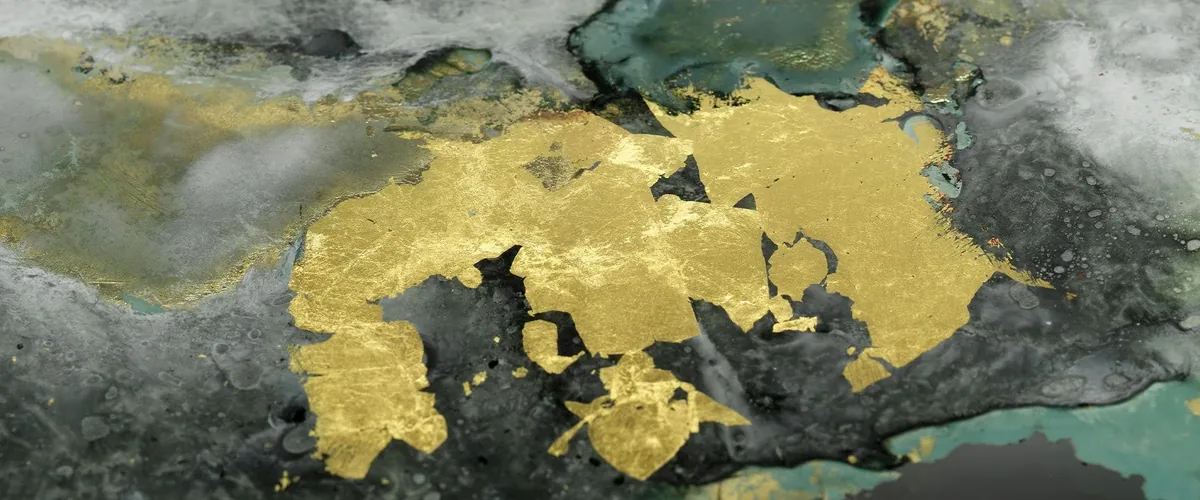
The most common form begins with gold leaf laid onto the back of the glass. First the glass is cleaned until it is faultless — the slightest fingerprint, the faintest film of dust, and the gold simply refuses to take. A whisper-thin layer of gelatine or glair (egg white) is brushed across the surface, and sheets of loose leaf, each one tissue-light and quick to lift on the smallest current of air, are floated down onto it and overlapped at the edges. Once dry, the gold is burnished tight against the glass and the surplus trimmed away. What remains is a single unbroken field of gold, mirror-bright, read entirely through the glass from the front. How that leaf is laid — by water and oil gilding — sets the whole character of the finish, bright and mirror-like or soft and matt.
Engraving and painting
With the gold in place, the artist works back into it from behind, drawing with a fine point that scratches through the leaf to bare the clear glass beneath. The whole image is built in negative — gold left where it is wanted, every engraved stroke reading as a line of pure clarity once the panel is turned to the front. Colour can then be carried over the gold in paint or pigment, and seen through the glass it arrives transformed: luminous, saturated, lit from behind by the metal it sits against. Watching an artist commit to those lines is humbling; there is no lifting them out again, and we have learned to give that focus the room and the unhurried weeks it asks for rather than the convenience of a deadline.
The most ambitious works layer technique on technique — gold leaf, silver leaf, painted colour, etching — until the surface holds a real depth, each element catching the light a little differently from the last.
Protection
Because all of this lives on the back of the glass, sealed away the moment the panel is installed, it has to be guarded from behind. A backing — paper, board, or a second sheet of glass — is fixed over the work to shut out moisture and shield the fragile skin of gold and paint. Glass, decoration and backing become one quiet sandwich, and only then is the panel set into its frame or its piece of furniture.
Applications in luxury interiors
Verre églomisé is, at heart, a panel material. It settles most naturally into a framed mirror or a decorative panel, the door front of a cabinet, wardrobe or bar, a backlit insert within a light fitting, or a leaf set into a screen or room divider. Its appetite for light makes it especially alive in rooms with good daylight, where the gold travels and shifts as the sun crosses the surface through the day, never quite the same at noon as it was at breakfast. We look at where it is used across an interior more fully elsewhere.
- Mirror surrounds and pier glasses — verre églomisé borders on antique-style mirrors are a classical application that never tips into looking dated
- Cabinet and wardrobe door panels — a single panel set into a wardrobe door reads as a jewel-like flash of light in an otherwise quiet room
- Bar and display cabinet fronts — the technique has a natural affinity with hospitality, where a little drama and luxury are not only allowed but expected
- Architectural glass panels — at scale, verre églomisé can stand as a room element in its own right: a wall hanging, a screen, an overmantel
- Bespoke lighting — reverse-painted shades and panels in pendant and wall lights cast an illumination quite unlike anything else, the light passing through colour and gold at once
Commissioning verre églomisé with Make Bespoke Studio
We work alongside specialist verre églomisé artists to produce panels for furniture and joinery commissions. It usually starts with a design — sometimes drawn by the interior designer, sometimes developed by the artist in answer to a brief. From there we prepare the technical drawings: the panel size, how it sits within its frame or its piece of furniture, the way it will be fixed — and the artist works the panel to those exact terms.
Lead times here run longer than for most decorative techniques — typically 8–16 weeks, depending on the complexity and the size of the panel. It is work that rewards being planned for at the brief stage, written into the scheme from the start rather than wished onto it at the end.
If verre églomisé feels right for something you are planning, we would be glad to show you examples and introduce you to the specialist artists we collaborate with. You might also enjoy our companion piece on marquetry — another craft that builds decorative surfaces of comparable depth, by entirely different means.