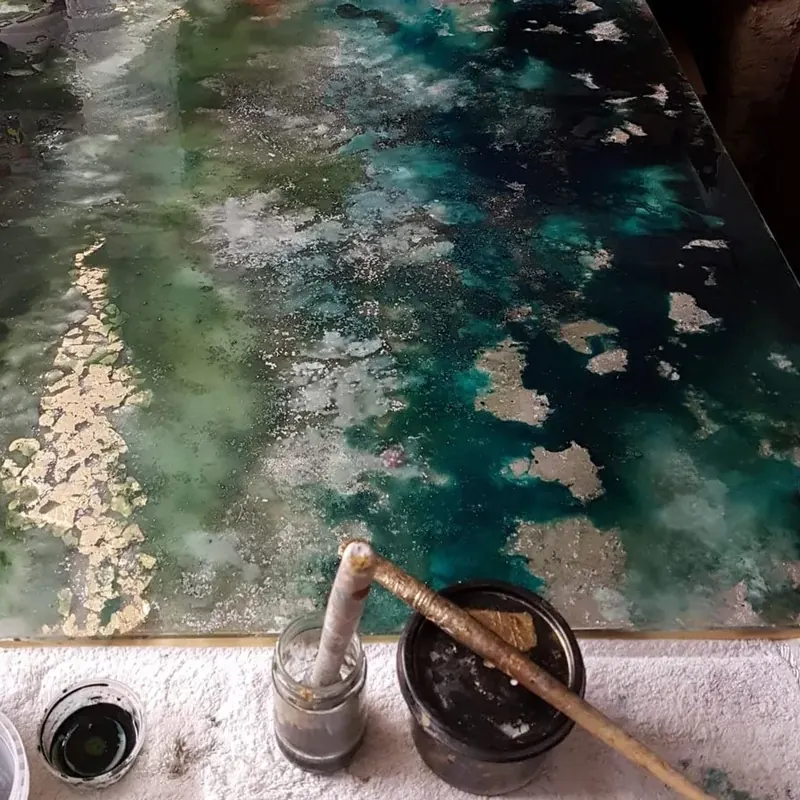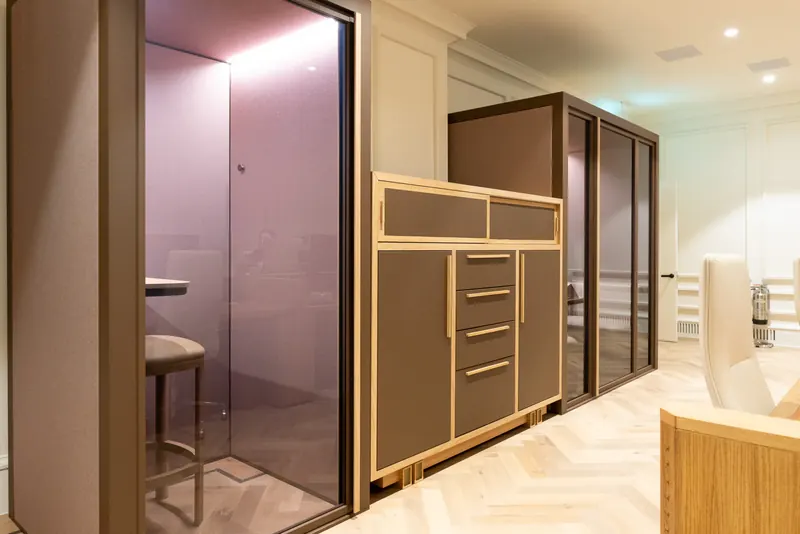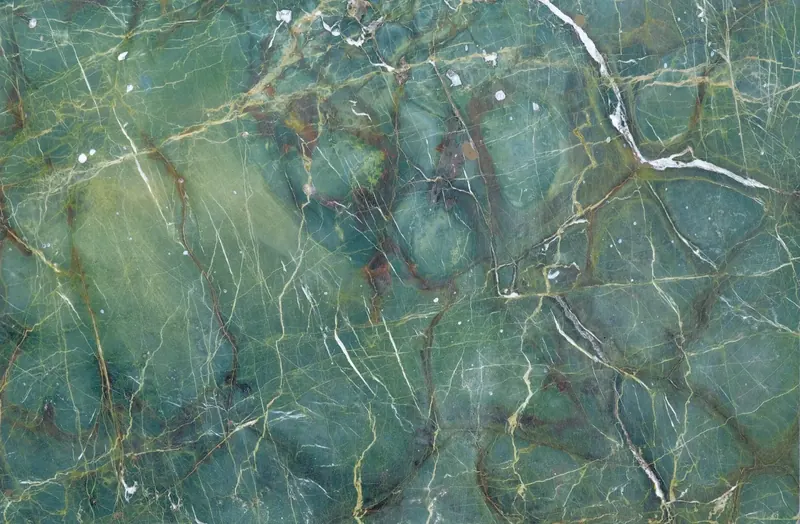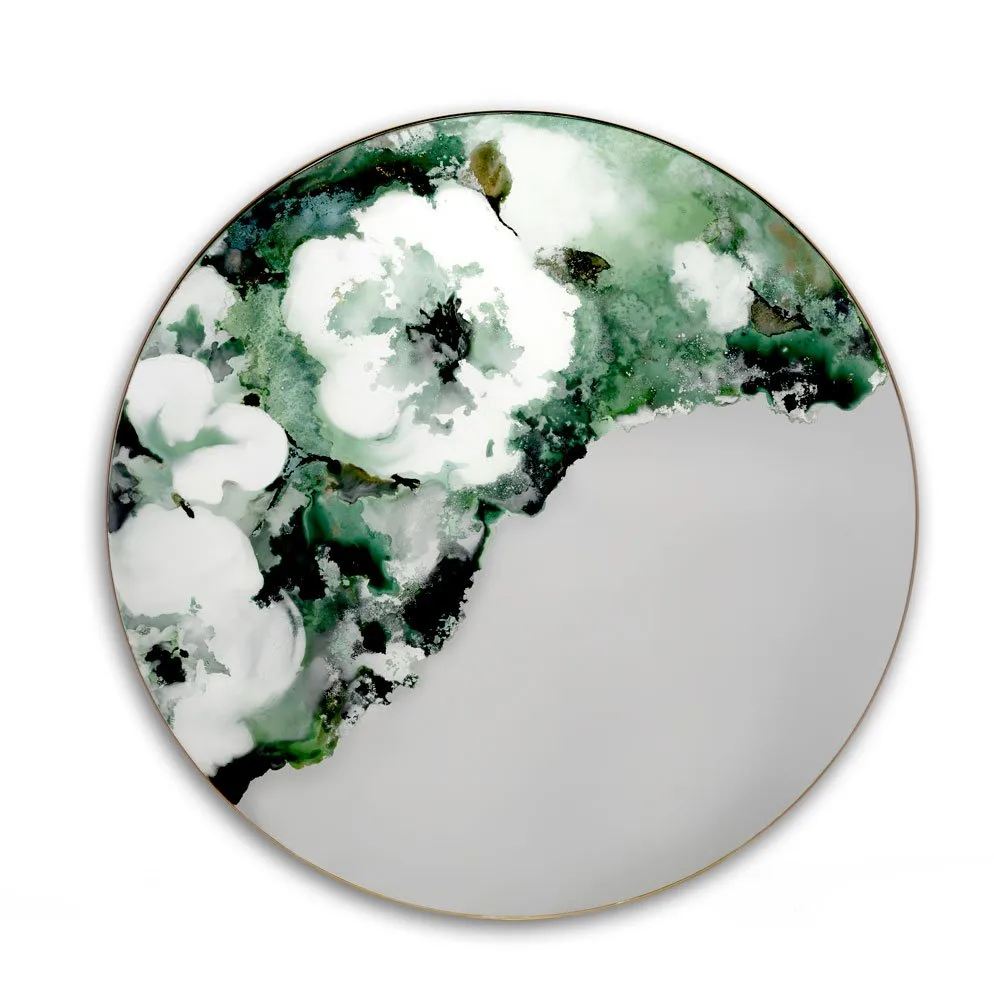
Verre églomisé works across an interior: feature walls, cabinet doors and screens, mirrors and overmantels, splashbacks and bars, ceilings and lifts, each panel detailed for the light it sits in and the protection it needs.
Walk into a room with a gilded glass wall at the far end and the light in the space changes shape: the surface gathers whatever is going — the lamp, the window, a passing reflection — and hands it back to the room, warmer and deeper than it arrived. That is what verre églomisé does. It is one of the few decorative finishes that is genuinely architectural; it can be a small jewel of a mirror or cover an entire wall, and it carries light, depth and a sense of preciousness wherever it lands. Because it is glass, it is also more versatile and far tougher than people imagine. Here is where gilded glass belongs in an interior, and the practicalities of each.
Feature walls and glass “wallpaper”
At its most ambitious, verre églomisé becomes the wall. Large panels, or a run of repeating panels read as one, can clad a feature wall as a shimmering mural or a patterned “glass wallpaper” — reflective, faceted, quietly impossible to ignore. It is a favourite for the statement wall of a dining room, a hotel lobby or a private lift lobby, where the gilded surface throws the light back into the space and gives it a depth the plaster behind it never could. At dusk, with the candles lit, a wall like this stops being a wall and becomes the most interesting thing in the room.
Joinery, cabinet doors and screens
On a smaller scale, verre églomisé set into bespoke joinery is one of the most luxurious details we offer. Gilded glass cabinet and wardrobe doors, the front of a drinks cabinet that catches the eye every time it is opened, inset panels in screens and room dividers — each turns ordinary cabinetry into something jewel-like. And because the glass sits cradled within its timber or metal frame, the delicate gilded face is held safely on the inside, which makes the detail every bit as practical as it is beautiful.
Mirrors and overmantels
The oldest home for the craft remains the mirror — framed mirrors and grand overmantels with gilded and painted borders, or fully decorated mirror panels. This is where verre églomisé began, and it is still where its romance runs deepest. A gilded, gently antiqued mirror over a fireplace, its silvering allowed to cloud and spot a little at the edges, is a centuries-old idea that has never once felt dated; it gives a new room the patina of one that has been loved for generations.
Splashbacks, bars and wet areas
Glass is impervious, and the gilding lives on the protected reverse, so verre églomisé performs far better than you would guess in wet and hard-used places — kitchen splashbacks, the front and back of a bar, vanity surrounds. The whole thing lives or dies on the detailing. We have made splashbacks that catch the morning sun behind a hob and bar fronts that glow under a single low light, and in every one the gilded reverse has to be properly sealed, the panel correctly fixed and the edges protected so that not a trace of moisture can ever reach the leaf. Get that right and a gilded splashback becomes a surface that is at once showpiece and workhorse, wiped down each evening and admired every morning.
Ceilings, lifts and statement surfaces
Because it reflects and amplifies light, gilded glass earns its keep overhead and in enclosed spaces where that quality is magnified — gilded ceiling panels, the interior of a lift, the back-bar of a restaurant. In hospitality especially, a verre églomisé surface in a small, much-passed space delivers a sense of luxury out of all proportion to its size; a thirty-second lift ride becomes something people remember. The principles overlap with our media-room and feature joinery work, where surface and light are designed together as one.
Designed for the place it lives
The thread running through all of it is that verre églomisé is always made for its specific home — the size, the light it will sit in, the work it has to do and the protection it needs. A splashback is detailed quite differently from a feature wall; a lift interior differently again from an overmantel. If you have a wall, a door, a surface or a space that could carry gilded glass, we would be glad to work out exactly how it should be made for it.