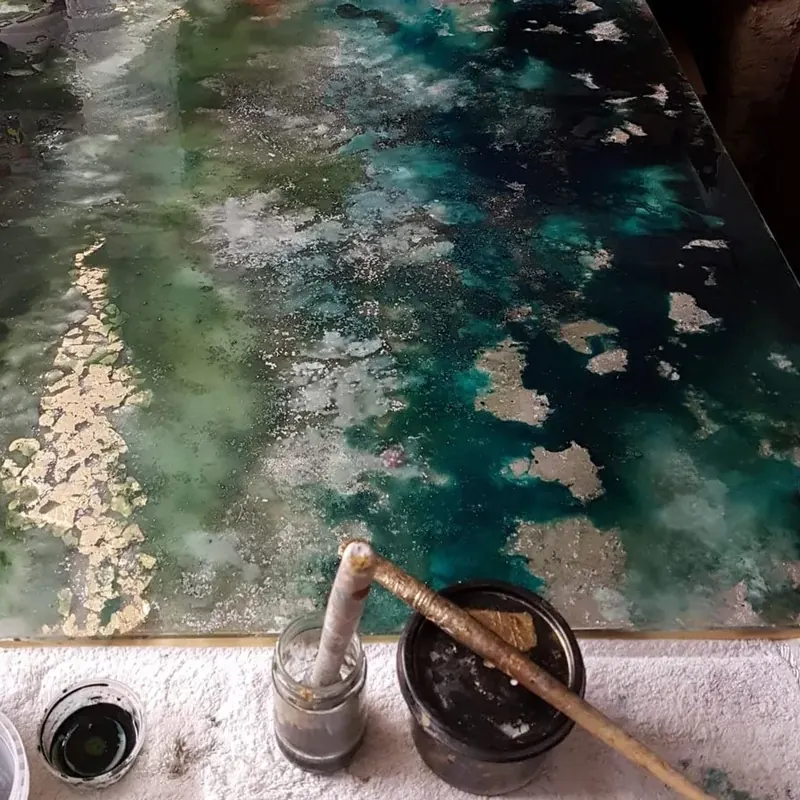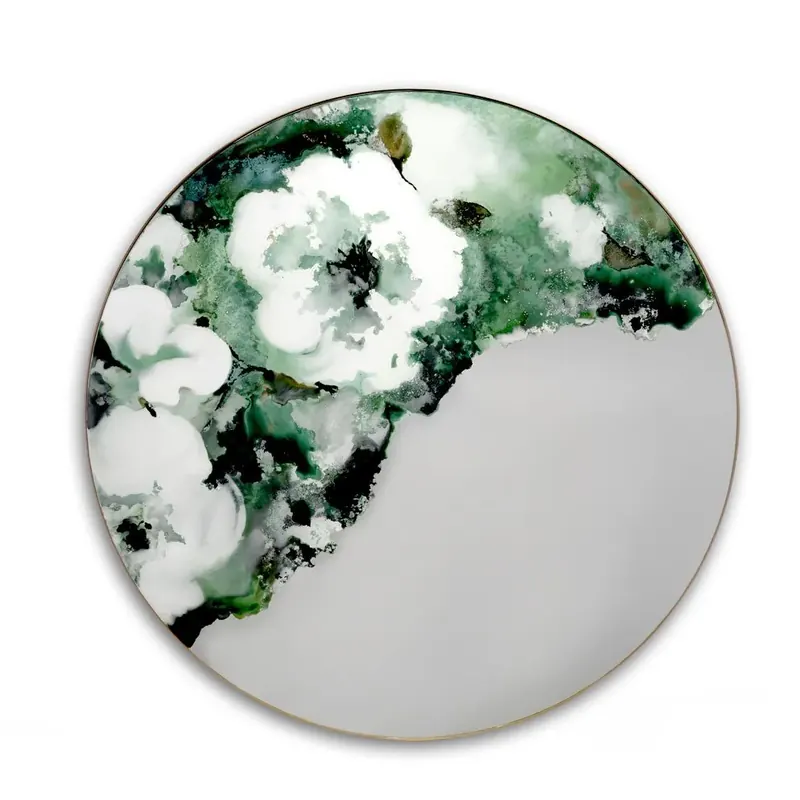
Verre églomisé is the ancient craft of decorating the reverse of glass with gold or silver leaf and paint: the French name honours Jean-Baptiste Glomy, the Parisian framer who made it fashionable.
Somewhere in the catacombs of Rome, pressed into the plaster of a tomb wall to mark a grave, sits a small disc of gold caught between two layers of glass. The portrait worked into it — a face, a name, a few words of farewell — is as crisp as the day it was made, perhaps seventeen centuries ago. The leaf that catches the light is barely thicker than a breath, yet it has outlasted the empire that produced it. That is the quiet promise at the heart of verre églomisé: that gold, sealed behind glass, becomes almost indestructible. The name is French and comparatively young; the craft it describes — decorating the reverse of glass with gold or silver leaf and paint, so the design is seen and protected through the glass from the front — is one of the oldest still practised, and its story runs from the ancient Mediterranean to the salons of eighteenth-century Paris, by way of a framer whose name it now carries.
Ancient origins
The idea of fixing gold leaf behind glass is genuinely ancient. The Romans made what we now call gold-glass — medallions and the rounded bases of drinking vessels, gold-leaf designs incised and sandwiched between layers of glass — and a remarkable number survive from late antiquity, many of them prised, centuries later, from the catacombs of Rome where they had been set as grave markers. The instinct behind them was simple and human: gold leaf is gorgeous and hopelessly fragile, a sneeze away from ruin, and sealing it behind glass was a way of making something beautiful permanent. The principle has barely shifted in two thousand years. The gilding is guarded by the very surface that shows it off, which is why a Roman face can still glint at you across the better part of a millennium and a half.
Jean-Baptiste Glomy and the name
The technique acquired its modern name far later, and from an unexpected quarter — not an inventor but a man with an eye for fashion. Jean-Baptiste Glomy (1711–1786) was a Parisian art dealer, framer and decorator, a framemaker working in the orbit of the court of Louis XV, and he had a particular gift for the slender gilded-and-black borders he set within picture frames and mounts — fine lines of gold and ink laid behind glass, framing a drawing without ever shouting over it. He became so bound up with the look that the craft simply took his name: verre églomisé, “Glomy-ed glass.” There is something rather lovely in that. A whole technique, ancient beyond reckoning, ends up named centuries after the fact not for whoever first thought of it, but for the framer who made it fashionable in Paris.
Revival and spread
Between the Roman tombs and Glomy's workshop, the craft went quiet and then woke again. It was revived in Renaissance Italy and travelled outward across Europe — to Holland, Spain, France, England and beyond — turning up in devotional panels, the borders of looking-glasses, cabinet fronts and architectural glass. (In the German-speaking lands the broader art of painting behind glass carries its own name, Hinterglasmalerei.) Every region bent it to its own motifs and uses, yet the spell underneath stayed exactly the same: a surface that seems lit from within, jewel-like, because the light has to travel in through the glass, strike the metal, and come back to your eye the long way round. It is a glow you do not so much see as feel.
Verre églomisé today
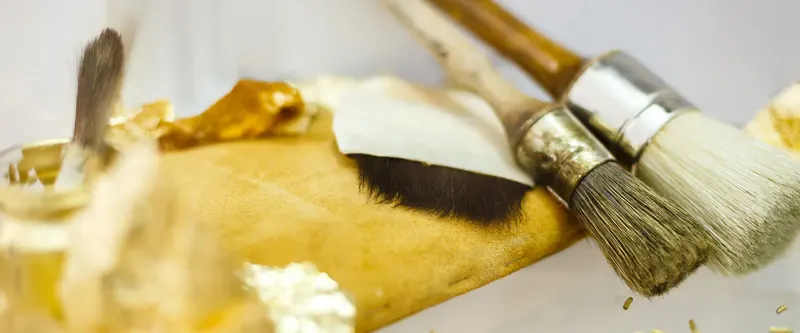
After a long spell out of fashion, the craft has found a real second life in contemporary luxury interiors, prized precisely for that mix of preciousness, light and patient handwork — and prized all the more because so few makers still have the technique in their hands. The methods Glomy's contemporaries would recognise on sight — water and oil gilding, reverse painting, careful distressing — are the same ones we now carry onto feature walls, joinery and statement surfaces rather than the edges of picture frames. That continuity is the whole point. When we lay leaf behind glass for a verre églomisé panel, we are working with our hands at a craft whose line runs unbroken back to those Roman discs — and I never quite lose the sense, easing a sheet of leaf into place, that I am simply the latest pair of hands in a very long queue.
A craft worth continuing
Part of what makes verre églomisé so worth the trouble is exactly that it survived — that a technique from late antiquity, named for an eighteenth-century framer, is still made by hand at a bench today rather than studied behind museum glass. Carrying that lineage forward, into contemporary rooms and onto a contemporary scale, is precisely the kind of work we exist to do. If a piece of that long, luminous history would suit your project, we would be glad to make it for you.