Straw marquetry is a decorative technique in which split, flattened rye straw is laid strip by strip to build a surface of extraordinary lustre, warm and iridescent in a way no other veneer can match.
Split a stalk of rye straw down its length, press it flat under a warm iron, and the dull outer husk gives way to an inner surface that gleams like watered silk. Lay strip beside strip, each one butted hard against the last, and a panel begins to gather light the way still water does — catching it, throwing it back, shifting tone as you move. That is straw marquetry: a decorative technique that takes the most ordinary of materials and coaxes from it a lustre most precious veneers cannot match. The straw is rye, the same plant grown across northern Europe for thousands of years; everything else is patience and the hand.
It is a rare craft. Few workshops in Europe still practise it at a level suitable for luxury interiors, and commissioning straw marquetry means working with a small community of highly specialised artisans, people who will spend a day laying a surface no larger than a book. The result is furniture or joinery that is genuinely unlike anything else: a surface that stops visitors mid-room and prompts the same two questions every time — what is it, and how on earth was it made.
What is straw marquetry?
Straw marquetry is the craft of laying split, flattened straw, strip by strip, onto a surface to form a pattern or picture, in the way wood veneer is used in wood marquetry. The straw is usually rye. Each stalk is opened along its length, pressed flat and, if colour is wanted, dyed before it is laid. The silica in the straw gives the finished surface a directional lustre that shifts between pale gold and deep amber as the light moves across it.
It is closely related to wood marquetry: both build a pattern as a sheet and lay it onto a ground. The difference is the material. Wood veneer is sliced and cut to shape piece by piece; straw is split and laid edge to edge, and its surface catches the light along the grain rather than evenly. Make Bespoke Studio produces straw marquetry to commission, as described on our straw marquetry craftsmanship page.
The history of straw marquetry
Straw work is thought to have begun in the East, and by the early seventeenth century it was being made across Europe. The Cleveland Museum of Art, which holds an eighteenth-century straw marquetry writing desk, notes that its makers included cabinetmakers and specialist artisans, home craftspeople, nuns, monks and noble amateurs. Early work was small in scale, on boxes, coffers and other precious small objects, and much of it came from religious houses. Far from a cheap substitute, its silky gloss and bright colours earned it esteem as decoration on a par with gemstones, tortoiseshell and ivory.
In the eighteenth century straw work reached a wider market: boxes and small pieces of furniture were sold by Paris dealers in luxury goods, and by the end of the century coloured-straw marquetry was a speciality of some European spa resorts. The most famous straw work of all was made by Napoleonic prisoners of war. Those held at Dartmoor and in other prisons built for them made intricate boxes from materials that would otherwise have been thrown away, and the prison best known for it was Norman Cross, near Huntingdon, where up to around 7,000 prisoners were held between 1797 and 1814. Peterborough Museum holds more than 800 objects from the camp, including straw marquetry.
The 20th century brought a significant revival in the work of the French decorator Jean-Michel Frank, who in the 1920s and 1930s used straw marquetry on furniture, screens and wall panels to extraordinary effect. His pieces for clients including the Vicomtesse de Noailles and Nelson Rockefeller established straw marquetry as a material of the most refined and particular taste — humble grain dressed for the grandest of rooms. That association has never really faded: today, the name Jean-Michel Frank still appears, almost as shorthand, in the design briefs that come to us specifying straw marquetry work.
Frank was not alone. The decorator André Groult also made straw marquetry furniture in the 1920s, and from the 1980s his granddaughter, Lison de Caunes, restored his pieces and set about reviving the craft, going on to make new work for houses including Guerlain and Cartier.
After the Second World War the designer Jean Royère brought colour and freer forms back to straw marquetry. In the 1950s he covered low tables, among them the “Flaque” table, and a 1958 illuminated bar in straw, dyeing some of it black and scattering stars of coloured straw across the surface.
How straw marquetry is made
Harvesting and preparation
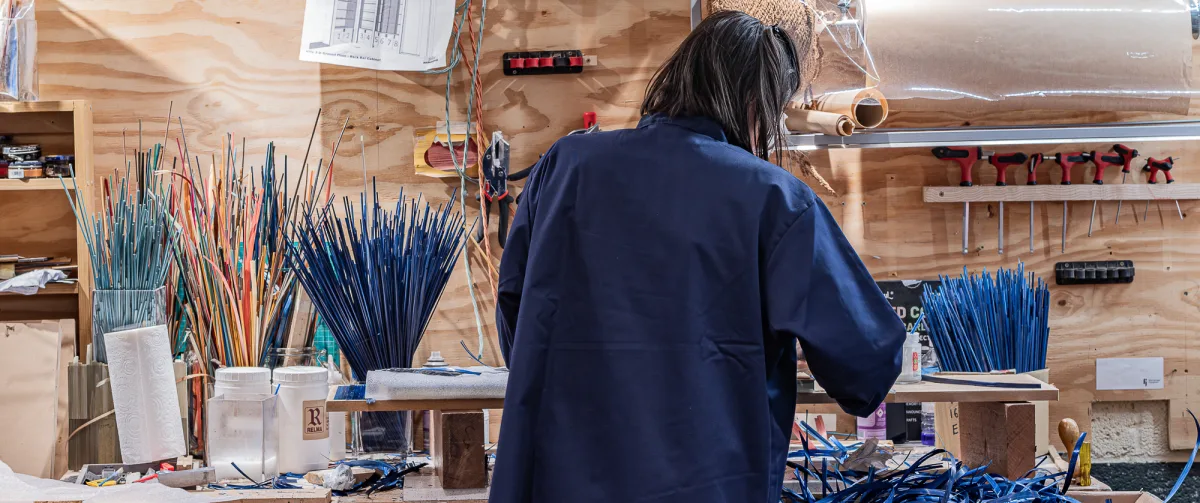
Everything depends on the moment of harvest. Cut too early and the straw is soft and pale; cut too late and it has dried out, the sheen already gone. The stalks are gathered and dried, then soaked in water to bring back some suppleness before they can be worked. Each one is slit open along its length with a specialist tool and pressed flat under a hot iron — and it is here, the first time you do it, that you understand the whole craft in a single second. The husk opens and the inner stem catches the light, glossy as enamel. That gleam is the entire reason the material exists; the dull outer skin is peeled away and thrown out, and only the bright inner face is kept.
Rye, wheat and oat
Rye is the straw most often chosen for luxury work because it grows long and straight, with a silica-rich skin that takes the light well. Stems can reach about 2.5 metres, but only around 60 centimetres of each is usable once it has been split and selected, which is part of why the craft is so scarce. Wheat and oat straw have also been used, and historical accounts describe them being split, soaked and ironed in the same way.
Dyeing
Left to itself, straw moves through a quiet range of pale gold to warm amber. But it takes textile dye readily, and the colours can be deep and saturated — inky blue, forest green, terracotta, a true black. The dyeing is done before the straw is ever laid, and in normal interior use the colour holds well, though like any natural material it can lighten with prolonged exposure to direct sunlight. Set a few dyed straws beside the natural tones and the designer has a full palette to compose with, every shade still carrying that low inner shine beneath it. Our straw arrives already dyed, from our French supplier.
Assembly
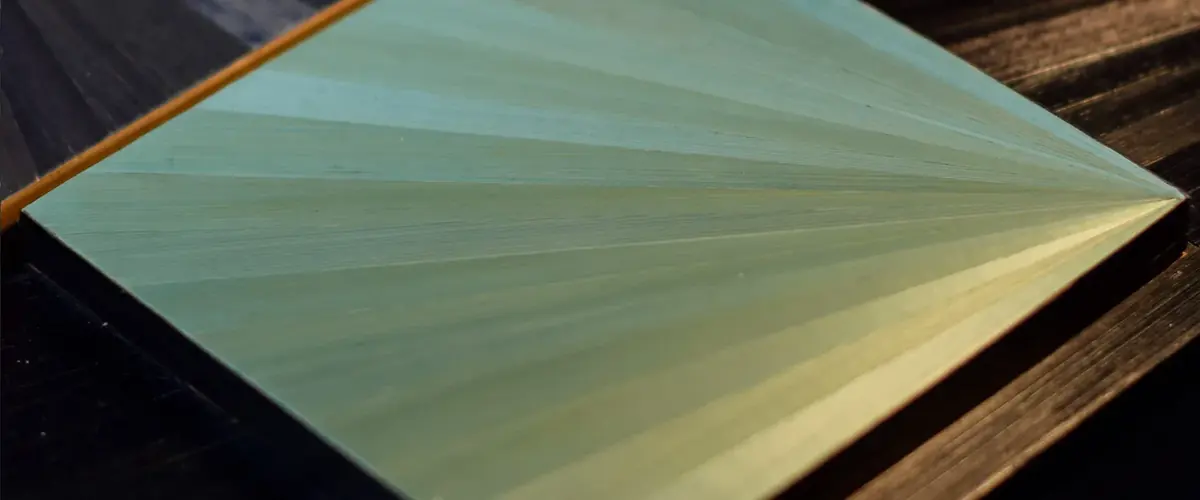
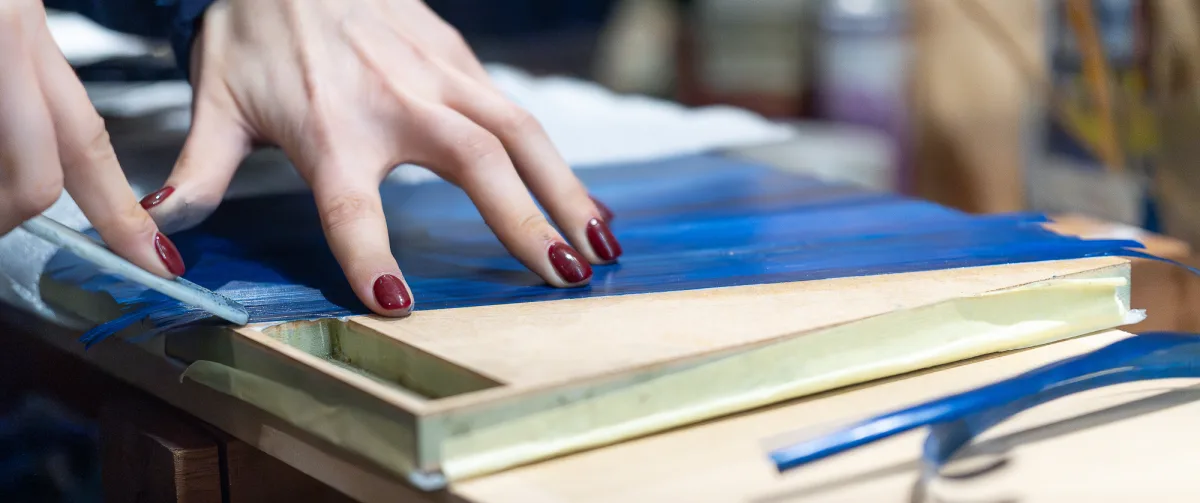
The flattened strips are cut to length and laid onto a substrate — traditionally a sheet of card or thin wood, and in our panels generally moisture-resistant MDF — one at a time, each strip butted tightly against the last. They can run in parallel, in chevrons, in sunbursts radiating from a point, in diamond grids or in compositions of real geometric complexity. What governs everything is direction. Because the lustre lives in the grain of each strip, two adjacent sections laid at different angles will read as two different tones, almost as a change of colour, though no colour has changed at all — it is purely the light, turning as the grain turns. The first time we watched a panel come off the bench and saw the whole pattern flare and dim as we walked past it, we stopped specifying it as decoration; it is closer to a way of catching light and holding it still.
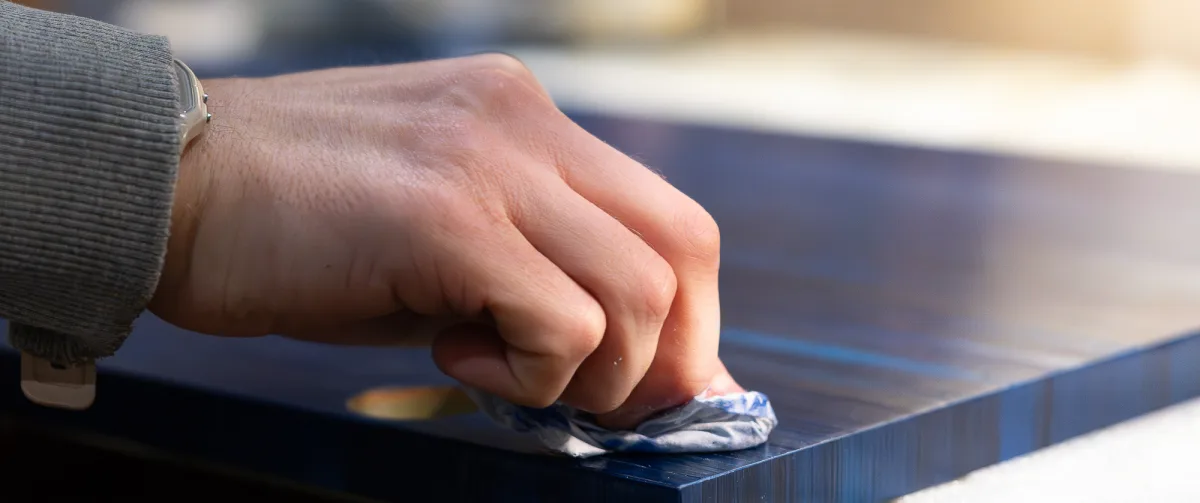
Once the panel is complete, it is glued down under pressure, trimmed and cut to the required size, and finished with a thin coat of shellac or lacquer — just enough to protect the surface and draw out that last degree of lustre.
Patterns that work best
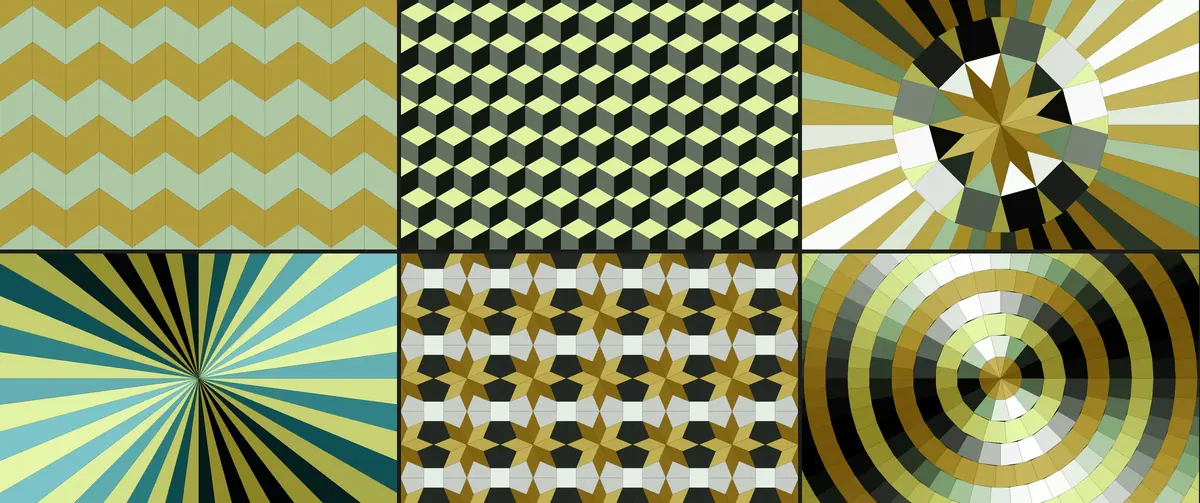
Straw marquetry is a linear medium: every strip is straight and narrow, and its lustre runs along its length. That shapes the patterns it does best. Parallel runs, chevrons, herringbone, diamond and lozenge fields, stars, fans and sunbursts all follow naturally from straight strips laid at angles to one another, and because adjacent sections laid at different angles read as different tones, the pattern is drawn as much by light as by colour.
Curved cuts are possible, but angular patterns work best. The strips are straight and their lustre runs along their length, so straight lines and clean angles let the direction of the straw do the work. For a designer, the useful way to think about it is that the direction of the straw is the design: planned well, a simple geometry in one or two colours can be more striking than anything elaborate. Thirty patterns, shown in colours you choose from our dyed straw chart, are in the straw marquetry pattern and colour tool.
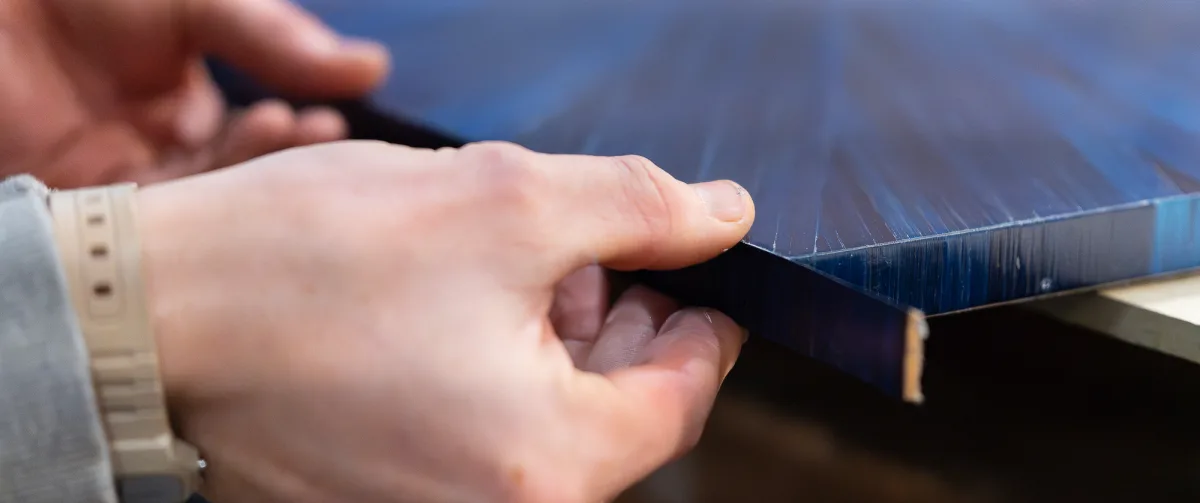
A starburst shows the strength of the medium. For Taman Duta Villa, a private residence in Kuala Lumpur, Make Bespoke Studio produced door panels in a blue-violet straw starburst whose rays radiate from a shared centre and carry across the faces of the doors, so that the pattern resolves as one piece when the doors are closed. The blue shifts from deep indigo to violet as the surface turns to the light. Read about the Taman Duta Villa project.
Applications in contemporary luxury interiors
Straw marquetry is most naturally suited to flat planes — panels, furniture fronts, cabinet doors, screens, wall linings, headboards. Its beauty is essentially two-dimensional: this is a surface material, not a structural one, and it gives most where it can lie open to the light and reflect it back.
The scale and geometry of the pattern set the entire character of a piece. Fine parallel strips in a single colour make a quiet, refined surface that rewards a second, closer look but never raises its voice across a room. A bold sunburst in two contrasting straws does the opposite — it declares itself the moment you walk in. And a large diamond grid in natural straw, run the full width of a room across a run of cabinetry, stops reading as furniture altogether; it becomes a material event, a wall of shifting gold that happens also to open and store things.
Our straw marquetry panels are made with a specialist partner workshop in East London — one of the few still working at this level — for bespoke furniture and joinery commissions. If you are considering a piece that might take straw marquetry, we would be glad to put a few samples in your hands — it is a material that has to be tilted to the light to be understood — and talk through what might be possible. See also our article on wood marquetry for the related technique worked in timber veneers.
Caring for straw marquetry
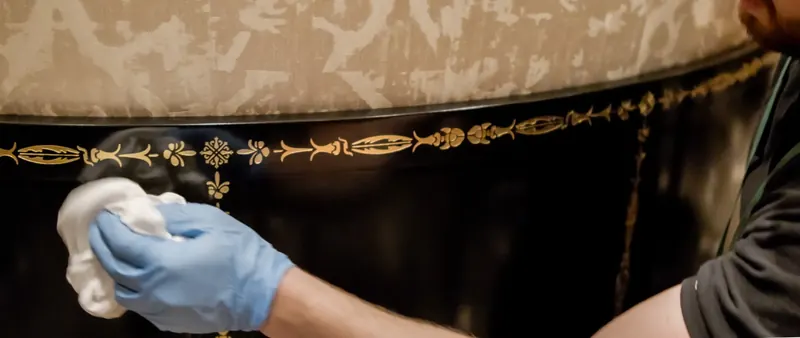
Sealed with lacquer and used as intended, straw marquetry is stable and long-lived; Art Deco panels from the 1930s survive intact today. It is cleaned with a dry or barely damp soft cloth wiped along the direction of the straw, avoiding abrasives, solvents and standing water. It suits vertical and light-duty surfaces such as wall panels, cabinet doors and headboards better than high-wear tops such as bars and restaurant tables.
Frequently asked questions
What is straw marquetry?
Straw marquetry is the craft of laying split, flattened straw, usually rye, strip by strip onto a surface to form a pattern or picture, in the way wood veneer is used in wood marquetry. The silica in the straw gives the surface a lustre that changes with the light.
How is straw marquetry made?
The straw is soaked, split lengthwise, flattened under a warm iron and, if colour is wanted, dyed. The strips are then laid one at a time onto a substrate in the planned pattern, glued under pressure, trimmed and sealed with a thin protective coat.
What straw is used for straw marquetry?
Rye is the usual choice for luxury work, valued for its length, straightness and silica-rich skin. Wheat and oat straw have also been used, split and ironed in the same way.
Who made straw marquetry in the past?
Straw marquetry was being made across Europe by the early seventeenth century, by nuns, monks, home craftspeople and cabinetmakers. Napoleonic prisoners of war made well-known straw-work boxes at Norman Cross and other prisons. The craft was revived in the 1920s and 1930s by Art Deco decorators including André Groult and Jean-Michel Frank, brought back into colour by Jean Royère in the 1950s, and revived again from the 1980s by Lison de Caunes.
Is straw marquetry durable?
Yes, when it is sealed with lacquer and used on suitable surfaces. It is stable and long-lived, and is cleaned with a dry or barely damp soft cloth wiped along the direction of the straw. It is best kept to vertical and light-duty surfaces rather than high-wear tops.
Can you commission straw marquetry?
Yes. Make Bespoke Studio produces straw marquetry to commission for furniture and joinery, working with specialist partner workshops. We do not sell it as stock sheets or kits. See our straw marquetry craftsmanship page for lead times and samples.
What patterns can straw marquetry make?
Patterns built from straight lines and angles work best: parallel runs, chevrons, herringbone, diamonds, stars, fans and sunbursts. Curved cuts are possible, but angular patterns are where straw marquetry is at its strongest.
What colours does straw marquetry come in?
Natural golds through deep amber, and a full range of dyed straws, from greens, reds and blues to blacks. We buy the straw in already dyed from our French supplier. If a scheme is specified in RAL, tell us about the project and Make Bespoke Studio can make samples starting from the RAL colour and select the closest dyed straw from the colour chart on our straw materials page.
What is straw marquetry laid on?
Straw is laid onto a rigid panel. Make Bespoke Studio generally uses moisture-resistant MDF (MRMDF), chosen for its stability, and can use other surfaces where the project needs them.