On verre églomisé the decisive choice is how the leaf is laid: water gilding is burnished to a bright mirror shine, while oil gilding cannot be burnished and keeps a soft, matt, satin glow.
Watch a gilder lay water gilding and there is a moment that doesn't look like craft at all. The leaf goes down dull, almost grey — a tissue of metal floating on a film of water. Then the agate burnisher passes over it, and the gold simply wakes up: matt foil one second, and the next, something that looks less like metal than like light held still behind the glass. That moment is the whole argument of this piece. On a verre églomisé panel, the decision that most defines the finished look is not the design, or even which metal you choose — it is how the leaf is laid. Gold and silver go onto glass two fundamentally different ways, and a trained eye reads the difference across a room.
Water gilding — the bright mirror
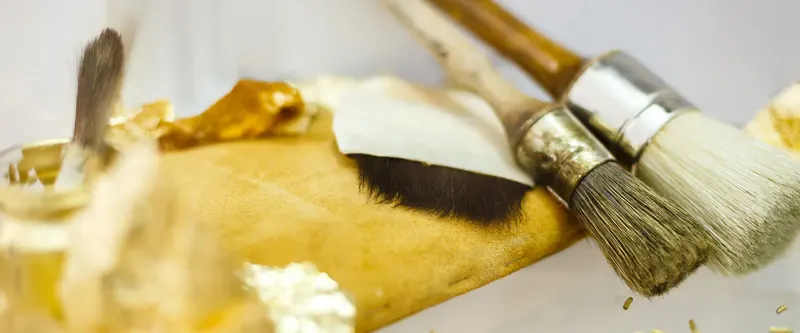
Water gilding is the old, demanding way, and the one that gives gilded glass its mirror. A warm, water-based size — traditionally gelatine or rabbit-skin glue, which smells faintly of the glue-pot the moment it touches the bench — is floated across clean glass, and the leaf is laid into the wet, which draws it down perfectly flat. As it dries the leaf bonds, and then it can be burnished to that deep, liquid shine. The result is the closest thing there is to a true gold or silver mirror: high reflectivity, real depth, and that shifting, almost living luminosity. It is the method behind the most precious, jewel-box panels — and the least forgiving, because the leaf has to be laid quickly and faultlessly while the size is still alive under your hands. You get a single pass; hesitate, and the leaf creases or tears and the whole patch is gone — which is partly why we still lay it by hand, on glass, when so much else has moved on. The other reason is harder to put in a spec: that moment when the gold wakes under the burnisher has never once stopped being a quiet thrill.
Oil gilding — the soft matt
Oil gilding swaps the water size for an oil-based one — a slow-drying varnish. The leaf is laid onto the tacky surface and left; it can't be burnished, so it keeps a softer, matt, satin quality instead of a mirror shine. What it gives up in brilliance it pays back in patience and durability: it is far more forgiving, happier over large areas and imperfect conditions, and reads as quiet and contemporary. Where water gilding sparkles, oil gilding glows — the difference between a chandelier and candlelight.
Which to choose
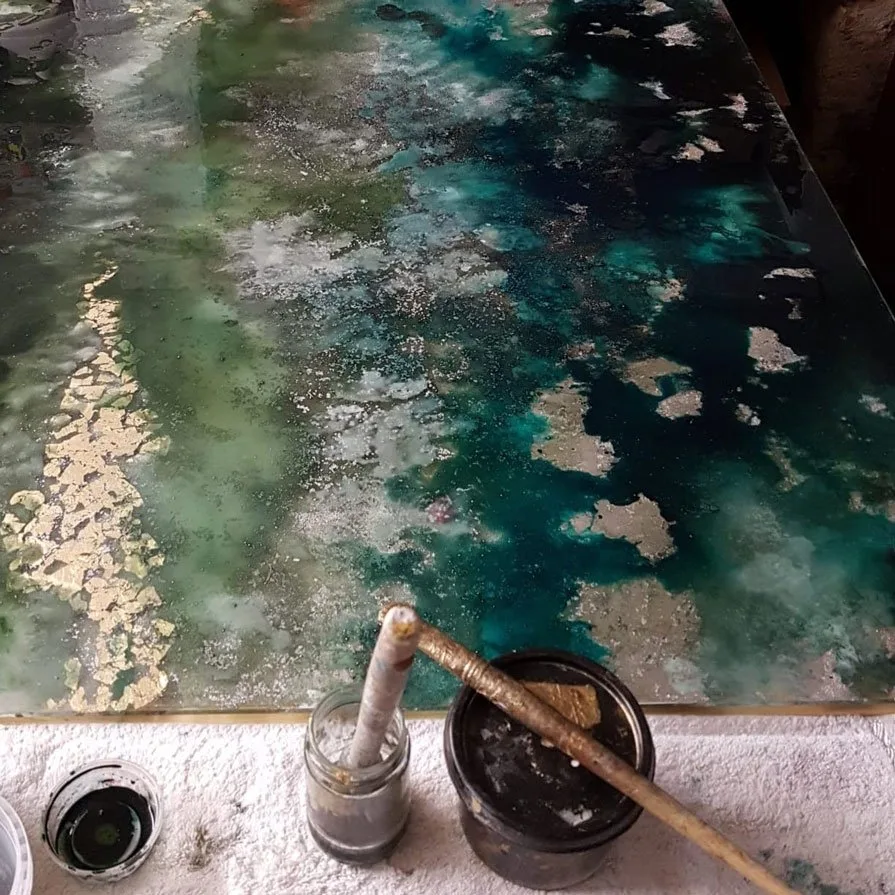
The choice is aesthetic before it is technical. Reach for water gilding when you want maximum reflectivity and preciousness: a true gold mirror, a jewel-box panel, the brightest surface in the room. Reach for oil gilding when you want a soft metallic that reads as warmth rather than flash, or simply for a larger expanse where its robustness earns its keep. And the most sophisticated panels often refuse to choose at all — setting burnished water-gilded passages against matt oil-gilded grounds so the surface changes its mind as you walk past it.
The leaf itself
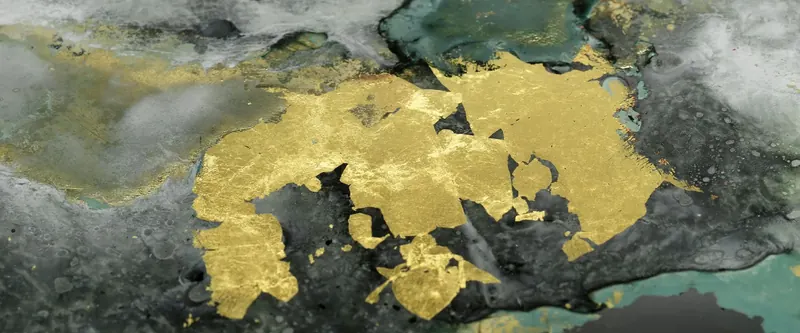
Method is half the story; the leaf is the other half, and it is where the colour lives. Past the familiar warmth of 24-carat gold there is a whole palette to play with: 22ct “moon gold”, paler and cooler, like winter sun; white gold and palladium, silvery and tarnish-proof; true silver, the brightest of all but quick to tarnish unless it is sealed; and the warm blush of copper and bronze. Any of them can be laid by either method, over clear or tinted glass, which multiplies the possibilities almost endlessly. Choosing the leaf and the method together is how a panel is tuned to a room — the same considered eye we bring to all our gilding and gold-leaf work.
Hand-painting and building depth
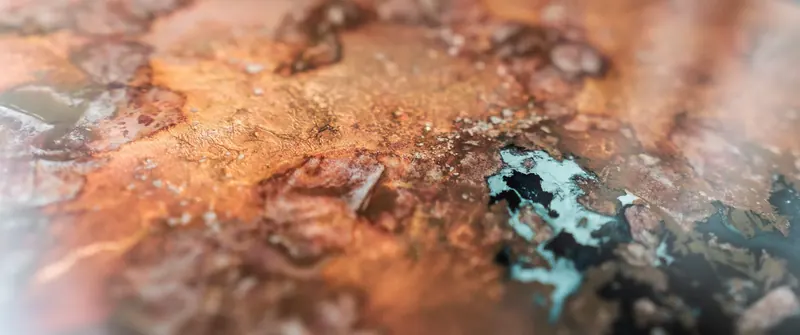
Gilding is still only half of verre églomisé; the other half is the hand-painting, and the depth of a fine panel comes from the conversation between the two. Over years at the bench we have worked out our ways of building genuine dimension into a gilded surface — layering different leaf against itself (pale moon gold set beside warm 24-carat, a flash of silver caught behind a wash of colour), painting translucent and opaque pigments in reverse both over and under the metal, and gently distressing chosen areas so light sinks to different depths. Worked this way, the eye stops reading a flat sheet of gold and starts reading something with floors and ceilings to it, the colours and metals hovering at different levels behind the glass. That is the trick, if it is a trick at all: a panel that doesn't just catch the light but seems to keep a little of it.
The finish, decided at the start
Because the method is baked in from the very first pass, this is a decision made at the design stage, not tweaked at the end. So we like to have the conversation early — bright or soft, precious or quiet, which leaf, over which glass — because it silently decides everything about how the finished surface meets the light. If you have a gilded panel in mind, that first conversation is the part we love most.