This glossary sets out the vocabulary of wood veneer: how a log is cut into leaves, how those leaves are matched, and how figure is described, so that a specification says exactly what you intend.
Crown, quarter, burr, book-match — veneer has a vocabulary you can suddenly see once you know it. Walk past a panelled wall and the words start to surface on their own: the arch of figure climbing the centre of a leaf, the ripple that moves with the light, the mirrored pair that proves the wood is real. Most of this language was settled long before anyone alive was specifying furniture, and when a designer asks for a crown-cut, book-matched walnut with a balanced lay-on, every word in that sentence is doing precise work. We reach for these terms across the bench every day, and a few minutes spent on them will save a great deal of guesswork later. This glossary collects them — how veneer is cut, how leaves are matched, how figure is described and what the technical vocabulary of the workshop means — so a specification says exactly what you intend.
The basics
Veneer
A thin sheet of real wood — typically 0.6mm in Europe — sliced from a log and bonded to a stable substrate. Veneering is not a lesser version of solid timber; it is the only way to achieve matched grain across wide surfaces, the only practical use for the rarest figured logs, and far more dimensionally stable than solid boards.
Leaf
A single sheet of veneer as it comes off the slicer. Leaves from one log are kept in the order they were cut, which is what makes matching possible.
Flitch
The bundle of consecutive leaves from one log, kept in cutting sequence and still smelling faintly of the tree. Specifying from a single flitch is what guarantees colour and grain continuity across a large piece — and why we reserve flitches at the very start of a project, before anyone else can break the run.
Lay-on
Veneer leaves jointed together into a complete face, ready to be pressed onto a panel. A lay-on for a cabinet front may join a dozen leaves in a planned match.
Substrate and balancing veneer
The stable core — usually MDF or plywood — that veneer is pressed onto, and the lower-grade veneer applied to its reverse face. The balancer matters: a panel veneered on one side only will cup as humidity moves. Every quality veneered panel is built symmetrically.
How veneer is cut
Rotary cut
The log is turned against a blade like paper off a roll, yielding wide, continuous sheets with a broad, variable grain. Economical and common in construction plywood; rarely chosen where appearance leads.
Crown cut (flat cut)
The log is sliced parallel to its centre line, producing the familiar cathedral grain — arched figures running up the centre of the leaf with straighter grain at the edges. The default cut for most furniture and joinery faces.
Quarter cut
The log is sliced at right angles to the growth rings, producing straight, even, vertical grain. Calmer and more architectural than crown; the usual choice for wall panelling and linear modern work.
Rift cut
A variation on quarter cutting, angled slightly to avoid the ray fleck that quartered oak otherwise shows. Specified when straight grain is wanted without the flecking.
Ribbon cut
Quarter cutting applied to interlocked-grain tropical species — sapele, anigre — producing alternating bands of light and dark that shift as you walk past. The stripe is the point.
How leaves are matched
Book match
Consecutive leaves opened like the pages of a book, so each pair mirrors its neighbour along the joint. The most common decorative match; symmetrical, formal, and slightly varied in light reflection from leaf to leaf — alternating leaves present opposite faces, the subtle "barber pole" effect that proves the wood is real.
Slip match
Consecutive leaves slid side by side without flipping, repeating the grain rather than mirroring it. Quieter and more uniform than book matching; the usual choice for quartered veneers and contemporary panelling.
Random match
Leaves deliberately mixed for an unmatched, planked character — closer to the look of solid boards.
Diamond and sunburst matches
Decorative matches in which leaves are cut and jointed at angles so the grain radiates from the centre of a panel — diamonds from straight grain, sunbursts from crown. The territory of desks, dining tables and Art Deco revival work, and a close cousin of marquetry.
Describing figure
Figure
The pattern on the face of a leaf — distinct from both species and cut. Two leaves of the same oak can carry entirely different figure.
Burr (burl)
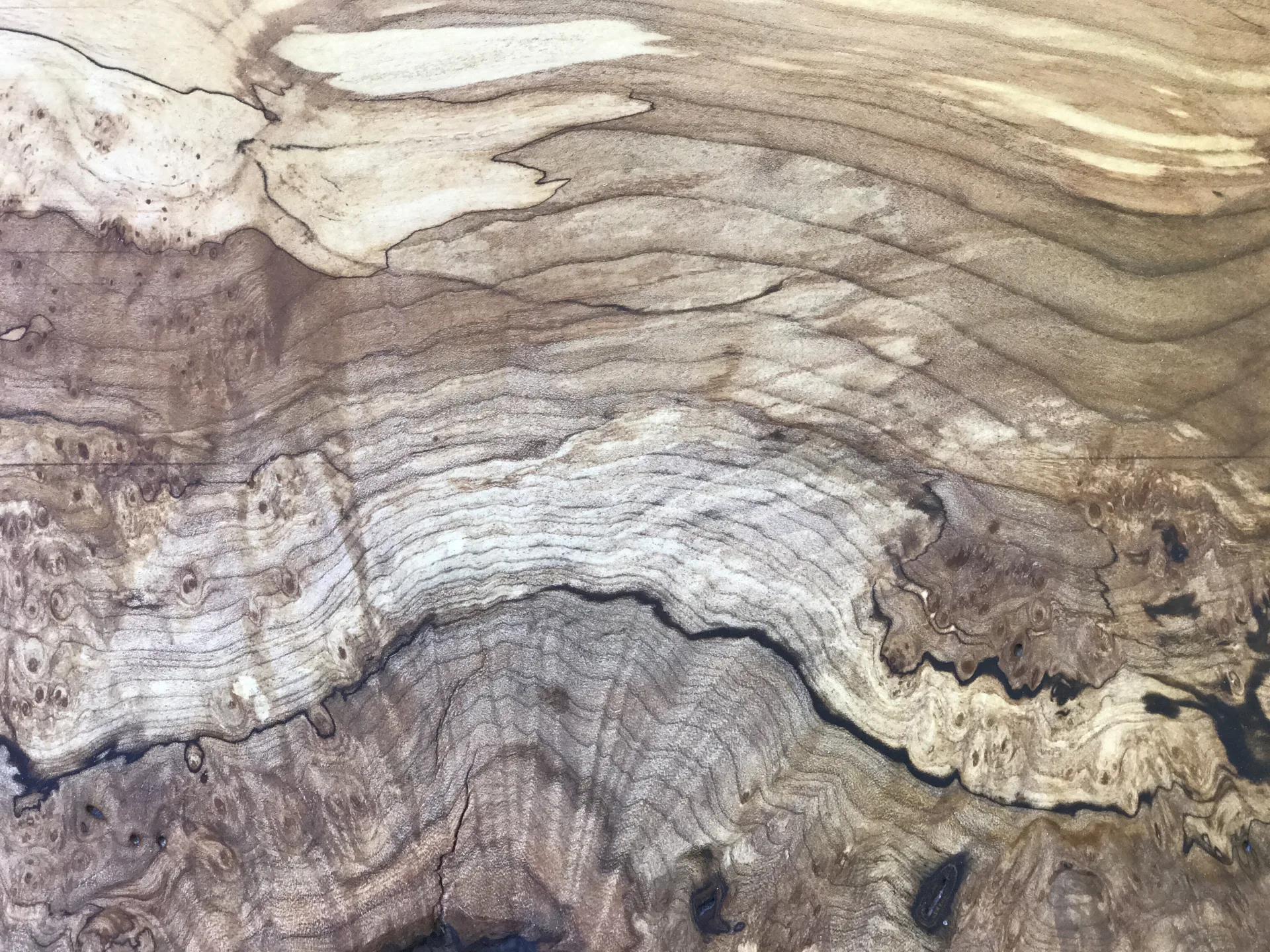
Veneer sliced from the dense, knotted growths a tree forms around stress — a tight, swirling cluster of eyes and curls. Rare, fragile, expensive and unmistakable. Walnut, oak and elm burrs anchor the high end of the veneer trade.
Bird's eye
Small circular "eyes" scattered across the leaf, found almost exclusively in rock maple. A signature of pre-war luxury interiors, ocean liners and pianos.
Fiddleback
Tight, even ripples running across the grain at right angles, named for its traditional use on violin backs. In sycamore and anigre it produces a surface that appears to move under raking light.
Quilted
A billowing, three-dimensional figure resembling rumpled fabric, most dramatic in big-leaf maple and bubinga.
Ray fleck
The shimmering flecks that appear when oak is quartered, produced by the tree's medullary rays. Prized in Arts and Crafts work, avoided in minimal schemes — which is what rift cutting is for.
Cathedral
The arched, flame-like figure at the centre of a crown-cut leaf. When designers ask for "cathedral grain", they are asking for crown cut.
The engineered end of the spectrum
Dyed veneer
Real veneer pressure-dyed through its full thickness — consistent greys, blacks, blues and greens that no natural timber supplies, and a staple of contemporary and marquetry work.
Reconstituted (engineered) veneer
Veneer manufactured from fast-growing plantation species, dyed, laminated into blocks and re-sliced to imitate a target species or pattern. Perfectly consistent, ethically attractive where rare species are under pressure, and increasingly good — though the repeat is regular in a way nature never is.
Specifying veneer well
A complete veneer specification names the species, the cut, the match and the finish — and on high-value work, reserves the flitch. "Walnut" is not a specification; "American black walnut, crown cut, book-matched, from a single flitch, 20% sheen lacquer" is. Get those few words right and a panel arrives looking exactly as you pictured it. Our wood veneer library holds samples of everything described here, alongside the exotic veneers used in feature work. If you are specifying veneer for furniture or joinery and want to see the difference between a slip and a book match in person, tell us about your project and ask about samples — the vocabulary makes far more sense, and the choices a great deal easier, with the leaves in your hands and the light moving across them.