Three finishes account for most of what a bespoke workshop applies: wood veneer, a thin slice of real timber over an engineered substrate; lacquer; and leather, each with its own character, uses and care.
A scheme nearly always begins with the drawers. Pull one open in our materials library and you find veneer leaves stacked like sheet music; another holds leather swatches by the dozen, each with its own weight and scent; a third, offcuts of stone and brushed metal that catch the light differently every time you turn them. Clients arrive with a colour in mind and leave with something they felt under their fingers. That is how surface finish gets decided — by touch, against the light, in the hand. And it is among the most visible decisions in any bespoke furniture commission, because it governs how light plays across a piece, how the piece sits beside the materials already in the room, and how it will age over the years it spends there. Three finishes account for the majority of what we apply in our workshops: wood veneer, lacquer and leather. Each has its own character, its own uses and its own care. This guide sets out what you need to know to choose between them.
Wood veneer
The natural choice
Wood veneer is a thin slice of real timber, typically 0.6mm to 1mm thick, laid over an engineered substrate such as MDF or plywood. It gives a piece the look and the feel of solid timber at a fraction of the weight, and with far steadier behaviour through the seasons — engineered substrates do not move the way a solid board will. And because every leaf is cut from an actual tree, no two are ever quite the same; the figure is a record of how that tree grew, knot, ripple and all.
The decision that shapes a veneered piece more than any other is grain matching. Consecutive leaves from the same flitch (the section of log a run of veneers is sliced from) can be book-matched, where neighbouring leaves are opened out like the pages of a book to mirror one another into a symmetrical butterfly across a panel. Or they can be slip-matched, laid in sequence without flipping. On a long run — a wardrobe wall, a kitchen island, a panelled corridor — carrying the match across the whole sweep so the figure travels unbroken from one panel to the next is the quiet difference between a serious job and a standard one. It is also the kind of thing nobody notices and everybody feels.
Among the species we reach for most often are American walnut, smoked oak, figured maple, ebony, macassar ebony and English oak. The rarer, more exotic veneers — bird's eye maple, thuya burl, zebrawood, rosewood — come through specialist suppliers and earn their place on statement pieces, where a single panel is meant to hold the eye.
- Best for: furniture with natural warmth, joinery with organic character, pieces where grain pattern is a design element
- Finish options: open-pore oil, satin lacquer, full-gloss lacquer, wire-brush texture
- Maintenance: periodic oiling for oil-finished pieces; lacquered veneers require no routine maintenance but are vulnerable to heat and impact
Lacquer
Colour and clarity
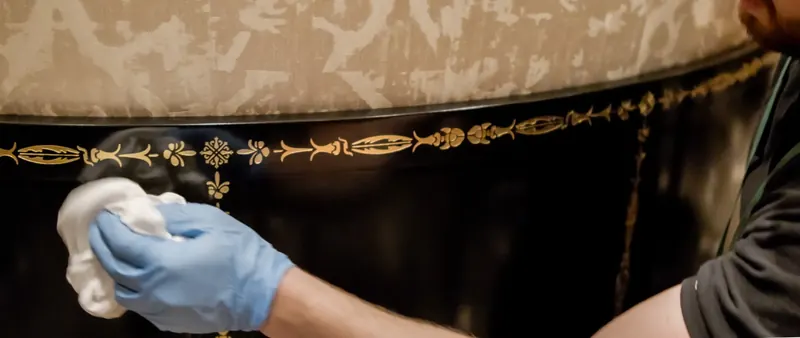
Where veneer carries the story of a tree, lacquer carries colour and nothing else — a smooth, even surface in any shade you can name, sprayed or laid on by hand. It is the finish we reach for when the brief wants a deep, saturated hue, or a pale neutral so quiet the piece reads as part of the architecture rather than furniture standing in the room, or a high gloss that takes the light and gives back a reflection.
Lacquer is sprayed in our dedicated booths, where the air is kept still and dust-free — the smallest mote settling on a wet coat will telegraph through the gloss, so the controlled environment is not a luxury but the whole point. Sheen runs from full-matte through satin, the most common choice for furniture, up to full-gloss. Colour is matched to any RAL, NCS or Farrow & Ball reference, or mixed to a specification of your own.
Two-pack lacquer (also called 2K) is what most furniture work calls for; it cures to a hard, durable surface that shrugs off scratches and most of what a household cleaning cupboard can throw at it. Cellulose lacquer is more reversible, which makes it the right choice for heritage restoration, where what you put on must one day come off again. UV-cured lacquer is the hardest of the three, reserved for flooring and surfaces that take the heaviest wear.
- Best for: contemporary furniture in strong colours; pieces designed to disappear into a room as architectural elements; high-contrast or monochromatic schemes
- Sheen options: full matte, eggshell, satin, semi-gloss, full gloss
- Maintenance: wipe down with a damp cloth; avoid abrasive cleaners; high-gloss surfaces show fingerprints and require regular polishing
Leather
Warmth and durability
Leather brings a warmth and a depth of texture that no synthetic has ever convincingly borrowed, along with an association of quality that registers long before you could put a word to it. On upholstered work — seating, headboards, banquettes — it is among the hardest-wearing surfaces we can offer, the kind that looks better at twenty years than at two. On panelled surfaces, as inlays or wrapped fronts, it adds a layer you take in through the hands as much as the eyes: the heft of the panel, the faint give under a fingertip, the scent that greets you when a drawer opens.
The leather most often specified in luxury residential work is full-grain leather — the top layer of the hide with its natural grain left intact. It earns a patina as it ages, and that patina is the point, prized rather than guarded against. Corrected-grain leather has its surface buffed and embossed with an even pattern; it is more uniform in appearance and usually less costly. Nubuck is full-grain leather buffed on the outer face to a soft, suede-like nap, chosen for seating and panelling where a matte, tactile surface is wanted — the sort of finish that quietly invites a hand to rest on it.
We source our leathers through specialist UK and European tanneries, and can match specific references from Promemoria, Poltrona Frau, Edelman, Moore & Giles and other leading suppliers. The hides are cut and sewn here, in our upholstery workshop.
- Best for: upholstered seating, headboards, banquettes, desk surfaces, panelled inlays, bar fronts
- Types: full-grain, corrected-grain, nubuck, suede, embossed
- Maintenance: periodic conditioning with a leather cream; avoid prolonged exposure to direct sunlight; wipe spills immediately
Which finish is right for your project?
The honest answer is that it depends — on the piece itself, on the room it is bound for, and on the wider palette of the interior around it. In practice, the most satisfying pieces rarely settle on one. A veneered carcass with lacquered door fronts, say, or a leather-fronted bedside set under an oiled walnut top; the interest often lives where two surfaces meet.
We advise on material selection throughout the commissioning process, and we never let a decision be finalised on a screen or a sample card alone — physical samples come first, every time. I have watched too many clients change their mind the moment a leather they admired in a photograph is laid across their own table, in their own light. So if you are early in the choosing, contact us and we will bring samples to your studio or to site. We can also make up small test pieces — a lacquer panel in your chosen colour, a veneered offcut showing two or three grain matches side by side — so that when you commit, you commit with confidence.
To see the full range of surfaces we work with — stone, shagreen, straw marquetry, metal finishes and the more specialist treatments besides — browse our materials library. It is, in the end, just a digital version of those drawers: a place to start with your eyes, before you come and start again with your hands.