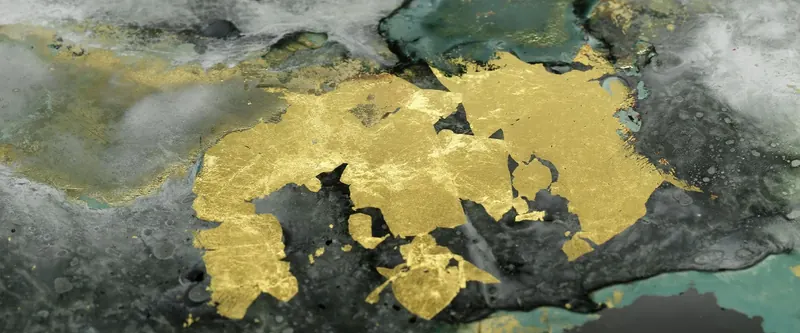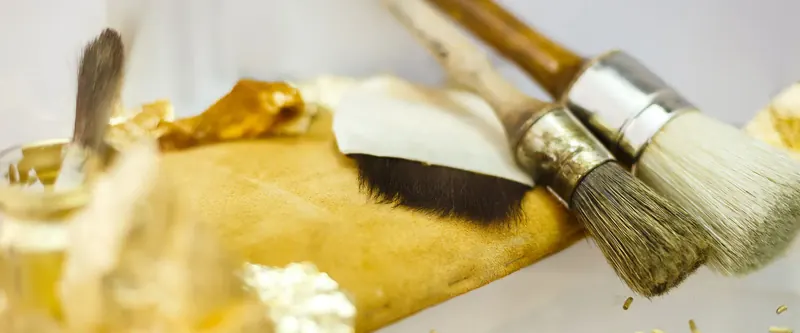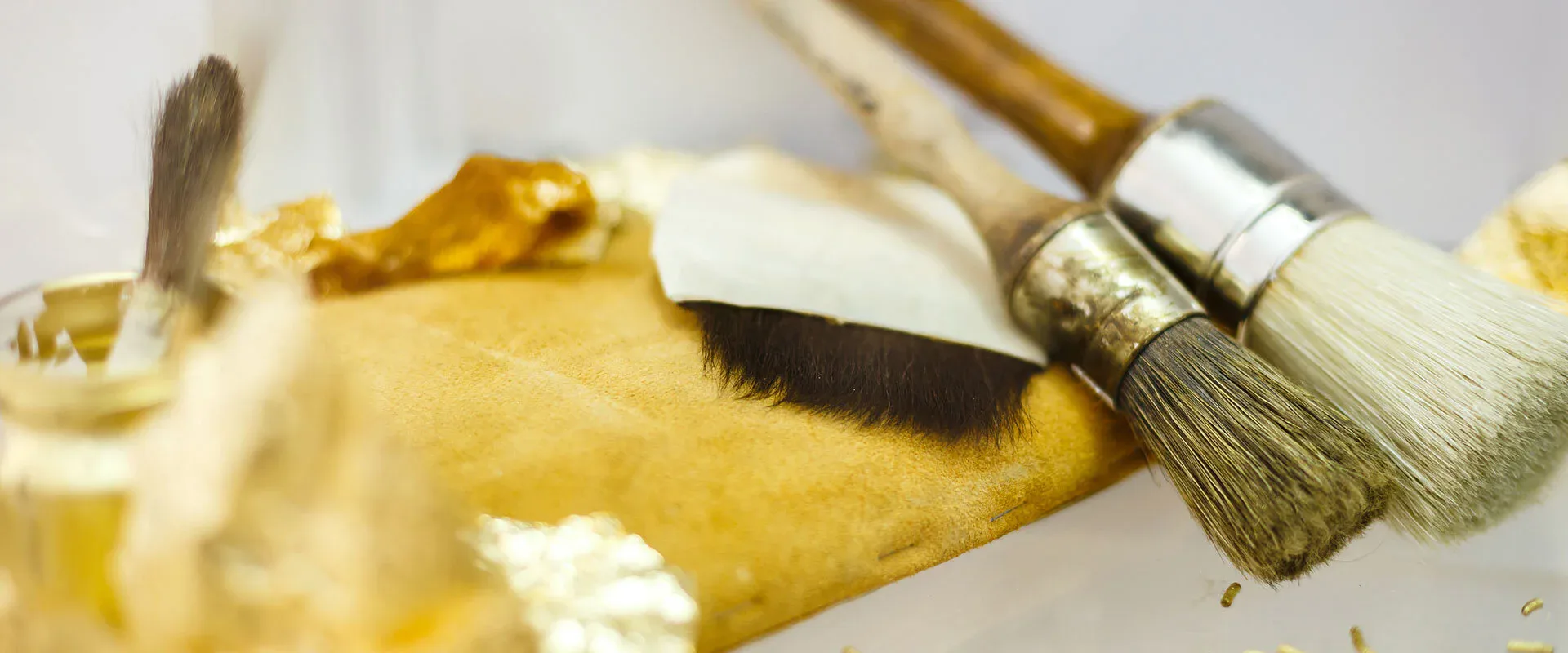
Gilding is the craft of applying an extremely thin layer of metal leaf, gold, silver, palladium or composition metal, to a surface, giving it the appearance of solid precious metal at a fraction of the weight and cost.
The first thing you notice at a gilder's bench is the stillness. Windows are kept shut, doors closed, breath held; a single draught will lift a square of leaf off the cushion and carry it away as if it never existed. The leaf itself is almost nothing — a film of metal so thin it stirs at the warmth of a hand passing nearby. And then, with the lightest touch of a brush, it settles onto the surface and the whole piece seems to gather light. That is gilding: the craft of applying an extremely thin layer of metal leaf — gold, silver, palladium or composition metal — to a surface, to give it the appearance of solid precious metal at a fraction of the weight and cost. It is one of the oldest decorative crafts, and it remains a defining feature of the most luxurious interiors: gilded frames, furniture detailing, carved mouldings, and the metallic ground behind verre églomisé glass. Done well, gilding has a depth and a warmth that no gold paint can imitate.
What gold leaf actually is
Gold leaf is real gold, hammered to a thinness measured in fractions of a micron — so thin it is translucent, holding a green-blue glow when you lift a square to the light, and so weightless and delicate that it cannot be touched by hand without disintegrating. It is supplied in small squares interleaved with tissue, lifted on a flat sable brush drawn once across the cheek so a trace of skin-oil catches the leaf, then laid onto a prepared gesso ground. Genuine gold leaf is most often 22–24 carat; lower carats and composition leaf (an imitation gold alloy) and silver and palladium leaf extend the palette and the price range.
Oil gilding vs water gilding
There are two principal methods, and the difference is fundamental.
Oil gilding lays the leaf onto a slow-drying oil size (an adhesive). It is more robust, can be used on a wider range of surfaces, and is suitable where the gilding will be handled or exposed — but it has a uniform satin sheen and cannot be burnished to a high polish.
Water gilding is the traditional, more demanding method: the leaf is laid onto a surface prepared with layers of gesso and bole (a fine clay), dampened with water at the moment of application. Water gilding is more fragile, but it is the only method that can be burnished — polished with an agate stone to a brilliant, mirror-like shine. There is a moment in that polishing we never tire of: the leaf goes down dull and matte, almost grey, and then the agate passes over it under a little pressure and the gold simply wakes up, deepening into a warm liquid shine you can see your reflection in. The contrast between burnished and matte areas on a single piece, both gold, is one of the signatures of fine gilded work, and it is only achievable through water gilding.
The preparation underneath
Most of the work in gilding is invisible, and most of it happens long before any gold appears. The surface must be built up and made flawless before a single square is laid, because the leaf is so thin that it reveals every imperfection beneath it — every scratch, every raised grain, every faint unevenness telegraphs straight through. Traditional water gilding means multiple coats of gesso, each one sanded glass-smooth until your fingertips can find nothing, then layers of bole burnished to a sheen, before the gold even arrives. The quality of a gilded surface is decided in that quiet, unglamorous preparation as much as in the laying of the leaf.
Where gilding is used
- Furniture detailing — gilded edges, carved mouldings, feet, capitals and applied ornament on casegoods and seating frames.
- Mirror and picture frames — the classic application, where burnished and matte gold are combined.
- Architectural detail — gilded mouldings, cornices and feature elements in the most decorated interiors.
- Behind glass — as the metal-leaf ground in verre églomisé, where the leaf is applied to the reverse of the glass and protected by it.
Commissioning gilded work
Gilding is a specialist craft, executed by gilders working within our production process and integrated at the design stage so the gilded element is planned into the piece rather than added to it. We produce sample panels first — small studies in the actual leaf, the actual method, the actual sheen — and we ask you to hold them, turn them in the light, set them next to the rest of the room, before anything is committed. Gold behaves differently against a dark interior than a pale one, and it is far better to discover that on a panel than on a finished frame. The craft sits within our wider gilding capability and the full range of decorative crafts set out in our luxury craftsmanship guide. If you have a piece in mind, we would be glad to gild a sample and let the gold make its own case.