French polishing is the traditional pinnacle of wood finishing: dozens of wafer-thin layers of shellac laid on entirely by hand over days or weeks, each melting into the last to build a deep, glassy surface within the wood.
The smell reaches you first of all — shellac and spirit, sweet and sharp, the scent of a finishing room that has not really changed in two hundred years. Then there is the sound, the soft, dry whisper of the rubber gliding over timber, round and round, and the way the surface seems to gather light a little more with every pass. Look into a French-polished tabletop once it is finished and your eye falls through the surface into the wood rather than bouncing off it. That depth is the product of one of the slowest, most skilled processes in furniture making — dozens of wafer-thin layers of shellac, laid on entirely by hand over days or weeks, each one melting into the last. French polishing is the traditional pinnacle of wood finishing, and on the right piece it is worth every hour it asks of you.
It is not the right answer for every surface, though, and part of the craft is knowing when to reach for it and when to leave it alone. Here is what French polishing actually is, how it differs from modern finishes, and where a hand-finished surface earns its place.
What French polishing is
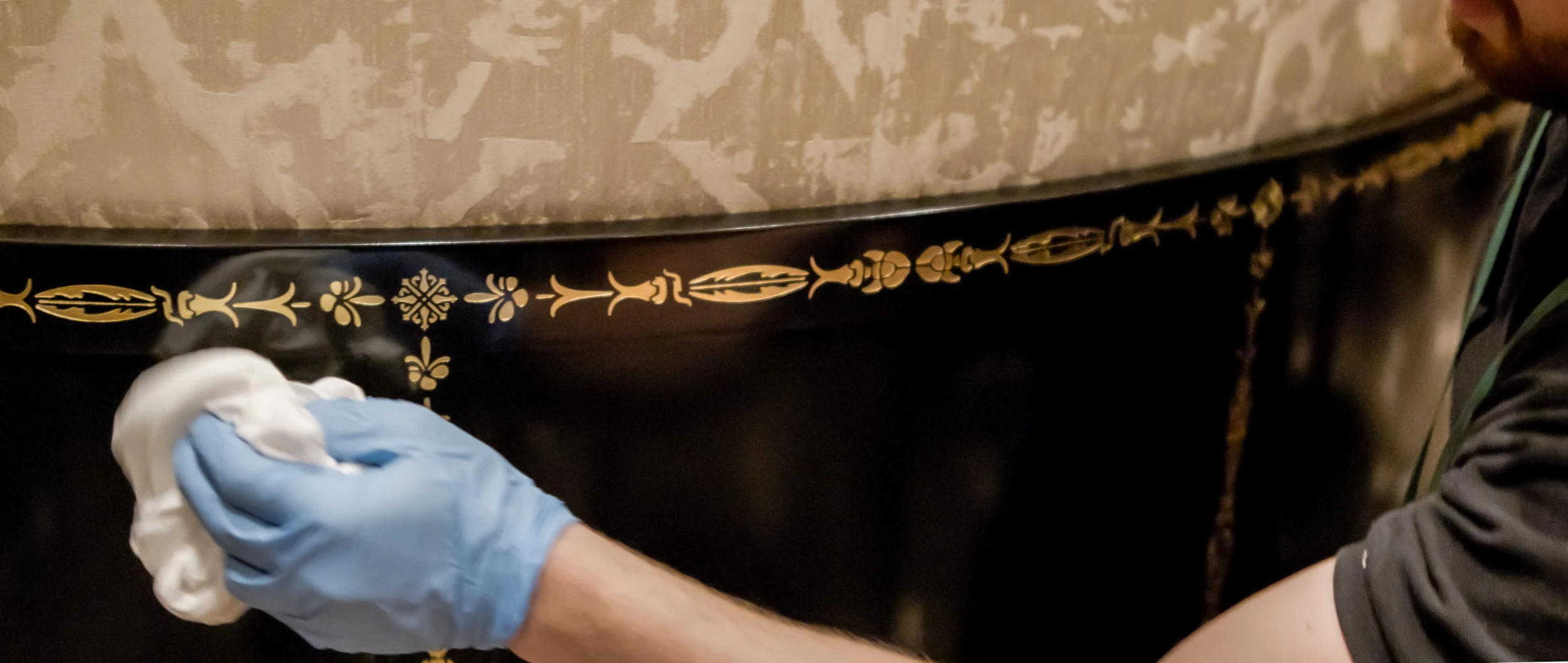
French polishing is a technique, not a material. The material is shellac — a natural resin, secreted by an insect and dissolved in alcohol — and the technique is the way it is laid on: with a rubber, a cloth-wrapped wad of wadding charged with polish, worked over the surface in long, overlapping strokes and tight, patient circles. Each pass leaves a film so thin it is almost invisible; the alcohol flashes off, and the next pass softens and fuses into the one beneath it. Slowly, session by session, the surface builds into a deep, glassy skin that is part of the wood rather than a coating sitting on top of it. There is no single coat to point to — only the accumulation of a hundred quiet gestures.
Why it differs from lacquer and spray
A modern sprayed lacquer is fast, hard, consistent and largely a surface affair — a tough skin laid over the timber in an afternoon. French polish is its opposite in almost every respect: slow, hand-built, optically part of the wood, carrying a warmth and depth that comes precisely from those many thin layers. The trade-off is durability. Shellac is softer than a catalysed lacquer and far less forgiving of heat, alcohol and standing water, which is why it belongs on pieces that are treated with care rather than on a kitchen worktop or a bar. Where a piece needs the look of depth with the toughness of a modern finish, there are other finishes that get part of the way there — but nothing fully stands in for the hand-polished surface.
The process
The work runs in stages, and each one has to be earned before the next. First the timber is filled and the grain prepared until the surface is dead flat — any flaw will be magnified by the polish, never hidden by it. Then comes bodying up: session after session of charging the rubber and laying down polish, building the film while coaxing it not to drag or cloud. Between sessions the surface is left to harden, and there is nothing to do but wait. Finally the polish is spirited off — a few last passes with a near-dry rubber and the barest touch of alcohol that burnish the film to a flawless, even shine. You cannot hurry any of it. I have learned, more than once, that the moment you try to push a surface on faster than it wants to go is the moment it tells you off — it drags, it dulls, it sulks — and you put the rubber down, wait, and come back to it tomorrow. The surface sets the pace, and a large tabletop can take weeks.
Where we use it — and where we don't
We reserve French polishing for pieces where its depth and authenticity earn its fragility: fine dining tables, cabinets, desks and decorative pieces that will be looked after, and the restoration of antique furniture where any other finish would simply be wrong. We do not use it where a surface will meet heat, standing water or hard daily use — there, a modern repairable finish is the honest choice, and saying so is part of the job. Matching the finish to how a piece will actually be lived with is as much a part of the craft as the polishing itself. See how the pieces themselves are produced in our woodwork workshop.
Care and repairability
One quiet gift of shellac is that it is endlessly repairable. Because every layer fuses into the last, a scratch or a pale watermark can be worked back in by hand and re-polished where it stands, with no hard line between old and new — something far more difficult with a catalysed lacquer, which often has to be stripped back and resprayed entirely. A well-polished piece, cared for, can be brought gently back to life again and again over a lifetime, and then over the next one.
The wider craft of hand finishing
French polish sits at one end of a whole spectrum of hand finishing we draw on across the workshop: hand-applied oils that sink into the timber and are easily refreshed, hardwax oils that give a more durable low-sheen surface, and waxes that lend a soft final lustre under the palm. Each is chosen for the piece and the life it will lead. What they all share is the hand of the finisher — that judgement, made in the moment, about when a surface is exactly right, which no machine has ever managed to reproduce.
Colour, grain and sheen
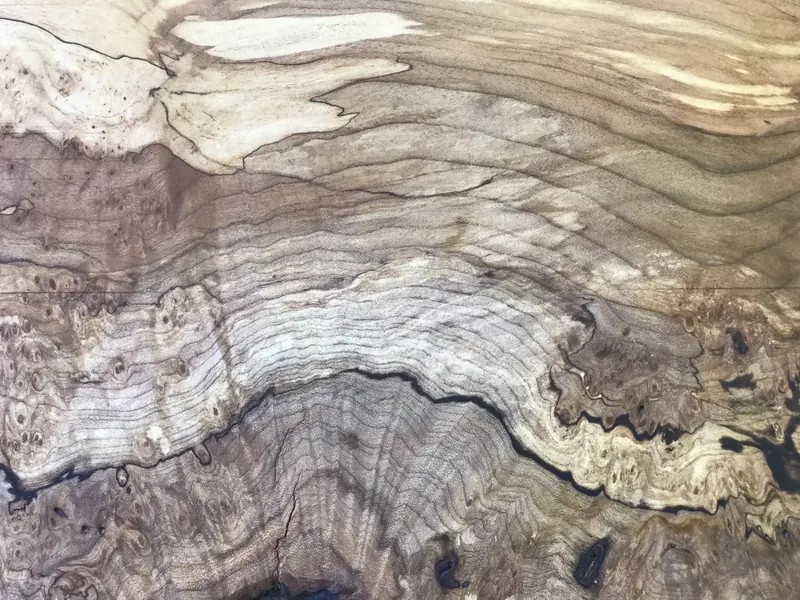
A polished finish is not only about shine; it is the moment the colour and grain of the timber are finally resolved. Before the polishing proper, open-grained woods are grain-filled so the surface reads as glass rather than texture, and the polish itself can be tinted to warm a pale timber, deepen a figure or pull a run of veneers into harmony. The polisher reads the wood as the work goes on, adjusting by eye as the grain gives up its secrets. Sheen is a choice, too: the same shellac can be left at a soft, hand-rubbed satin or burnished all the way to a deep gloss, and matching that sheen to the piece — restrained on a writing desk, mirror-bright on a decorative cabinet — is part of the judgement. None of it is set by a dial; it is decided surface by surface, by eye and by hand.
The case for the slow finish
In a world of fast, sprayed, near-indestructible finishes, French polishing is gloriously inefficient — and that, in the end, is the whole point. On the pieces that deserve it, the depth and the unmistakable hand of a polished surface are part of what makes the object worth living with at all. If you have a piece, new or old, that calls for a hand-finished surface, it is exactly the kind of slow, absorbing work we love most.