The difference between MIG and TIG welding is speed versus finish: MIG is fast and suits hidden structural joints, while slower TIG gives a fine, low-spatter weld that can be polished away wherever a seam shows.
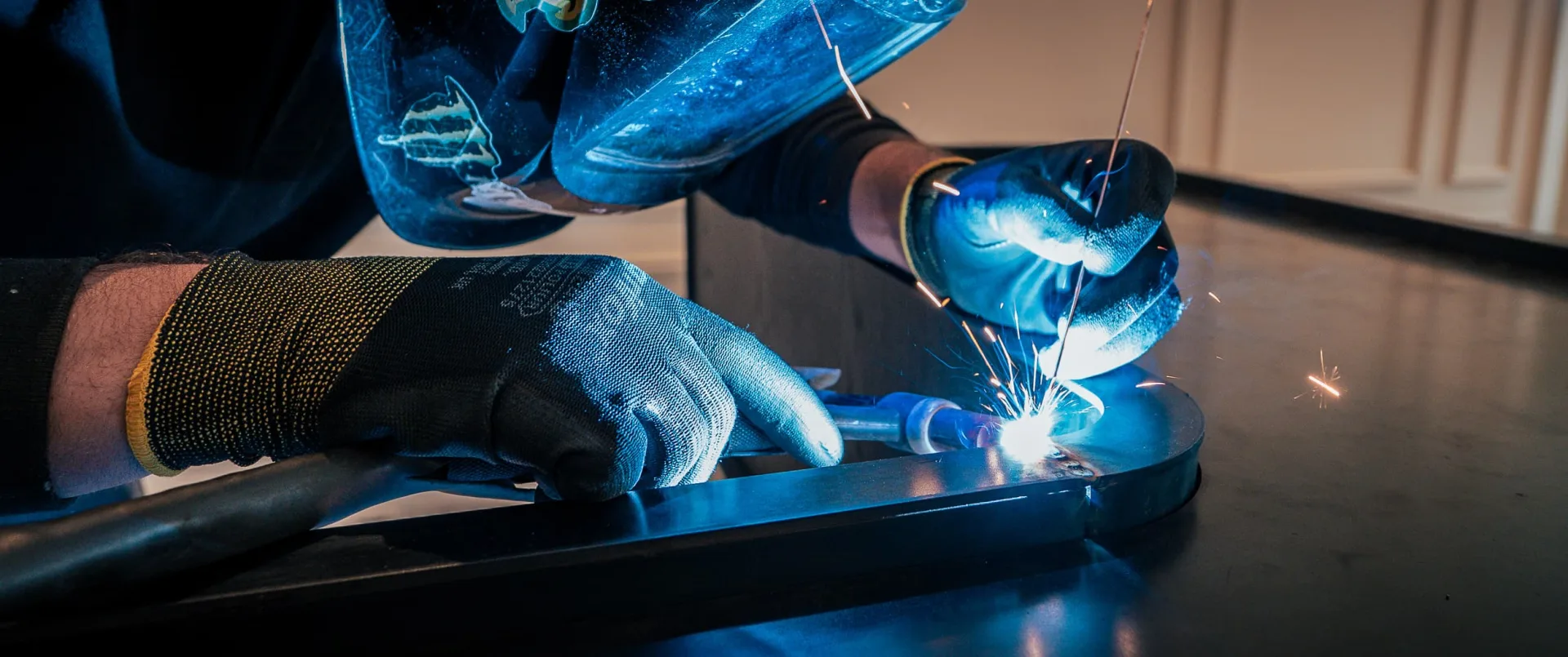
Stand in the metal shop on a busy morning and you can hear the difference before you see it. At one bench, a continuous stutter — a steady, confident crackle that travels along a seam and is gone, the welder moving at the pace of a draughtsman ruling a line. At the next, something slower and more measured: a soft pulsing hum, a foot easing on a pedal, a rod fed in by hand a fraction at a time, the whole body still and concentrated. Two welders, two arcs, two completely different rhythms. Lift the helmet on the first and you find a broader bead, a little spatter to dress back. Lift it on the second and the join is a row of fine, even ripples, almost jewellery, already most of the way to vanishing. The first is MIG; the second is TIG. They reach the same end — two pieces of metal fused into one — by entirely different means, and the choice between them is one of the quiet decisions that separates resolved metalwork from metalwork that carries visible scars.
Almost every piece of fine metalwork in a luxury interior is held together by a weld, and most of those welds are laid by one of these two processes. What follows is how each works, and how a fabricator decides which to use, and where. For the steels and finishes these welds end up in, see steel fabrication.
MIG welding
MIG — metal inert gas — feeds a continuous wire electrode through the torch, melting it into the joint while an inert gas shields the molten weld from the air. Because the wire never stops feeding, the welder can keep moving, and MIG is fast: it lays metal quickly, gets the heat in and out efficiently, and forgives a less than perfect hand. That speed is also its honesty about its limits. The bead is broader and less controllable than a TIG weld, and it throws a fine scatter of spatter — little frozen beads of metal — that has to be chipped and ground away afterwards.
That combination — speed, and lower total heat into the work — makes MIG the right choice for the primary structure of a piece: the frame members, the internal joints, the welds that carry the load and will ultimately sit behind a face or a finish where no one will ever look. Getting the heat in and out quickly matters for more than the clock, too. It limits the total thermal load the workpiece has to absorb, and that keeps distortion across the whole assembly to a minimum.
TIG welding
TIG — tungsten inert gas — asks something quite different of the welder. The arc is struck from a non-consumable tungsten electrode held in the torch; the filler rod is fed into the pool by the other hand, a touch at a time; and the heat itself is governed underfoot, on a pedal eased up or down as the work demands. It is slower, and it asks for years in the hand before it looks easy. What it gives back is total command of the heat and the weld pool — and from that command comes a fine, precise, low-spatter weld that can be ground and polished back into the surrounding surface until there is simply nothing left to see.
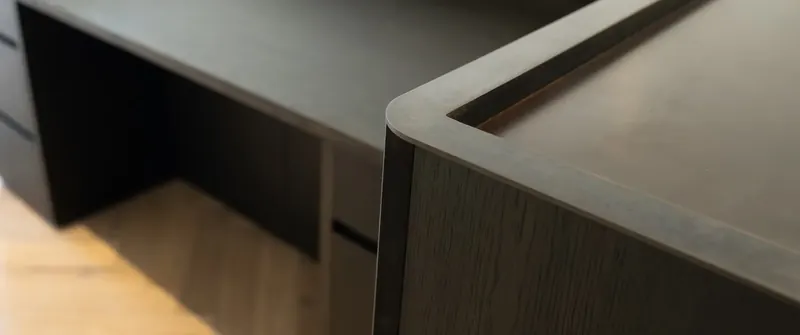
That control is why TIG goes wherever a seam will be on show: a visible frame joint, a mitred corner, the meeting of two faces, anywhere the eye will travel along the weld line. On those joints TIG is the only honest answer — a MIG weld in the same place would have to be hacked back hard and would still, in the right light, read as a line where no line should be. TIG is likewise the process for thin material, and for metals that punish a careless excess of heat, brass and bronze among them.
The decision: reading the sightlines
The real choice between MIG and TIG is made long before a torch is lit — on the drawing, reading the eventual sightlines of the finished piece. Which joints will be seen? Which will be touched? Which sit quietly behind a face or a finish? Structural, hidden joints go to MIG for speed and lower heat; visible, on-show joints go to TIG for a weld that can be made to disappear. A single commission almost always carries both — MIG through the primary structure, TIG wherever the seam will show. We tend to walk the drawing with a finger and mark each joint as one or the other before any metal is cut, because the cost of getting it wrong is borne much later, and by then it is too late.
Knowing which joint is which is part of the planning that separates a piece that resolves cleanly from one that does not, and it is emphatically not something that can be rescued at the finishing stage. A structural joint laid in MIG in a spot that turns out to be visible cannot be polished into invisibility — the breadth of the bead is already there. And reaching for a fine TIG weld everywhere, to be safe, simply makes the work needlessly slow and needlessly expensive, with nothing on the surface to show for it.
Heat, distortion and the metals that punish it
Both processes put heat into the metal, and heat is what brings distortion — the gentle ripple that creeps into a flat panel, the broken radius in a curve that was supposed to run true. Managing the total heat is central to both: short runs rather than long beads, sequencing the welds so the workpiece warms evenly rather than dragging itself out of shape, pausing to let a part cool under your hand before going again. Some metals forgive far less than others. Brass in particular, with its low zinc boiling point and its eagerness to carry heat away, demands the fine, pedal-governed control that only TIG can offer on visible work — a craft we go into in our note on welding brass.
Why it matters to the finished piece
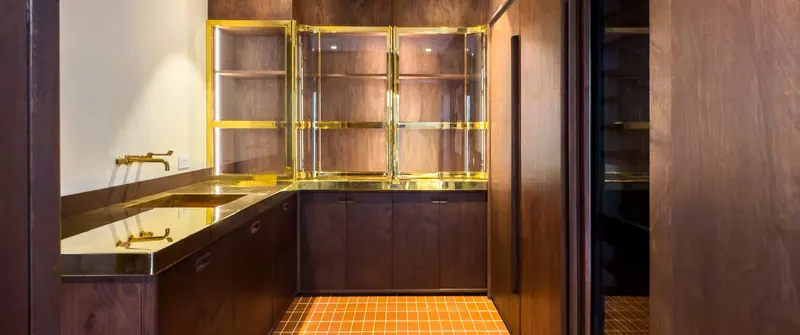
For a designer or a client, the welding process is, when it is done well, completely invisible — which is exactly the point of all of it. A weld chosen rightly and laid cleanly simply disappears: the metal reads as one continuous object, the line runs unbroken, the surface stays whole and quiet under the hand. The whole skill is in making the join vanish, and that begins not at the arc but at the drawing, in choosing the right process for each seam. The wider fabrication sequence that surrounds the welding is set out in our note on sheet metal fabrication, and the full metalwork capability in our guide to bespoke metalwork.