Welding brass is one of the most demanding jobs in metal fabrication, because zinc boils well below the temperature at which copper melts: control the heat too loosely and it burns out, leaving the weld porous, brittle and discoloured.
There is a moment, a second or two before the arc settles, when the brass tells you everything. The pool brightens to a deep gold, the surface goes liquid and mobile, and a faint white wisp lifts off the metal. That wisp is the warning. It is zinc, leaving. Welding brass is one of the more demanding skills in metal fabrication, and the reason is sitting right there in the alloy. Brass is copper and zinc, and the zinc is the problem: it boils at around 907°C, well below the temperature at which the surrounding copper melts. Heat a brass joint too aggressively and the zinc vaporises out of the alloy: it burns off as that white fume, leaves the weld porous and brittle, and changes the colour of the surrounding metal. A welder who can lay a clean bead in steel will not, without retraining their hands and their eye, lay a clean bead in brass. The margin for error is measured in seconds and in millimetres of heat travel.
That difficulty is exactly why welded brass reads as luxury. A brass cabinet, a brass worktop, a brass-framed glazed door — these are objects that announce, to anyone who knows how metal behaves, that a skilled hand spent a long time getting them right. This is what is actually involved.
Why brass is hard to weld
Three properties make brass a specialist job. The first is the low boiling point of zinc. Because zinc vaporises below the working temperature of the joint, every second of excess heat strips alloy out of the weld and throws toxic zinc-oxide fume into the air, which is why brass welding is always done with proper extraction and respiratory protection. The skill is to put in just enough heat to fuse the metal and no more.
The second is thermal conductivity. Brass pulls heat away from the weld pool extremely efficiently — faster than steel — so the heat you apply does not stay where you want it. You can feel it travelling: the workpiece goes warm in your gloved hand a good distance from where the torch actually is. That means a joint can be cold and unfused at the seam while the surrounding metal is already overheating and discolouring. Managing that gradient is the central craft of the work.
The third is distortion. Like all metals brass expands as it heats and contracts as it cools, but its conductivity and softness make it prone to pulling out of true. On a flat panel this shows as a ripple; on a curved component it shows as a kink or a flat spot in what should be a continuous radius. Distortion accumulates: each pass adds a little, and by the end of a complex assembly a piece that was cut accurately can have wandered visibly out of shape unless heat has been controlled at every stage.
MIG and TIG — and when each is used
Two welding processes do most of the work in fine brass fabrication, and the choice between them is a finishing decision as much as a structural one.
MIG welding (metal inert gas) feeds a continuous wire electrode and lays metal quickly. It is faster and more forgiving on heat travel, which makes it the right choice for the primary structure of an assembly — the frame members and joints that carry the load and will ultimately be hidden or sit behind a face. MIG puts a structure together efficiently and gets the heat in and out quickly, which limits the total thermal load on the workpiece.
TIG welding (tungsten inert gas) is slower, cleaner and far more controllable. The welder holds a non-consumable tungsten electrode in one hand and feeds filler rod with the other, governing the heat with a foot pedal — both hands and a foot all working at once, like a slow and very deliberate instrument. That control is why TIG is used wherever a seam will be on show: it produces a fine, precise, low-spatter weld that can be polished back into the surrounding surface until it disappears. On a piece where the weld lines are part of what the eye sees — a visible frame joint, a mitred corner, the meeting of two faces — TIG is the only honest choice.
In practice a single commission moves through both: MIG on the primary structure for speed and lower heat input, TIG wherever the seam will be seen. Knowing which joint is which — reading the drawing and the eventual sightlines to decide before a torch is lit — is part of the planning that separates a fabricated piece that resolves cleanly from one that carries visible scars.
Heat management and distortion control
Everything in brass welding comes back to heat. The fabricator works to keep the total heat input as low as the joint will allow, and to spread what heat there is so it never concentrates long enough to burn the zinc or pull the metal. In practice that means short runs rather than long continuous beads, sequencing the welds so the workpiece heats evenly rather than from one end, and pausing to let the metal cool between passes. There is a discipline in that pausing that we have learned to respect. The temptation is always to push on and finish the seam, and brass punishes exactly that impatience, so we have trained ourselves to put the torch down and wait, even when the piece is humming with momentum. On curved components — the leaves of a curved door, a radiused frame — heat input is managed especially carefully, because distortion in a curve is far more visible than distortion in a straight edge: the eye reads a broken radius instantly.
Curving the brass in the first place is its own discipline. Bending brass to a defined radius without kinking or discolouring it requires specialised tooling and careful heat management at every stage; force it cold and it kinks, overheat it and it discolours and loses temper. The bend and the weld then have to live together — a perfectly bent leaf can still be pulled out of true by careless welding at its edges.
Finishing: colour-matching and consistency of sheen
Welding is only half the craft. The other half is finishing, because a welded brass structure leaves the bench looking like several different metals: the bright seams, the straw-coloured heat shadows around them, the untouched faces. It is not a single uniform colour until it is made one. Every weld, every heat-affected zone, every corner and curve has to be brought to the same standard by hand — thorough polishing of the entire assembly, weld by weld, until the structure reads as one piece of metal rather than an assembly of parts.
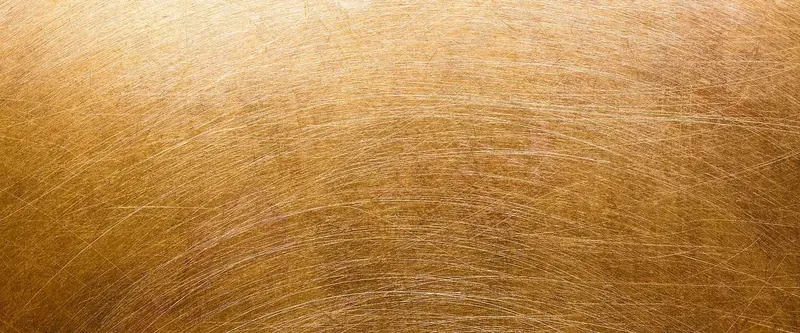
The harder finishing problem is colour-matching. Brass is not one colour; it is a family of alloys and finishes, each with its own tone and reflectance. When a brass piece has to sit alongside existing brass — tapware, ironmongery, an adjacent fitting — the fabricated metal must be matched to that reference exactly, and hold the match across every visible surface. That means working through samples of alloy and finish, turning them under the light next to the reference, until the new metal and the reference read as a single family. And consistency of sheen matters as much as tone: the same warmth at a handle as at a worktop surface, the same depth at the curve of a door as at the welded joints of its frame. A perfect tone with inconsistent sheen still reads as wrong.
A worked example: the Camberwell brass commission
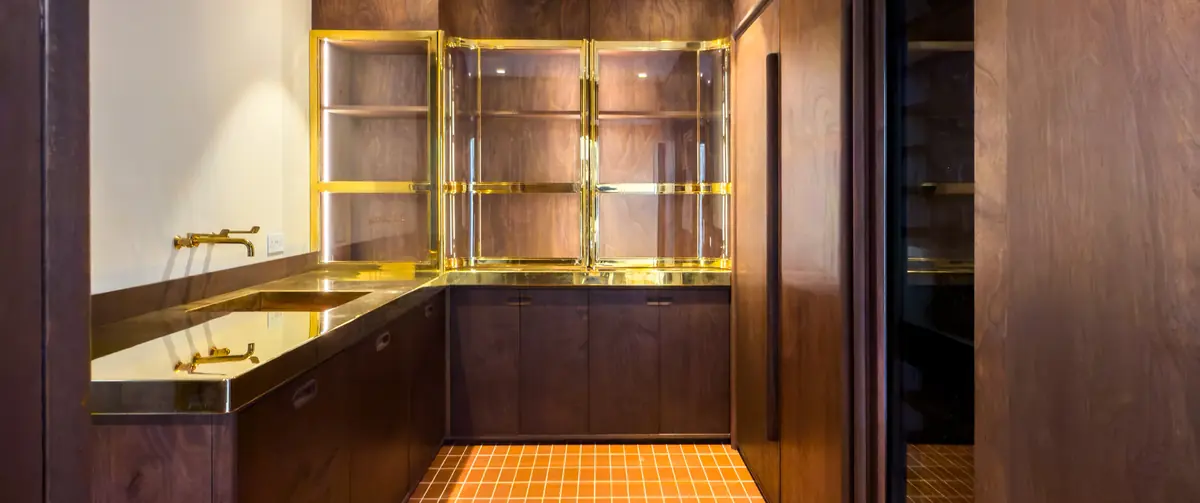
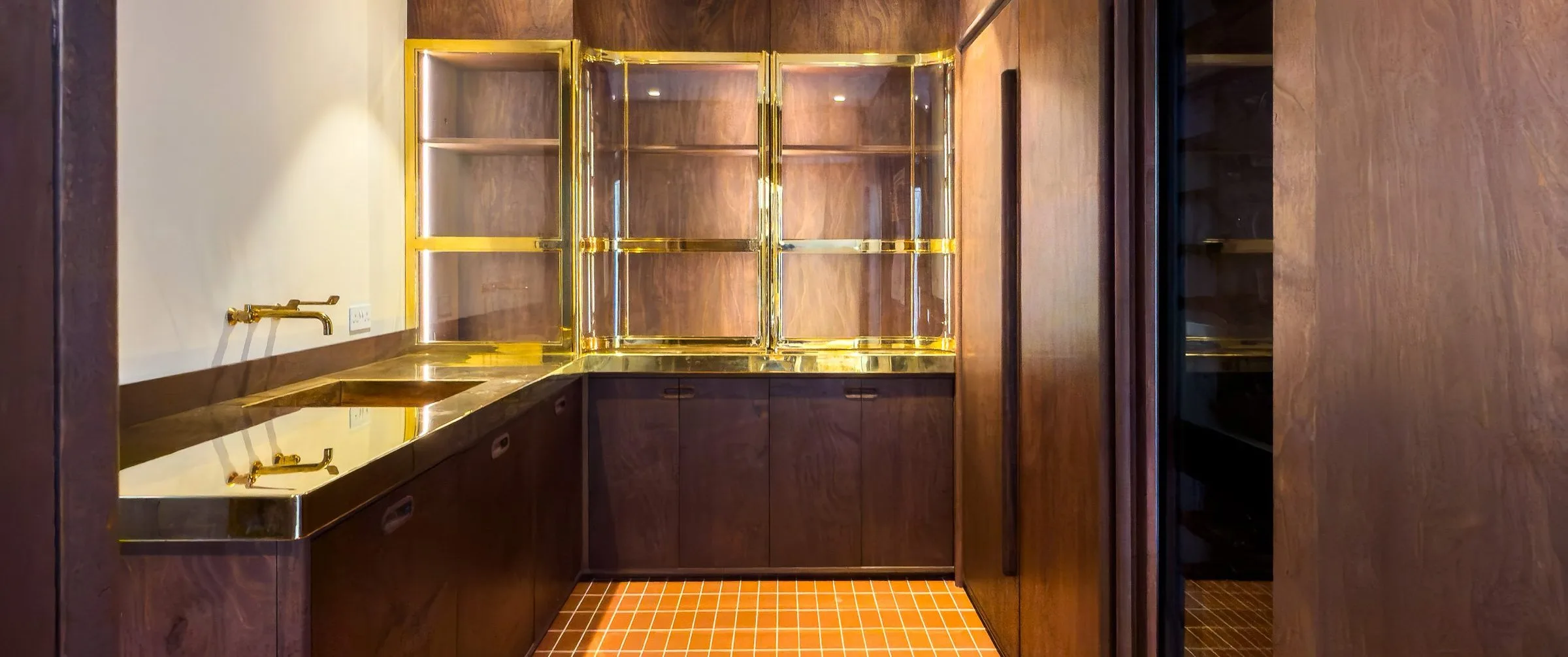
A recent residential commission shows every one of these disciplines in one piece. For a private house in Camberwell, working in collaboration with Tim Gaudin Joinery, the studio fabricated a brass utility cupboard with curved, glass-fronted doors set in a welded brass framework, together with brass worktops, integrated into a crafted utility room.
The design called for gracefully curved glazed doors in a welded brass frame — technically the most demanding element, because the brass had to be bent to a precise radius and then welded at its edges without the weld pulling the curve out of true. Fabrication moved through CNC cutting, hand-finishing, MIG welding on the primary structure, and TIG welding wherever a seam would be on show. Heat input was managed carefully on the curved door leaves, where distortion accumulates fastest.
The colour reference was set by the client's choice of tapware: they had chosen taps in a specific tone of brass, and the cupboard frame had to match that tone exactly and hold it across every visible surface. The colour-matching process worked through samples of brass alloy and finish until the frame and the taps read as a single family of metal, with the same sheen at the handles as at the worktop and the same depth at the door curves as at the welded frame joints. Once the frame was assembled, the entire structure was polished — every weld, every corner, every curve brought to the same standard — before installation alongside the joinery, with fine adjustments made on site until the unit sat precisely within the surrounding cabinetry and the curved glass was inserted to complete it.
The worktops: brass over a stable core
The brass worktops in the same commission illustrate a related technique. Rather than a solid brass slab — heavy, expensive and prone to its own movement — the worktops were produced by wrapping brass sheet over a moisture-resistant MDF substrate. The MDF core gives the surface dimensional stability and rigidity; the brass skin gives the reflective surface and the warmth that defines the space. Accurate dimensioning is critical to this method: every measurement has to account for the thickness of the brass wrapping itself, so the finished surfaces read level, flush and precise rather than slightly oversized at the edges. The result is hardwearing enough for a working utility room while keeping the quality of solid brass at the surface.
A living finish
One of the qualities that draws clients to brass is that it does not stay still. A finished brass piece can be maintained at a mirror polish with regular care, or allowed to patinate — to darken and soften with age into deeper tones of ochre and bronze with subtle verdigris highlights, a living finish that records the room it occupies and, for many clients, only deepens the sense of craftsmanship. We have come to like this about the material: a piece we sweated over at the bench keeps changing long after it leaves us, quietly taking on the warmth of the household it lives in. Either path is valid; the decision is the client's, and a well-made piece supports both. How brass, bronze and steel age is covered in more depth in our note on metal finishes.
Commissioning welded brass
Welded brass work is made in our metalwork shop and integrated with the studio's wider furniture and joinery output — brass frames on upholstered seating, brass detailing on casegoods, brass cladding and worktops in fitted schemes. Because the skill is genuinely specialist, brass commissions are drawn, sampled and prototyped before fabrication: detailed drawings of the framework, curves, glazing rebates and fixing points are produced and approved, and where colour-matching to existing metal is required, the alloy and finish are signed off against a physical reference before a single structural weld is laid. The capability sits within our wider bespoke metalwork offering, alongside steel, bronze and patinated finishes.