Bespoke metalwork is the design, fabrication and finishing of metal components made to a specific commission rather than drawn from a catalogue, appearing at every scale from a brass worktop to a balustrade or lighting armature.
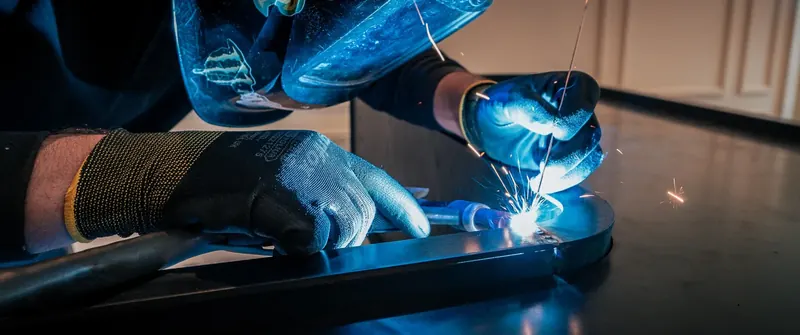
You hear the metalwork shop from along the corridor: the high bright note of a cut-off wheel, the steady tick of a TIG arc, a fan of sparks arcing off a grinder and dying on the floor. There is the smell of hot steel and flux, and the dull warmth that rises off a length of brass an hour after it has been worked. Out of all that noise and heat come the quietest things in a finished room — the frame beneath a chair, the base of a dining table, a blackened-steel desk that looks as though it has always stood there. Bespoke metalwork is the design, fabrication and finishing of metal components made to a specific commission rather than drawn from a catalogue, and in a luxury interior it appears at every scale: a brass worktop, a balustrade, a bar front, a lighting armature, an inlaid line in a timber surface. The metal is rarely the whole piece, but it is almost always the part that sets the structural standard and signs the work.
This guide sets out what bespoke metalwork involves — the metals, the finishes and the applications — for designers and specifiers deciding how to brief it.
The metals
Brass is the warm gold standard of luxury metalwork: an alloy of copper and zinc that, freshly cut, glows almost pink before it settles into colour. We work it into frames, worktops, cladding and detailing, and it will take whatever finish a scheme asks of it — polished, satin, brushed, antiqued, or left unlacquered to live and darken with the room. It is also one of the most demanding metals to weld, because the zinc burns off below the working temperature of the joint — a craft covered in detail in our note on welding brass.
Bronze is darker and richer than brass, with a complex brown undertone that reads almost organic in polished form. It is specified where a warm metal needs more depth and gravity than brass — statement bases, door furniture, feature cladding — and it patinates beautifully, deepening over the years into colours no fresh finish can imitate.
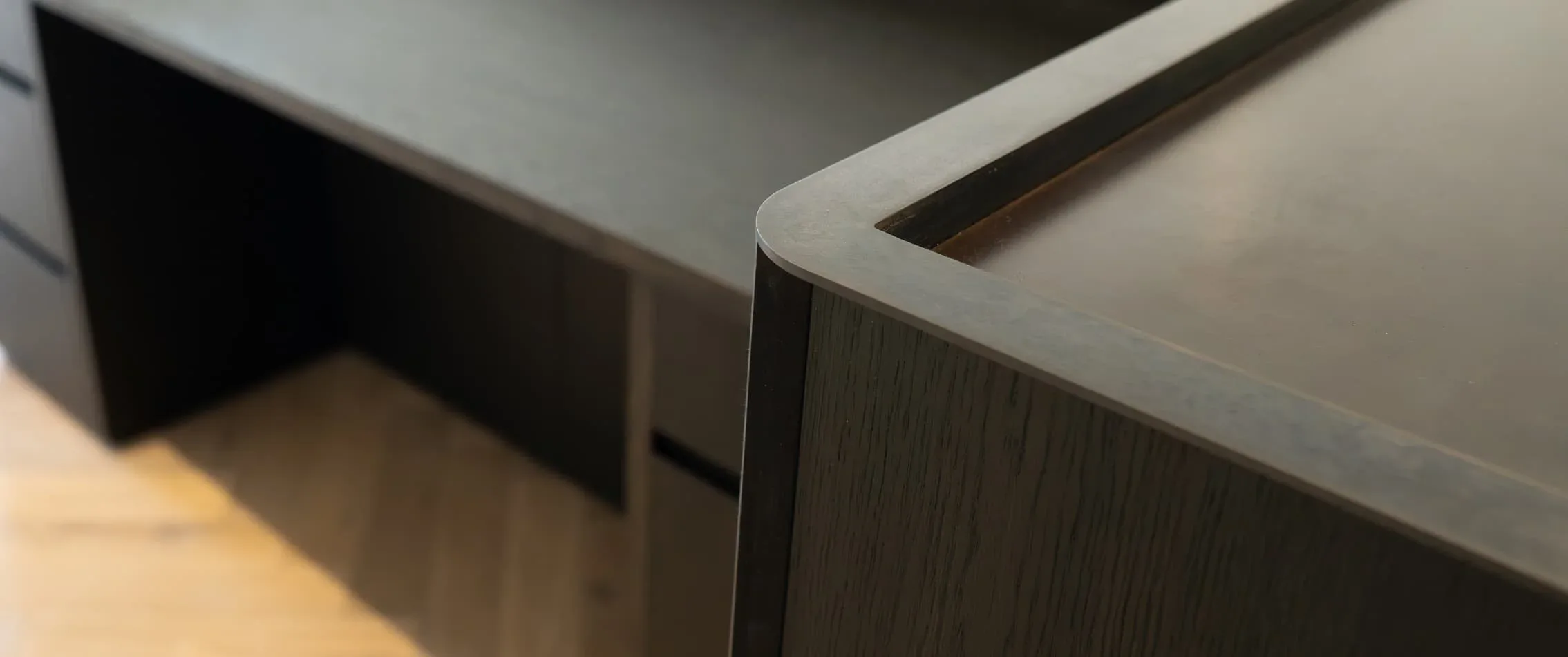
Steel is the structural workhorse, and in its blackened and patinated forms it is also a finished surface in its own right. Blackened steel speaks confidently and quietly: a soft, light-absorbing dark that sits behind much contemporary architectural detailing, reception desks, screens and furniture frames. Our reception desk at 5 St James's Square pairs it with graphite oak — the steel carries the structure and draws the line, the oak warms what the steel would otherwise hold cool.
Stainless steel and aluminium are specified where corrosion resistance or weight matter — outdoor and marine work, large-span structures, pieces that must be lifted and moved. Powder-coated aluminium in particular is the standard for outdoor and rooftop furniture frames, where a piece has to shrug off weather for years and still feel light to carry.
The finishes
Finish is where metalwork becomes luxury, and it is the part we most often ask a designer to come and feel for themselves. The same brass component can be mirror-polished, satin-brushed, hammered, antiqued or left to patinate, and each reads as a different material once it is in a room. Blackened steel can be matte or waxed; bronze can be brought to a warm shine or oil-rubbed to a deep, soft darkness that swallows light. Every one of these is chosen for how it catches the light, how it sits against the other materials in the scheme, and how it will age. The full range is set out on our metal finishes page, and how each ages is covered under metal finishes: a specifier's guide.
A crucial detail in any multi-component commission is consistency: every visible surface has to read as one family of metal, with the same tone and the same sheen, even where the pieces were cut, formed and finished on different days at different benches. Where metal must match existing fittings — tapware, ironmongery, an adjacent supplier's work — the alloy and finish are sampled and signed off against a physical reference, held side by side under the actual light, before a single component is fabricated.
The applications
- Furniture metalwork — frames and bases for upholstered seating, dining and console tables, bar stools and benches, in brass, bronze, blackened steel or polished metal. The metalwork arrives at the furniture bench fully prepared, ready to be upholstered or topped.
- Worktops and surfaces — brass, bronze and patinated-metal worktops, often wrapped over a stable core for flush surfaces and crisp, knife-clean edges, as in our Camberwell House brass commission.
- Architectural metalwork — balustrades, handrails, screens, room dividers, bar fronts and feature staircases, where the metalwork is part of the building rather than the furniture.
- Handrails and balustrades with PVD finishes — coloured, hard-wearing metal finishes for high-traffic hospitality, made to survive thousands of hands a day, as in the PVD handrails at 77 London.
- Lighting and inlay — metal armatures for bespoke lighting, and inlaid metal lines set into timber and stone surfaces.
How it is made
Bespoke metalwork moves through a consistent sequence: detailed drawings for approval, material and finish sign-off against samples, cutting (laser, CNC or shearing), forming (bending, folding, rolling), joining (MIG and TIG welding, riveting or mechanical fixing), and finishing (grinding, polishing, blackening, patinating or coating). Much of the patience lives at the two ends — the drawing that gets the seams in the right place, and the slow hours of finishing that decide whether a surface looks made or merely assembled. The fabrication processes themselves are covered in our note on sheet metal fabrication, and the welding decisions in MIG vs TIG welding.
All of it is made in our Sussex metalwork shop and integrated with the studio's wider furniture, joinery and lighting output, so a piece that combines metal with timber, stone, glass or upholstery is coordinated as a single commission rather than assembled from separate suppliers passing parts between them.
Briefing metalwork
For designers, the most useful things to settle early are the metal, the finish and the sightlines — which seams will be visible, which surfaces will be touched, and what the metal must match. From those three decisions everything else follows: the fabrication method, the welding approach, the finishing schedule and the lead time. Where the brief is still open, we make up sample finish panels for sign-off alongside the rest of the material selection, and put them in the hand under the right light — because metal is decided by touch and reflection, never on a screen. Bring us the room, the light it sits in and the materials it must live beside, and we will tell you what the metal wants to be. For the steel side in detail, see steel fabrication.