.webp)
Murano glass is the body of glassmaking technique developed and guarded on the islands of the Venetian lagoon since 1291, each method, from free-blowing to incalmo and sommerso, carrying its own signature, lead time and cost.
Step into a furnace on Murano and the first thing you feel is the heat — a wall of it, rolling off the glory hole before you are anywhere near the mouth. Then you notice the noise: the roar of the burners, the hiss of wet newspaper against hot glass, the maestro calling for a colour. And then the glass itself, gathered glowing orange on the end of a blowpipe, turning and turning so it does not slump. This is Murano: a cluster of small islands in the Venetian lagoon, and for more than seven centuries the most concentrated centre of glassmaking knowledge in the world. In 1291 the Republic of Venice ordered every glass furnace in the city moved here — officially to protect Venice from fire, in practice to protect the secrets of its most valuable industry. The glassmakers who settled on the island developed, refined and guarded a body of technique that is still practised, largely unchanged, in those same furnaces today.
Understanding those techniques is useful to anyone commissioning Murano glass lighting or decorative glass, because each one carries its own signature, and the chosen technique shapes the character, the lead time and the cost of the finished piece. What follows is the working vocabulary, in roughly the order a piece would move through the furnace.
The furnace techniques
Free-blowing and mould-blowing
Everything begins at the furnace, where glass is gathered molten on the end of a blowpipe at around 1,100°C — the colour of a sunset, too bright to look at directly. In free-blowing, the maestro inflates and shapes the gather entirely by hand, turning, swinging and coaxing it with wooden tools and wads of soaked newspaper that smoke and char against the heat as the glass cools and stiffens. There is a narrow window — a minute, sometimes less — in which the glass will do what you ask, and the whole craft lives inside it. Mould-blowing inflates the gather inside a carved mould to repeat a form precisely, indispensable when a chandelier needs twelve identical arms.
Incalmo
Incalmo joins two separately blown bubbles of different colours while both are still hot, fusing them edge to edge into a single vessel with a crisp horizontal band where the colours meet. It is one of the most demanding furnace techniques: both bubbles must be at exactly the same diameter and exactly the same temperature at the moment they touch, or the join shears apart. Its clean, graphic colour breaks have a strongly contemporary character. The first time we watched a maestro bring two globes together and seal them in a single breath, the join so clean it might have been drawn with a ruler, it was hard not to hold your own breath alongside him. Nothing about it looks difficult until you understand how little margin there is.
Sommerso
Sommerso — "submerged" — layers one colour of glass inside another by dipping a coloured core repeatedly into contrasting molten glass. The result is a thick-walled piece with distinct, suspended layers of colour, one seeming to float inside the next as though caught in still water. Developed commercially on Murano in the 1930s, it remains one of the island's most recognisable effects.
The canework techniques
Millefiori and murrine
Murrine are cross-sections of patterned glass cane: rods built up of concentric colours, stretched while hot — two people walking the molten rod down the length of the workshop until the pattern shrinks to a few millimetres across — then left to cool and sliced like a loaf. Each slice reveals the whole design in miniature, the way a stick of seaside rock carries its lettering to the centre. Millefiori — "a thousand flowers" — arranges flower-patterned murrine side by side and fuses them into a surface. The technique is Roman in origin; Murano revived it in the 19th century and made it its own.
Filigrana, reticello and zanfirico
Filigrana embeds fine threads of white or coloured glass inside clear cane, which is then blown into vessels whose walls carry perfect spiralling lines. Zanfirico twists multiple coloured threads into ribbon-like patterns inside the cane; reticello crosses two opposing spirals to form a net, with a tiny air bubble trapped, deliberately, in every diamond of the lattice. These are the island's most virtuosic techniques — pattern built into the thickness of the glass itself, holding its place as the bubble inflates and the walls thin to nothing. Hold a finished reticello piece to the light and the precision is almost unnerving; it is the kind of thing that takes a lifetime to do without thinking.
Surface and colour effects
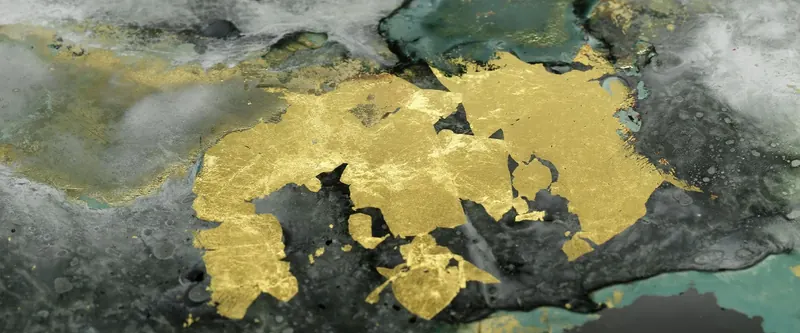
Aventurine glass carries thousands of microscopic copper crystals that catch the light and throw back a metallic glitter, discovered on Murano in the 17th century, reputedly by accident, which is how it earned its name ("a ventura": by chance). Battuto grinds the cooled surface into small, irregular facets that catch the light like beaten metal, soft underhand rather than sharp. Iridised finishes fume metal salts onto the still-hot surface for a low, oil-on-water lustre that shifts as you move around the piece. Gold and silver leaf can be laid against the gather and melted in, the leaf shattering into a fine suspended veil within the wall of the glass.
The wider vocabulary
Beyond the core furnace and canework methods, Murano's glossary runs deep — generations of makers, each leaving a word behind for a thing they found a way to do. The terms below complete the working vocabulary, useful when reading a fixture specification or an auction catalogue.
Cristallo is where Murano's supremacy began: the first truly clear, colourless glass in Europe, perfected in the 15th century. Lattimo is its opposite — an opaque, milk-white glass made with tin oxide, developed to rival porcelain and still used for diffusing shades. Chalcedony (calcedonio) mixes metal oxides into swirling, marbled veining that imitates the semi-precious stone; the recipes remain workshop secrets.
Avventurina — the Italian name for aventurine — suspends copper flecks in the melt for a glittering, night-sky effect, and demands exact furnace control to keep the metal from oxidising. Gold and silver leaf are fused directly onto the gather, fragmenting into a metallic veil within the glass; gold for warmth, silver for cooler shimmer, often combined with sommerso layers in chandelier work.
The texture techniques shape the surface itself. Bullicante traps a regular grid of air bubbles between layers. Pulegoso goes the other way: gas-forming additives froth the glass into a spongy, irregular bubbling. Balotton blows the gather into a diamond-patterned mould; rigadin uses a ribbed mould for fluting. Ice glass (ghiaccio) is plunged briefly into water so the surface crazes like cracked ice while the wall beneath stays sound.
The pattern techniques work in colour. Fenicio combs threads of trailed glass into feathered waves — a method older than Murano itself, inherited from Phoenician glassmaking. Cameo carves through layered colours to leave a raised design in relief. Glass tesserae and macette build patterns from fused mosaic elements, and iridised surfaces take a rainbow sheen from metal-oxide vapour applied hot — the soap-bubble lustre familiar from Art Nouveau glass.
Murano glass in bespoke lighting
Lighting is where these techniques come together at architectural scale, and where the glass finally does what it was always for — holding light. A classical Rezzonico chandelier is an assembly of dozens of free-blown and mould-blown elements — arms, leaves, flowers, pastorali — each made by hand, each slightly its own, and each replaceable. Contemporary fittings tend to use fewer, larger elements: incalmo globes, sommerso pendants, filigrana shades. Our partner furnace on Murano produces both, working from technical drawings we develop with the designer.
- Chandeliers — classical Rezzonico and Ca' Rezzonico forms, or contemporary compositions of blown elements
- Pendant lighting — single blown forms in sommerso, incalmo or filigrana, often in repeated runs for hospitality
- Wall and ceiling lights — pressed and blown diffusers, leafed or iridised for warmth
- Decorative elements — murrine panels, aventurine details and mirrored glass for furniture and joinery
Commissioning Murano glass with Make Bespoke Studio
We commission Murano glass through our partner furnace on the island, combining its furnace skills with our glass-blowing expertise, metalwork and installation. The process starts with the design intent — a sketch, a reference, a space — from which we develop technical drawings, colour samples and, for larger fittings, full prototypes. Lead times run from 8 weeks for simple repeated pendants to 20+ weeks for a large chandelier; glass keeps its own pace, and the best results come from not rushing the furnace.
If you are considering Murano glass for a scheme, we can arrange samples of specific techniques and colours, and put you in the conversation directly with the people at the furnace. A thousand years of practice sits behind every piece — and it is still, every time, made by hand, in the heat, in that one short minute when the glass will listen. See also our guide to bespoke lighting.