A bespoke sofa is built from the inside out: a kiln-dried hardwood frame, hand-tied or serpentine suspension, and layered foam, feather and down fills, then hand-upholstered to outlast anything off the shelf.
Before a single stitch goes in, a sofa is just a bare hardwood skeleton standing on the bench — pale beech, sharp corners, no softness anywhere. Nudge it and it does not so much as flex. There is a particular smell at this stage, dry timber and warm hide glue, and a particular sound when you knock the frame: a flat, solid tock with nothing loose behind it. That bareness is the whole point. A sofa is the hardest-working piece of furniture in most homes, and the one whose quality is most often hidden. From the outside, an expensive sofa and a cheap one can look almost identical on day one; the difference is entirely in what you cannot see — the frame, the suspension and the fills — and it reveals itself slowly, over the years that one sofa holds its shape while the other sags, splits and flattens. A bespoke upholstered sofa is built from the inside out, every layer chosen to last a generation rather than a guarantee period.
The frame
Everything begins here, and a good frame is made from kiln-dried hardwood — usually beech — dried to a stable moisture content so it will not move, crack or creak in a centrally heated room. The joints are the tell. A quality frame is jointed with glued and dowelled or mortise-and-tenon joints, corner-blocked and screwed, never stapled together from particleboard. We build frames to take decades of being sat on, leaned over and hauled up tight stairwells between one home and the next — and we build them as if someone will one day strip the sofa back and judge our work, because at a reupholster, thirty years on, someone will. It is the part of the sofa nobody ever sees and the part that decides whether it lasts ten years or fifty.
The suspension
On top of the frame sits the suspension — the layer that gives a seat its support and its character. Traditional eight-way hand-tied coil springs, knotted by hand in eight directions, remain the benchmark for a deep, resilient, slowly-yielding seat; there is a rhythm to tying them, twine pulled and looped and cinched until the whole bank of springs answers your hand as one. Serpentine (zig-zag) springs give a firmer, more contemporary feel and a slimmer seat. Webbing systems suit lighter, tailored designs. We choose the suspension to the way the piece is meant to sit, then build the seat up from there.
The fills
The comfort you actually feel is in the fills, and they are layered rather than single. A high-resilience foam core gives shape and longevity; it is wrapped in a softer layer and often a feather-and-down or fibre topping that gives the relaxed, sink-in surface and the plumpable look — the kind of cushion that takes the shape of whoever last sat there. Seat cushions are frequently a foam core in a feather-wrapped casing, the best of both: support that holds and a surface that softens. The mix of firmness is tuned to the client; a formal drawing-room sofa and a family snug are filled quite differently. Our note on leather and upholstery materials covers how the outer skin is chosen.
The upholstery
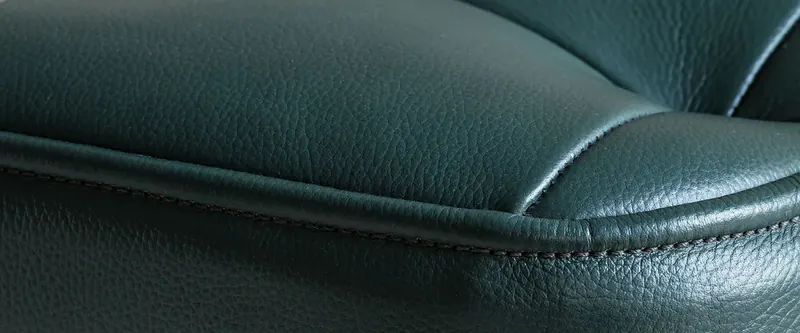
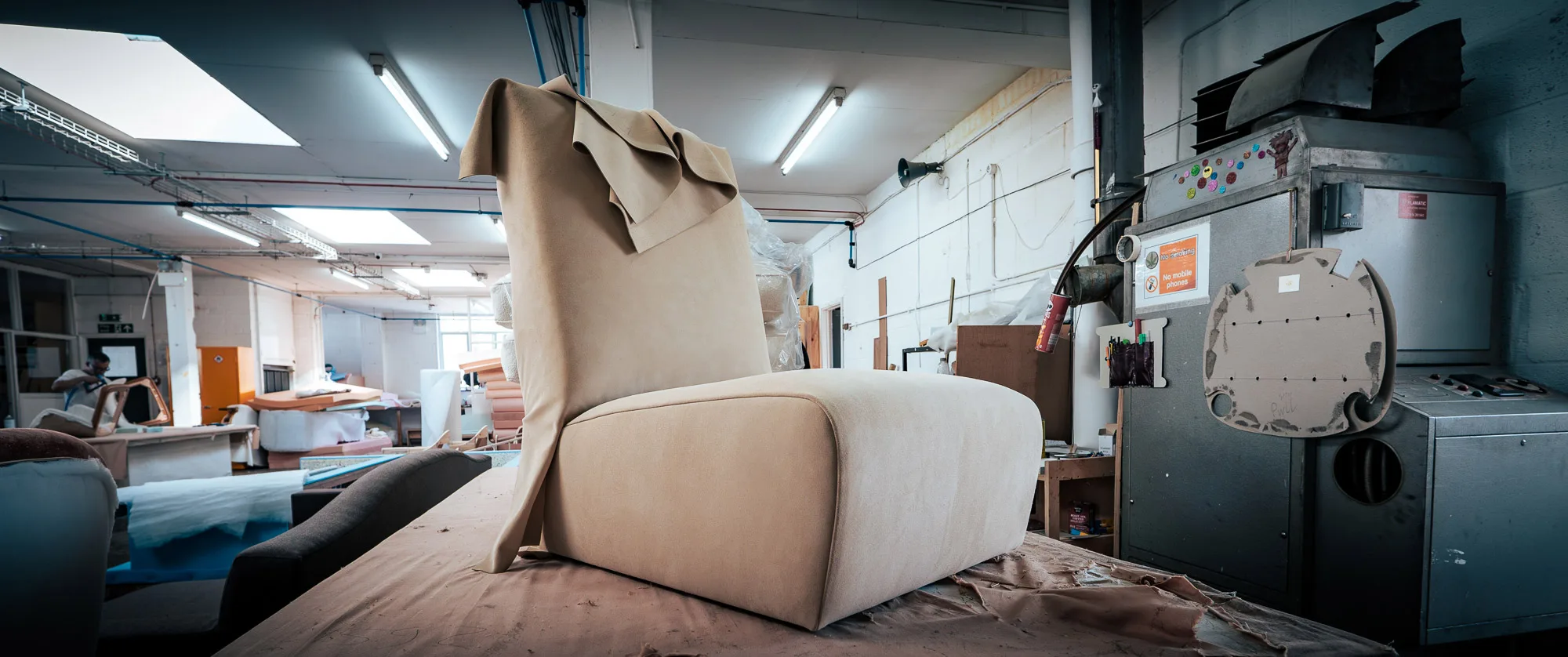
Finally the sofa is upholstered — and on a bespoke piece this is done over a tailored calico under-layer before the top fabric or leather goes on, so the shape is built and corrected in plain muslin first, where a mistake costs a metre of cheap cloth and not the good stuff. The top cover is cut so that pattern, nap and grain run correctly across every panel, piping and seam is hand-detailed, and on a fixed-cover sofa the fabric is worked tight and true with no puckering. The result is a piece where the upholstery looks inevitable — as if the fabric had grown on the frame rather than been fitted to it.
Tailored to the room and the sitter
Because every dimension is yours to set, a bespoke sofa can be tuned in ways an off-the-shelf piece never can. Seat depth decides whether a sofa is upright and sociable or deep and loungeable; seat height and firmness suit the people who will use it most; arm height and style — from a low track arm to a rolled English arm — change the whole character and the footprint. Back height balances comfort against the sightlines of the room. None of this is decoration; it is the difference between a sofa people drift towards and one they merely tolerate. We resolve these dimensions against the room and the way you actually sit — not how you say you sit — before a single spring is tied.
Why bespoke lasts
The case for a bespoke sofa is not really about looks; it is about the decades. A frame that does not move, a suspension that does not collapse, fills that can be topped up and a cover that can be replaced add up to a sofa that is repaired and re-loved rather than thrown away. It is also the only way to get exactly the dimensions, depth, firmness and proportions a particular room and a particular person need. A sofa is where a household settles at the end of the day, and it earns its keep quietly, for years. If you are commissioning seating and want it built to be lived on rather than replaced, that is exactly the work we most enjoy.