Veneer is a thin slice of real timber bonded to a stable core; book-matching opens two consecutive leaves like the pages of a book, so the grain mirrors symmetrically about the joint.
Lift a flitch of veneer down from the rack and open it, and the gesture is exactly that of opening a book: leaf after leaf, each a whisper thicker than paper, each carrying the same grain a fraction further into the log. Tilt one to the window and the figure catches the light — ripple, curl, the slow swirl of a burr — and the surface seems to deepen and shift as you move. There is a persistent myth that veneer is a cheap substitute for solid wood. In fine furniture the opposite is true: veneer is how the most beautiful and rare timbers are used, how grain is composed into something a solid plank could never achieve, and how large, stable surfaces are built without the splitting and movement that solid wood of that size would suffer. Veneer is not a shortcut — it is a craft in its own right, and on a serious piece of cabinetry it is where much of the artistry lives.
What veneer actually is
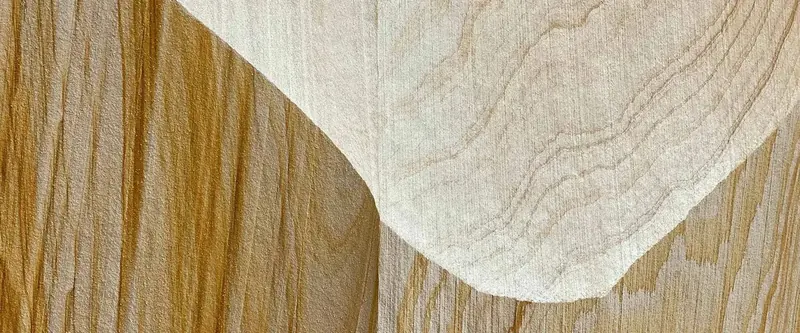
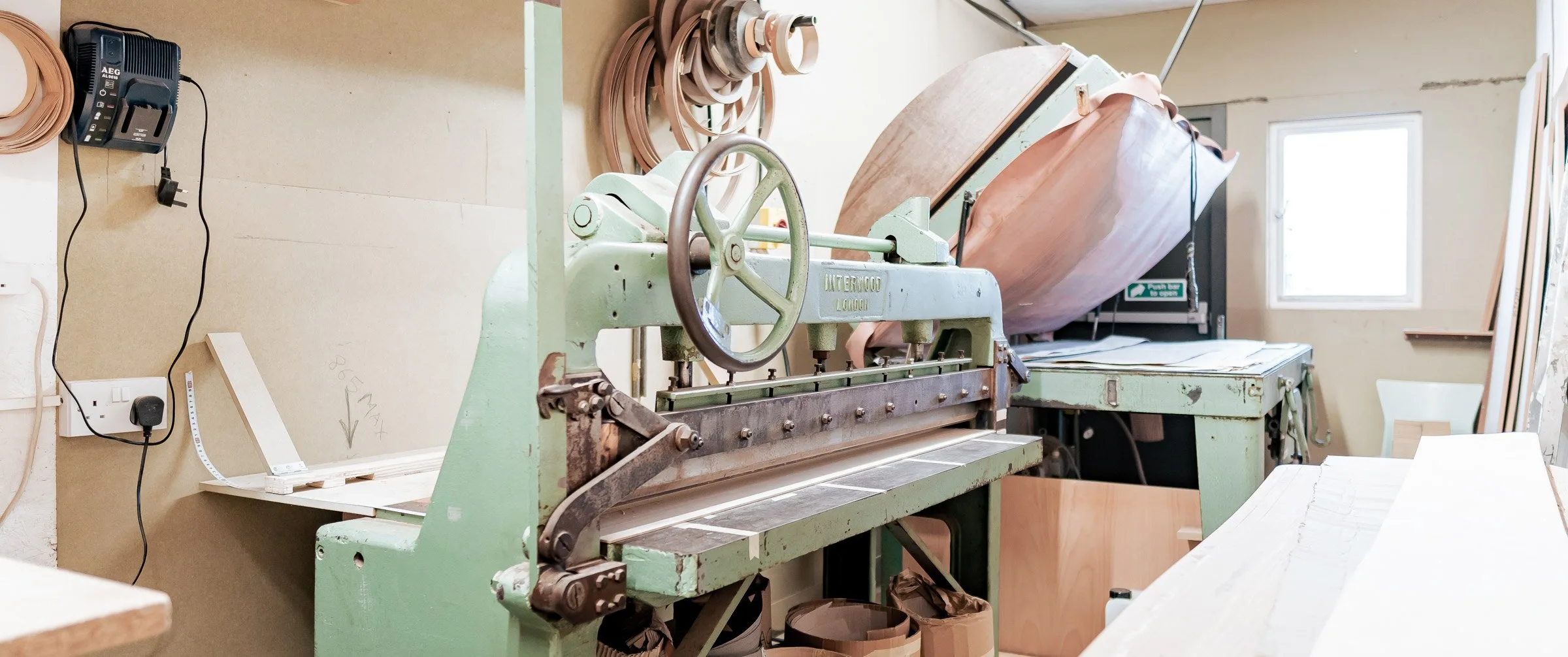
A veneer is a thin slice of real timber — typically less than a millimetre — cut from a log and bonded to a stable core such as a high-quality MDF or plywood. Hold one up and the light comes through it like a stained-glass panel; it is fragile enough to tear with a careless thumb, yet it is wholly, stubbornly real wood, with real grain, real figure and real depth. Because it is thin and laid on a stable substrate, it stays flat where a solid panel of the same size would cup and crack. One log can be sliced into hundreds of consecutive leaves, stacked in the exact order they left the knife — and it is that order, kept faithfully, which makes the next part possible.
Why fine furniture uses it
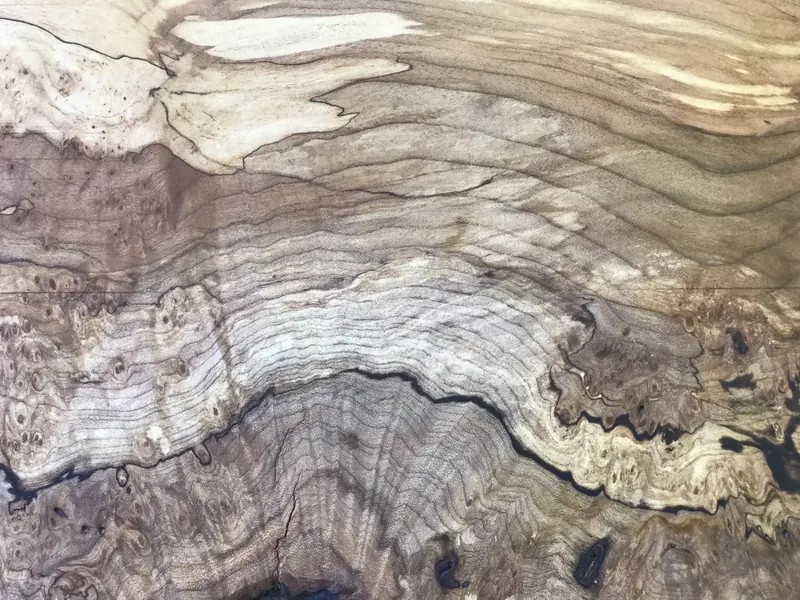
Veneer lets us do three things solid timber cannot. It makes the rarest and most figured timbers — burrs, crotches, ripple and curl — usable, since these exist only in small or unstable pieces that would never survive as a plank. It allows large surfaces, like a long sideboard or a run of doors, to be flat and stable for life. And, crucially, it allows the grain to be composed, because consecutive leaves from one log are near-identical mirror images of each other — the same river of figure, turned and turned again.
Book-matching and its cousins
Book-matching is the best-known technique: two consecutive leaves are opened like the pages of a book, so the grain mirrors symmetrically about the joint, creating the dramatic, butterfly-like figure seen on the finest cabinet doors and table tops. Slip-matching slides consecutive leaves side by side in the same orientation for a repeating, marching grain. Quarter-matching mirrors four leaves around a centre point for a radial, kaleidoscopic figure. Each produces a completely different character from the same log, and choosing between them is a design decision — we will sometimes lay the same four leaves up two or three different ways on the bench, just to see which one the timber wants to be, before a drop of glue is mixed.
Sequencing across a whole piece
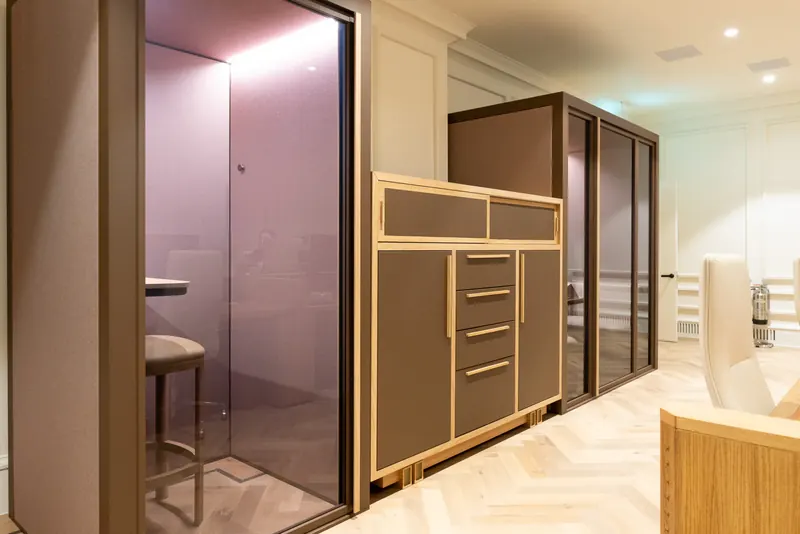
The real skill is not matching two leaves but sequencing dozens across a whole scheme — so the grain flows continuously from one door to the next, around a corner, or along a fitted run, as though the cabinetry were carved from a single impossible block. This is set out on the drawing board and the bench, leaf by numbered leaf, in soft pencil, before any glue is laid. Done well, it is invisible as a technique and unmistakable as quality: nobody ever points at it, and yet the eye simply reads the whole piece as calm and harmonious, never quite knowing why.
Veneer or solid — honestly
Neither veneer nor solid timber is “better”; they are right for different things, and a good maker uses both without apology. Solid timber is the honest choice for surfaces that are worked, knocked and re-finished over a lifetime — table tops that will be sanded back, chair frames, anything where the edge profile is carved rather than applied. Veneer is the right choice for large flat surfaces that must stay stable (a long sideboard, a run of doors), for the rarest figured timbers that only exist in unstable pieces, and wherever grain needs to be composed across a piece. The skill is matching each to its place — solid where movement and repair demand it, veneer where stability and figure call for it — rather than treating one as a substitute for the other.
The mark of a considered piece
Look at a veneered surface and ask whether the grain was simply covered or genuinely composed — whether it flows and mirrors with intent, or just happens to be wood-coloured. That difference is the difference between veneer as a cost-saving and veneer as a craft. When we veneer a piece, the layup is designed as carefully as the form, because on cabinetry it is the surface that people live alongside, run a hand over, read first and remember longest. Get it right and the timber tells the room a quiet, unbroken story — and years later, that is the part people still reach out to touch.