Inside the workshop, a bespoke commission passes through six specialist facilities in sequence: woodwork, metalwork, spraywork, stonework, upholstery and technology, each adding one skill so the finished piece carries the standard of all of them.
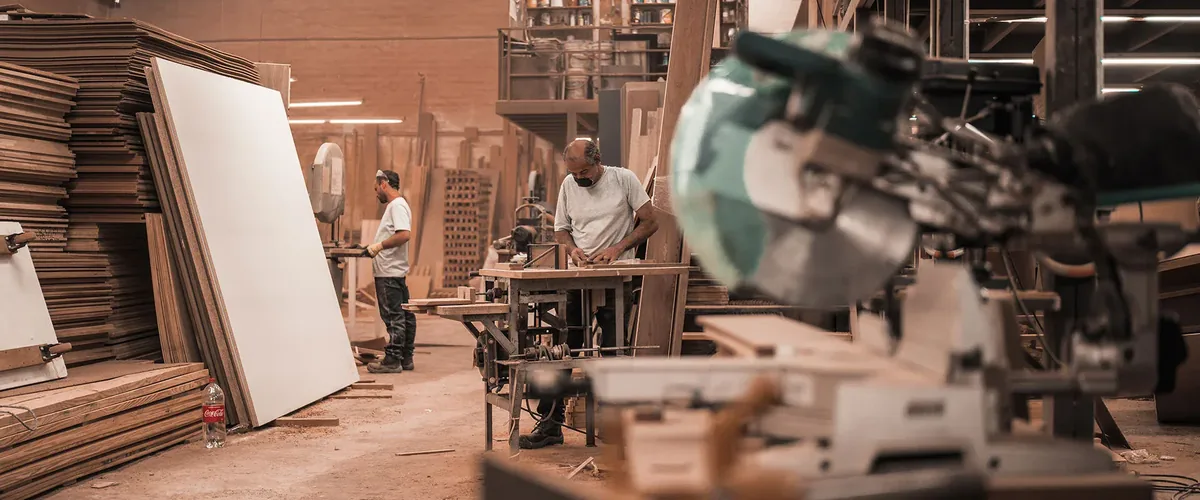
Come in early, before the machines are running, and the workshop tells you everything about itself in a single breath. The air is cool and faintly resinous — sawn oak from yesterday, a thread of lacquer carried under the door from the spray bay, the metallic tang that hangs over the welding bench. Light slants low across the assembly tables and catches the fine dust that never quite settles. On one bench, a half-built carcase waits with its clamps still on. On another, offcuts and pencil marks and a mug gone cold. Then the first machine wakes, someone calls good morning across the floor, and the day begins.
People often imagine a bespoke piece as the work of a single craftsman at a single bench. It almost never is. A commission passes through a sequence of specialist hands, each adding one particular skill at one particular stage, and the piece that finally arrives on site carries the standard of all of them. We have learned, over many years on this floor, that the final result is only ever as good as the least careful step — which is why we watch every one.
Production here runs across six distinct workshop facilities, each devoted to its own discipline. What follows is the journey we know by heart: how a typical commission travels through the studio, from raw material to the moment it is set in place.
Woodwork
Most commissions begin in the woodwork workshop, the loudest and most fragrant room in the building. This is where carcase construction happens — the structural bones of cabinets, tables, joinery carcases, bed frames and case goods. Our cabinetmakers work in both solid hardwood and engineered board depending on the application, cutting joints by traditional methods where the design asks for it and turning to CNC routing where a complex run demands the same joint made a hundred times without a hair of variation. You can stand by the bench and watch a shoulder being pared back by hand, a chisel taking shavings so fine they curl like ribbon.
Veneer work also begins here: book-matching, slip-matching and more involved decorative patterns including parquetry and marquetry layouts. The veneer team handles both standard and specialist leaves — burrs, crotches and figured grains, the difficult, beautiful ones that fight you on the press and reward an unhurried hand. Laying a length of figured walnut so the grain reads as one continuous flow across three doors is the kind of quiet problem we enjoy solving.
Metalwork
More and more, bespoke furniture wants metal in it — as structure, as detail, as a surface in its own right. Cross into the metalwork facility and the register of the room changes: the sweet smell of timber gives way to flux and hot steel, the bright flare of the welder, the ring of brass under a file. Here the work is in brass, bronze, steel and stainless steel — welding, forming, turning and polishing. Frames, leg structures, decorative banding, hardware and inset details are all made within the network rather than bought in, which means a finish can be matched exactly to a designer's intent rather than chosen from whatever a catalogue happens to offer.
PVD (physical vapour deposition) finishing, the hardest and most durable of metal surfaces, is carried out by specialist partners working precisely to our specification. And for those who want a metal that keeps living, we offer unlacquered finishes that darken and warm with handling over the years, alongside hand-burnished patinas and blackened steel — quieter, more characterful alternatives to the usual satin and mirror polish.
Spraywork
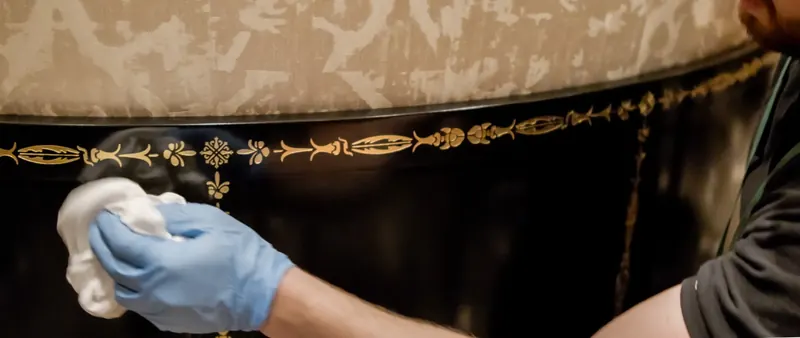
Lacquer finishing happens in the dedicated spraywork facility, a sealed, climate-controlled room that feels almost hushed after the clamour of the other workshops — filtered air, even light, every surface kept scrupulously clean, because the smallest mote of dust will record itself forever in a wet coat. The difference between lacquer laid down in these conditions and lacquer brushed on site is something you can see across a room: a depth and evenness of surface that site application simply cannot reach.
We work in both water-based and solvent-based lacquers, across the whole range of sheen from dead matt to a mirror that hands your reflection straight back. RAL and NCS colour matching is standard; we will also mix bespoke for designers chasing a colour that exists only in their head or on a fabric swatch. Special effects — limed, aged, crackled, metallic — come from the same finishing team, drawing on techniques both old and new. It is patient work; a high-gloss piece is built coat by coat, each one cut back and judged before the next goes on.
Stonework
Stone turns up in more and more commissions now — as table tops, shelving, drawer faces, integrated basins and decorative insets. The stonework facility is the wet, cool corner of the studio, the floor always slick, the saws hissing through water as they cut. Here we profile, polish and install natural stone including marble, quartzite, travertine, Pyrolave and Corian. CNC waterjet cutting lets us draw intricate profiles and inset patterns into a slab with a precision no hand could hold. There is a particular satisfaction in lifting the polished face of a marble top for the first time and watching the grain come alive under the light.
Stone is also worked into joinery itself — stone-faced cabinet doors, stone plinths for fitted furniture, stone thresholds for room-division joinery. Where stone meets wood or metal, the junction is everything; a hairline misjudged there will catch the eye for the life of the piece. We resolve those transitions here, in the workshop, rather than leaving them to be improvised on site.
Upholstery
The upholstery workshop is the soft-spoken room — carpeted in fabric offcuts, the air thick with the smell of new leather and foam, the steady tick of a sewing machine and the dull thud of a mallet seating tacks. It produces every fabric and leather-covered element: seat cushions and backs, headboards, banquette seating, panel upholstery, ottomans and fully upholstered frames. The cut-and-sew is all done by hand, and pattern-matching across cushions, welts and borders is treated here as a point of honour, not an optional nicety — a stripe that breaks across a seam is a stripe we will pick back and start again.
We work across the full range of materials, from performance fabrics and velvets to full-grain leather, suede and the more unusual stuff — shagreen-effect and metallic finishes among them. We are glad to take COM (customer's own material) where a designer has sourced something special through their own supplier relationships.
Technology
Beneath all of this runs the technology facility — the CNC routing, laser cutting, 3D modelling and digital fabrication that lets us repeat a thing perfectly, again and again, at a scale the hand alone could never sustain. It is the quietest room of the lot, lit by screens, the machines purring through their programmes while a maker watches the first part come off to make sure the drawing and the world agree. Complex joinery runs of hundreds of identical components, decorative panels that must register pattern-to-pattern without drift, furniture that has to hold tolerance in all three dimensions — all of it is marshalled here.
We model in three dimensions throughout the design development, both to talk things through with designers and clients and to guide the workshop's hand. The as-built drawings that come out of this room become the single source of truth for production, site measurement and installation — the document everyone downstream trusts.
From workshop to site
When the last stage is done, a piece is checked over against the original specification — we look at it the way we know the client will, and then a little harder — before it is wrapped, crated and carried out to site by our installation teams. For the more involved joinery, we survey the room before production even begins, so that what leaves the workshop fits the building as if it had grown there. There is a moment, every time, when a piece we have lived with for weeks goes out through the doors and into someone's home, and the bench it stood on falls quiet, ready for whatever comes next. If any of this resonates — whether you arrive with a single line of a brief or a full set of drawings — we would love to hear about it. Talk to us at any stage, from first thought to the day it is set in place.