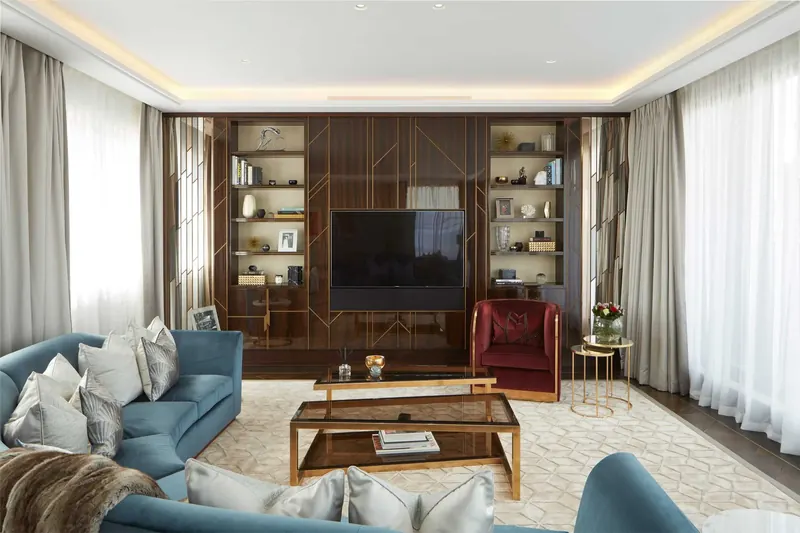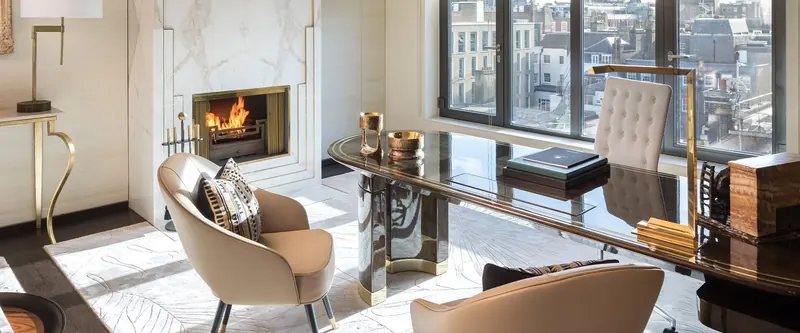
Bespoke office furniture is drawn and engineered for a specific building rather than bought from a catalogue: made to withstand intense use, last a decade or more, and stand for the company whose name is on the door.
Walk into a boardroom before a meeting begins and the furniture has already told you everything. A table that has been made for the space sits with a kind of quiet authority — the grain running clean from one end to the other, the surface unbroken, nothing that announces it was bought to fill a gap. The person who sits at the head of it is trusted before they have said a word, and a good part of that trust is carried by the things around them. A home treats its furniture gently. A workplace does not. A boardroom table is leaned on, written across, rolled up to in heavy chairs by hundreds of different people, and wiped down every evening for a decade or more. A reception desk is the first surface a visitor touches and the last that is allowed to look tired. This is some of the hardest-working furniture we make — and all the while it has to stand for the company whose name is on the door.
That combination — intensity of use, longevity, and the weight of being a brand made physical — is why bespoke furniture has quietly become the norm at the top of the commercial market rather than the exception. When we fitted out the private offices at 5 St James's Square, almost nothing on the floor came from a catalogue. The desks, the boardroom table, the storage walls and the reception were all drawn, engineered and made for that specific building, those specific dimensions, and that specific client. This is how that kind of work is approached.
Why the workplace is a different discipline
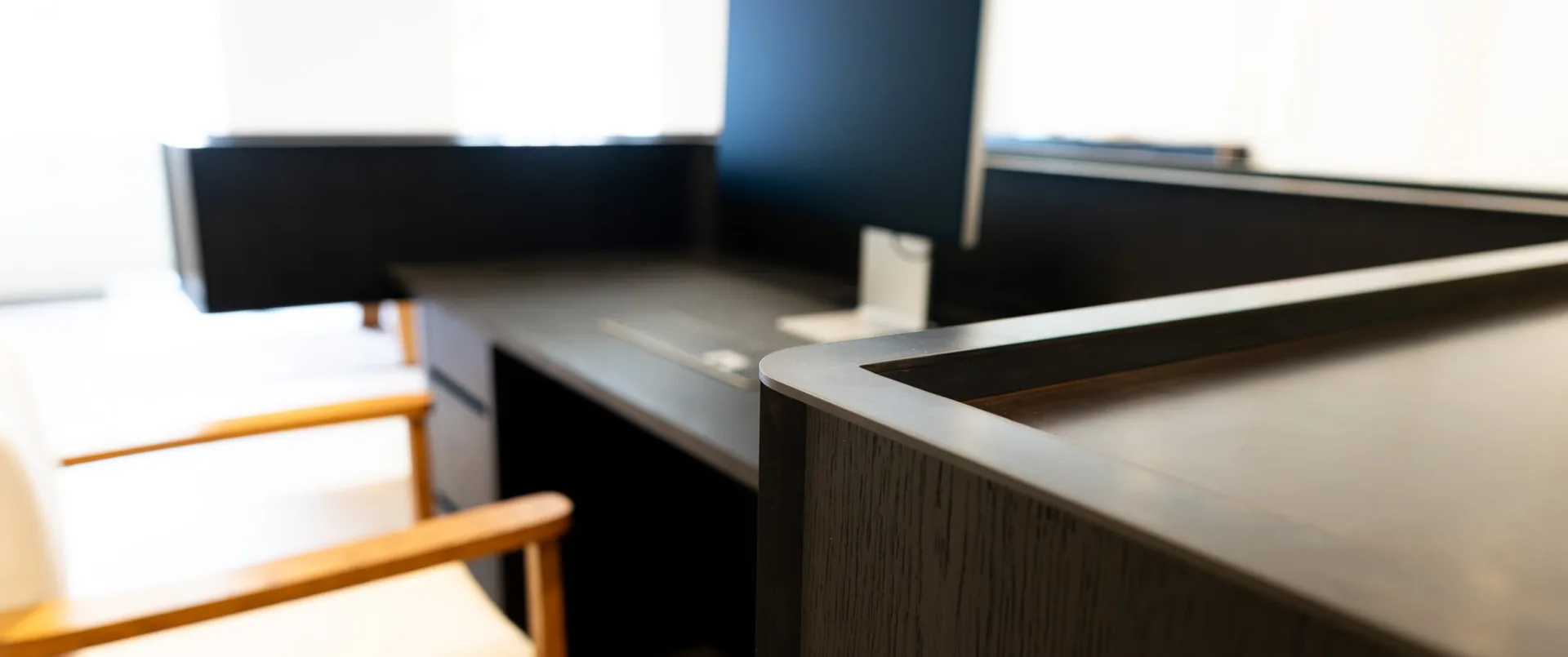
The first thing to understand is that contract-grade furniture is engineered to a different standard than domestic furniture. Use is more frequent, more careless, and spread across far more hands, so every joint, hinge and surface is specified for a longer life. Drawer runners are rated for tens of thousands of cycles rather than a few thousand. Edges are detailed so that the one part of a desk that gets knocked every single day — the front lip, caught by belt buckles and chair arms — cannot chip back to a pale, raw line. Finishes are chosen as much for how they age and clean as for how they look on the morning they are unwrapped.
There is also a layer of practical engineering that domestic pieces rarely need: power and data routed invisibly to where people actually work, cable management that survives being unplugged and re-plugged a hundred times, and construction that can be carried into a lift, eased through a fire door and assembled in a live building without a crane. None of this shows in the finished room, which is exactly the point. Good workplace furniture looks effortless and is anything but.
The core pieces
A workplace commission usually resolves into a familiar family of pieces, each with its own brief:
- Reception desks — the brand's handshake. Often the most sculptural object in the building, frequently combining a stone or solid-surface top, a timber or lacquered body, and concealed working storage for the people behind it.
- Boardroom and meeting tables — the centrepiece, and the most technically demanding object in the room (more on these below).
- Desks and workstations — where durability and cable management matter most, and where consistency across dozens or hundreds of identical pieces is its own engineering problem.
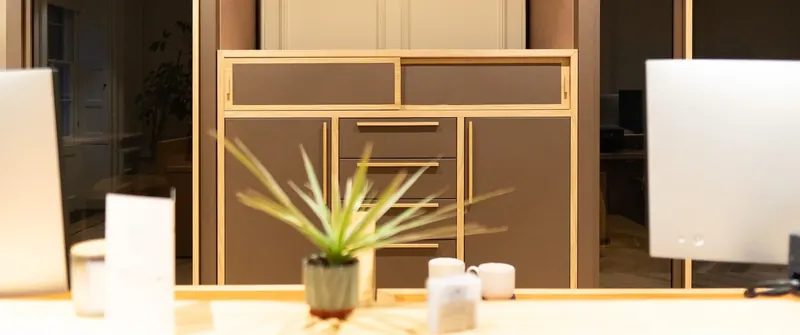
- Storage, credenzas and tea points — the joinery that lines the room: document storage, AV credenzas, coffee stations and the storage walls that double as acoustic and spatial dividers.
- Breakout and lounge furniture — as workplaces have become more hospitality-led, the soft, domestic-feeling furniture that makes an office feel like somewhere people want to be.
Engineering the boardroom table
If one object justifies a bespoke approach, it is the boardroom table. A large table is rarely a single slab; a four- or six-metre top has to be made in sections that can be brought into the building and joined invisibly on site, with the veneer set out so the grain reads as one continuous, mirror-matched surface across every joint. Getting that match right is a drawing-board exercise long before it is ever a workshop one — the leaves of veneer are laid out on the bench like a deck of cards, then selected and sequenced so the figure opens symmetrically from the centreline out and the eye never finds the seam. We have spent whole afternoons shuffling those leaves before a single cut is made; it is fussy, slow work, and it is the difference between a table that looks made and one that looks assembled.
Underneath, the table has to carry power, data and audio-visual connectivity to every seat without a single visible cable. That means concealed cable trays running the length of the base, flush pop-up or hinged access boxes let into the top, and enough internal volume in the plinth to hold the hardware an AV integrator will install later. We build these elements in from the first drawing, in coordination with the AV and electrical teams, rather than cutting holes into a finished table afterwards.
The invisible engineering: power, data and cable
Across the whole floor, the discipline that quietly separates good workplace furniture from ordinary furniture is cable management. Every desk needs power and data brought up cleanly from the floor box or the wall, held in a way that survives constant re-plugging, and hidden so the surface reads as one clean plane rather than a nest of wires creeping over the edge. We detail this with cable trays, sprung grommets, flush power modules and removable access panels, so the services can be reached and maintained for the life of the building without anyone taking the furniture apart. Increasingly that includes wireless charging let into the surface and USB-C delivered at the desk edge — small details that date quickly when they are bolted on as an afterthought, and feel permanent when they are designed in from the start.
Materials and finishes that survive the workplace
Material selection in the workplace is a balance between the richness a client wants and the punishment the surface will take. Timber veneers give the warmth and identity that make an office feel considered — and because they are bespoke, they can be matched to a brand's palette or to the architecture — but they are specified with hard-wearing lacquers and detailed with solid timber edges or metal trims at the points that take the daily knocks. Leather is used on desk tops and writing surfaces where a softer, quieter touch is wanted, warm under the hand and forgiving of a pen pressed too hard. Stone and solid surfaces carry reception and tea-point tops, where spills and cleaning are a constant. The art is in matching each material to the duty it will actually perform, so that nothing on the floor is the first thing to look worn.
Finishing is where longevity is won or lost. A workplace lacquer has to shrug off hand oils, cleaning products and the steady abrasion of a thousand sleeves, and it has to be repairable — a finish that can be locally cut back and re-coated in situ is worth far more over ten years than one that has to be sent away and the whole piece taken out of service. For more on how surfaces are built up and protected, our note on metal and timber finishes covers the same principles we apply here.
Acoustics and wellbeing
Open-plan workplaces live or die on acoustics, and furniture does a surprising amount of the work. Anyone who has tried to hold a phone call across a hard, echoing floor knows the difference a soft surface makes. Storage walls and high-backed booths are detailed with acoustic cores and upholstered faces so they absorb sound rather than bounce it back. Freestanding screens, planters and breakout seating break the volume of a large floor down into rooms-within-rooms. Upholstered panelling does for sound what it does for warmth — and because it is bespoke, it can be wrapped in the client's chosen fabric rather than the grey felt that gives so many offices their institutional feel. The result is a floor that is quieter, calmer and noticeably more pleasant to spend a day in.
Working around a live building
The last discipline is the least glamorous and the most important to get right: programme. Workplace furniture is almost always the final trade into a building, installed into a finished, often occupied space, on a date that cannot move because the client is moving in the following Monday whether the table is ready or not. That pressure shapes how the work is made. Pieces are built and finished entirely in the workshop, dry-assembled to prove the fit while there is still time to correct it, then broken down into the largest sections that will pass through the building's lifts and doorways, and reassembled on site with the joints designed to disappear. Install is sequenced around the other trades and, where a business cannot afford to stop, phased floor by floor so the company keeps working while its furniture quietly arrives around it.
A worked example: 5 St James's Square
The private offices at 5 St James's Square bring all of this together in one project. The brief asked for a workplace that felt closer to a private members' club than a conventional office — warm timbers, considered detailing, and not a visible cable anywhere. We made the reception, the boardroom and meeting tables, the desking and the storage walls as a single coordinated family, set out so the veneers ran consistently from one room to the next, with power and AV engineered into the tables and desks from the first drawing. Installed into a finished building to a fixed move-in date, it reads now as though the furniture and the architecture were always one piece of design, drawn by the same hand. That is the quiet ambition of good workplace furniture: not to be noticed at all, only to feel inevitable.
Bespoke is not the right answer for every office, and we will say so when it isn't. But for the spaces that carry a company's identity — the reception, the boardroom, the floors that clients see — furniture made for the building will always outlast and outperform furniture bought to fit it. If you are planning a workplace and want to talk through what is worth making bespoke and what is not, we are glad to be a sounding board long before there is anything to commission.