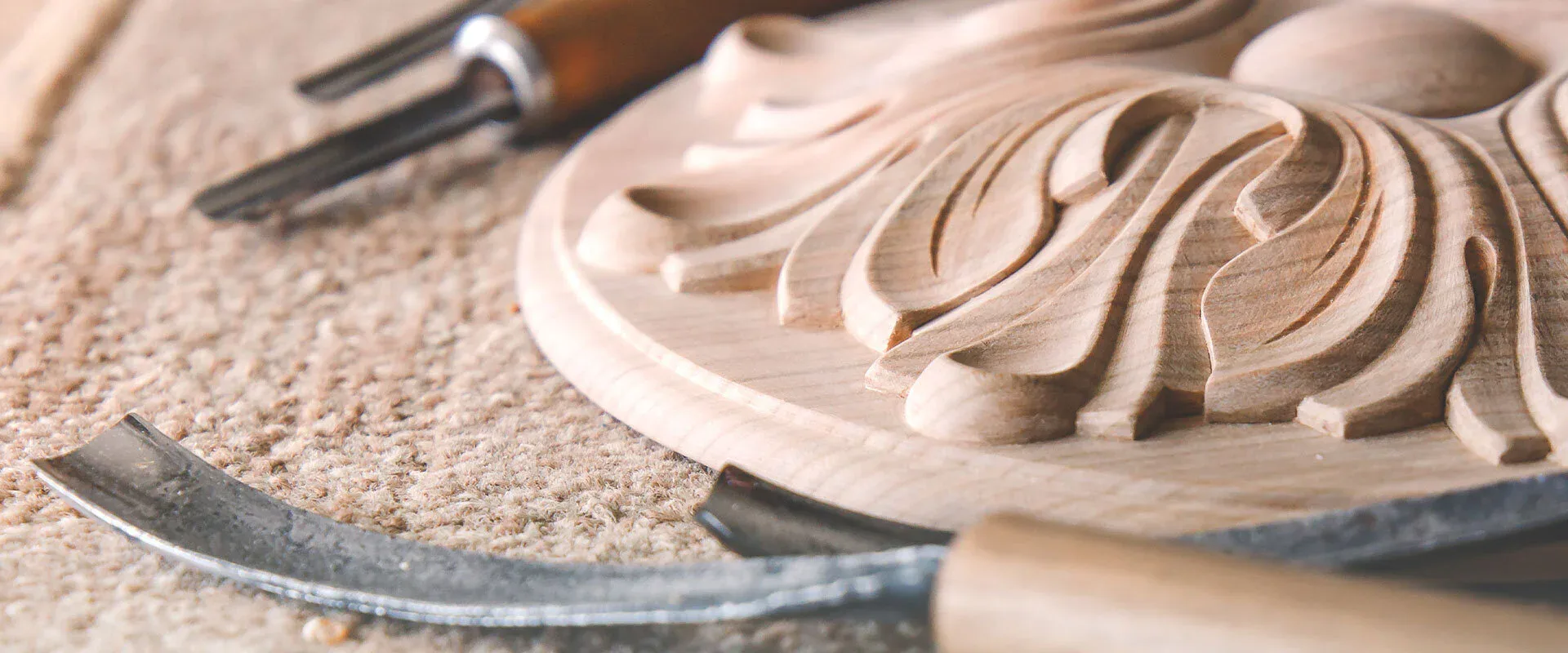
Hand-carving is the craft of shaping timber by hand with chisel and gouge to create form, ornament and relief, giving a surface a depth and life that machine carving, however precise, cannot match.
The sound carries before anything else — the soft, dense thud of a mallet on a gouge handle, then the long whisper as the blade peels a curl of timber away and lets it drop to the bench. The carver leans in close, head tilted, watching the cut the way you watch a tide. Shavings gather around the work like blossom. This is hand-carving: a carver working timber with chisel and gouge to create form, ornament and relief that no machine reproduces with the same life. It is the oldest furniture craft there is, and in an age of CNC routing it survives in luxury work for one reason — the human hand reads the grain, varies the cut, and leaves a surface with a depth and a slight irregularity that machine carving, however precise, cannot match. It is the difference between ornament that is merely accurate and ornament that is alive.
What a carver actually does
A carver removes timber to leave a form — working from a flat or roughed-out blank down to a finished moulding, a carved capital, a relief panel, a shaped show-wood arm or leg. The tools are gouges and chisels of many profiles, struck with a mallet for heavy removal and pushed by hand, palm against the steel, for the fine finishing cuts. The whole skill lives in reading the grain: timber carves cleanly in one direction and tears in another, and the carver is forever turning the work, changing hands, adjusting the angle to follow the wood rather than fight it. Push the wrong way and the surface splinters where you wanted it smooth — and there is no hiding it. A carved surface worked with the grain comes off the tool with a crispness and a low sheen that no amount of sanding can fake; you can feel it under your thumb before you can see it.
Where hand-carving belongs
- Show-wood on seating — the exposed, polished timber frame of a chair or sofa, where carved arms, legs and crests are part of the design.
- Mouldings and ornament — carved edge mouldings, capitals, rosettes and applied ornament on casegoods and architectural joinery.
- Relief panels — carved decorative panels on cabinet doors, bed surrounds and feature pieces.
- Period reproduction and restoration — matching and replacing carved elements on antique and period pieces, where machine work would read as obviously wrong.
Hand-carving and machine carving together
Modern bespoke work often uses both, and there is no shame in it. CNC routing can rough out a form quickly and accurately, taking away the bulk of the timber; the carver then finishes it by hand, bringing the surface to life and adding the detail and variation the machine never could. This is not a compromise but a sensible division of labour — the machine does the repetitive removal, the hand does the work the eye will actually read. Where authenticity demands it — period reproduction, the finest commissions — the whole piece is carved by hand from the blank, and you feel the difference the moment you run a finger along an edge.
The timber matters
Not all timber carves well. Close-grained hardwoods — lime, walnut, mahogany, pear — hold fine detail and cut cleanly; coarse or unpredictable grain tears and limits what is achievable. Lime in particular has been the carver's timber of choice for centuries because it is dense, even and almost grain-free, holding the crispest detail without a fight. I have watched a carver set aside a beautiful-looking board because the grain ran the wrong way through the place a flower would sit, and choose a plainer piece that would simply behave — and that, more than anything, is the lesson of the craft. Timber is the plainest of teachers; it tells you exactly how good you are, and it does not flatter. The choice of timber is part of the carving brief, not separate from it.
Commissioning carved work
Hand-carving is a specialist craft, executed by carvers working within our production process and planned in at the design stage so the carved element is part of the piece from the first drawing, never an afterthought stuck on at the end. Carved show-wood is then polished, lacquered or gilded to the scheme. The craft sits within our wider hand-carving capability and the full range of decorative crafts in our luxury craftsmanship guide. Come and stand at the bench while the shavings are still falling, and you will understand why we keep this work in human hands.