Wood flooring comes in three forms: parquet laid in geometric patterns, engineered boards on a stable core suited to underfloor heating, and solid planks that can be refinished for a century, each chosen for pattern, stability or character.
Step into a room with a wide-plank oak floor in the late afternoon and the floor draws your eye down. The low light rakes across the grain, picking out every ripple and figure, and the timber gives back a soft, contained glow. Underfoot there is a particular quietness — a give, a warmth, a sense of something that was once alive. No stone or synthetic surface does this. That quality is the reason wood flooring repays the attention it so rarely receives.
For all that it is the largest surface in any room — the plane that unifies everything above it — flooring is too often left until last, chosen under time pressure from a thin range, with little thought for how it will weather a decade of footsteps. Choose it well and the furniture, joinery and lighting settle into a coherent whole. Choose it poorly and no amount of quality elsewhere quite recovers. So the question is rarely whether to use wood. It is which wood, and how to specify it so the floor still looks right in twenty years.
Our flooring collections are made by manufacturing partners in France, Italy and the UK, in engineered and end-grain oak, and supplied through the studio from Chelsea Harbour in London. Here is what you need to know to specify with confidence: pattern, construction, heating, finish and care, and how each decision shapes the floor you will eventually walk on.
Wood flooring at a glance
Three constructions cover almost every floor. Pattern, species and finish are chosen separately from them: herringbone can be laid in engineered or solid oak, and an engineered floor can be oiled or lacquered.
| Construction | What it is | Best suited to | Watch for |
|---|---|---|---|
| Engineered | A real wood wear layer bonded to a stable layered core | Underfloor heating, wide boards, open-plan rooms and large spans | The wear layer sets how many times it can be sanded |
| Solid | Each board a single piece of timber from top to bottom | Settled, traditional rooms without underfloor heating, and floors meant to be sanded many times | Moves more with humidity, and needs more depth |
| End-grain | Blocks cut so the cross-section of the timber faces upward | Hard-wearing floors, entrance halls, bars and features | Needs a sound, dry, level substrate and correct acclimatisation |
Parquet: the case for pattern
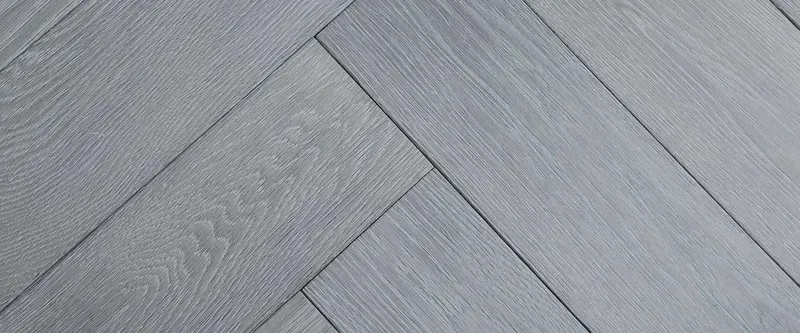
Parquet — wood laid in a geometric pattern rather than simple parallel planks — turns a floor from a surface into a design element. The most enduring of the patterns is herringbone, rectangular blocks set at right angles to one another so the eye reads a continuous, interlocking weave. The Versailles panel, a grid of square frames holding diagonal infills, is the most architectural of them, the kind of floor that quietly tells you which room you have walked into. Chevron, where planks are cut at an angle so their ends meet in an unbroken arrow, is the most contemporary of the classic forms — cleaner, more directional, and unforgiving of a careless joint.
There is a practical reward hidden inside all that geometry. The pattern breaks up the natural movement and tonal variation in timber far better than long parallel planks ever can, so the small shifts a floor makes through the seasons read as texture rather than fault. It makes parquet quietly forgiving in rooms with underfloor heating, or where the light falls unevenly across the day.
To see how a pattern reads in a room, lay it in our floor visualiser, in your choice of timber and finish.
Herringbone, chevron and the other patterns
A floor reads first as a pattern. These are the principal layouts, and how they differ.
| Pattern | How it is laid | How it reads |
|---|---|---|
| Herringbone | Rectangular boards with square-cut ends, set at right angles so the end of one board meets the side of the next | A stepped zigzag, traditional and rhythmic, and forgiving of small variations in the joint |
| Chevron | Boards with the ends cut at an angle, so they meet in a continuous point | A clean V down the line of each run: cleaner, more directional and less forgiving of a careless joint |
| Hungarian point | The traditional French name (point de Hongrie) for the pointed-arrow layout | Often used as another name for chevron. Some suppliers use it for a herringbone variant whose ends line up, so check the drawing |
| Versailles panel | Square frames holding diagonal infills, made up in panels | The most architectural of the parquets |
| Fingerblock | Squares of short strips, with alternate squares turned ninety degrees | A woven, quieter surface |
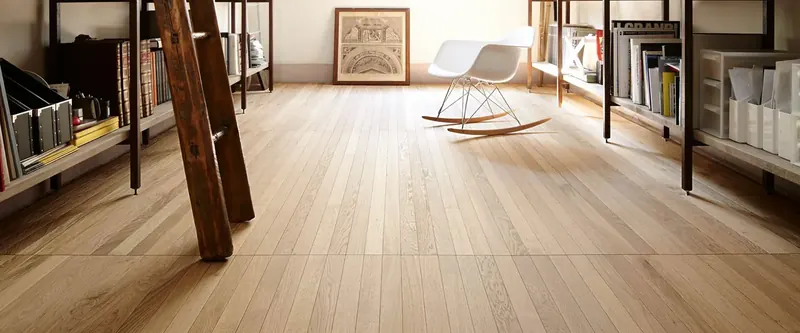
| Plank | Long boards in parallel, in random, brick or third-stagger lays | Calm and open, with the length of the room doing the work |
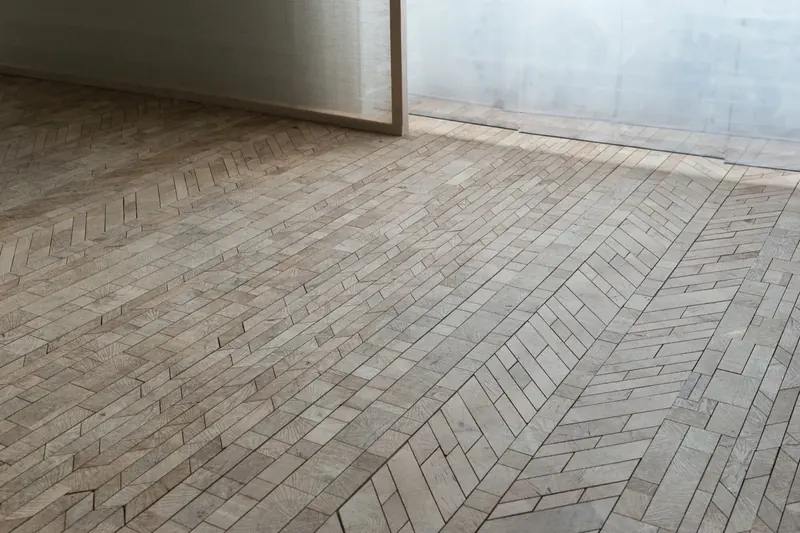
| End-grain patterns | The cross-section of the timber turned upward and laid in grids, roofs, bricks, arrows or an irregular mosaic | Depth and texture, as in Forêt and Opus |
As a rule, longer boards and larger blocks read calmer, and shorter blocks make a busier surface. Whichever you choose, ask for the block dimensions and the end angle on the drawing, because two floors with the same name can look quite different.
To see them laid in a room, in your choice of timber and finish, open the floor visualiser at herringbone, chevron, Versailles, fingerblock or plank.
Engineered wood: stability for modern interiors
Engineered wood flooring is built from a real wood veneer, typically 3–6mm thick, bonded over a stable core of cross-ply plywood or HDF. Stand on it and you would never know — the top layer is genuine timber, with the same grain, the same warmth, the same finish as a solid board. What you gain is composure. Those cross-laid plies hold the board steady against the expansion and contraction that humidity drives, the movement that makes a solid floor gap, cup or bow.
For modern interiors with underfloor heating — now the standard in most new-build luxury residential and hospitality work — we recommend engineered construction without much hesitation. The core lets the heat rise through evenly, without the internal stresses that pull a solid floor apart over a warm winter. Engineered boards also sit lower, since they do not need the sub-floor depth a solid installation demands — a quiet help when floor-to-ceiling height is precious.
Two numbers decide how an engineered board lives: the thickness of the wear layer and the construction of the core. The wear layer is the oak you walk on, and it sets how many times the floor can be sanded. As a rule of thumb, a wear layer of 4 to 6 mm allows several sandings over decades, while a thin one can be spent after a single pass. A multi-layer plywood core is generally the most stable, and fibreboard cores are generally more sensitive to moisture. Ask for both numbers in writing, and see our guide to engineered and solid wood flooring for the full comparison.
Solid wood: character and longevity
Solid wood — planks or blocks cut whole from a single piece of timber — remains the choice where character matters above all, and where a floor is expected to be sanded and refinished again and again across a long life. A well-kept solid oak floor can last a century or more. Each refinishing cuts back to fresh wood beneath the wear, and with it comes the chance of a new colour, a new finish, a second life for the same boards your grandparents walked on.
It suits listed and period buildings especially, where the floor has to read as honestly of its age. Wide, character-grade boards — the ones that keep their knots, their colour shifts, the small disagreements in the grain — carry a presence that even the best engineered alternative does not quite reach. There is a particular satisfaction in a room where the boards have outlived everyone who first chose them, and in adding to that lineage rather than starting it over.
End-grain oak: the hardest face of the timber
In an end-grain floor the blocks are cut across the trunk, so the growth rings and rays face upward and the cut end of the fibre, not its side, takes the wear. It is the orientation once chosen for workshop floors, and for the wooden cobblestones that softened the noise of carriages in parts of nineteenth-century Paris, because it wears far more slowly than a flat-sawn plank.
Our end-grain collections are Forêt, in six patterns selectable board by board and mounted on planks, Opus, a mosaic of pre-assembled tiles with no visible repeat, Élément, one chevron component laid in many arrangements, and Cube, square blocks in an even grid. Forêt and Opus are oiled, and an oiled surface can be refreshed in worn areas without sanding the whole floor; Élément and Cube are sealed with a hard varnish. End-grain oak asks for a sound, dry, level substrate and proper acclimatisation, and heating over it is confirmed with the maker.
Underfloor heating
Underfloor heating is now very common in new-build luxury and deep-renovation work, and it asks a lot of a wood floor. The conditions are specific: engineered construction as the default (end-grain solid oak needs the maker’s approval), a floor surface that never passes 27°C, a fully bonded fixing, and a subfloor that has been tested dry and run through a commissioning programme. Herringbone, chevron and panel parquet are laid fully bonded in any case, which is also the best arrangement for heat transfer. Our guide to wood flooring over underfloor heating sets out the figures and the order of work.
Fixing and preparing the floor
A floor is only as good as the work beneath it. The subfloor must be clean, dry, sound and flat, and for herringbone, chevron and panel floors flatness is critical: a common tolerance is a gap of no more than 3 mm under a 2 m straight edge. The subfloor is tested for moisture and the readings recorded before the boards arrive, the building is closed in and held at normal living temperature and humidity, and the boards are acclimatised in the room for the time the maker specifies. We ask for two to three days in their packs at 16 to 24°C and 45 to 65 per cent relative humidity, and may ask for more over underfloor heating.
There are three ways to hold a wood floor down. Fully bonding it to the screed with a flexible adhesive gives the most stable result and a solid sound underfoot, and it is the method we prefer over underfloor heating, and the one recommended for herringbone, chevron and panel floors. Floating an engineered plank over an underlay is quicker and easier to lift later, but the footfall is hollower and the floor moves as a single sheet, so it suits planks, not patterns. Nailing to joists or battens is the traditional method for solid boards.
Every floor also needs room to move: we ask for a minimum gap of 15 mm around the perimeter and every obstruction, hidden beneath skirting, scotia or a threshold. Pattern floors are set out from the centre line of the room, laid dry first, and laid by a qualified, experienced floor installer. We confirm subfloor, moisture and acclimatisation requirements with your contractor before installation. Our guide to wood flooring installation sets out what a good specification includes, from site conditions and subfloors to setting out, movement gaps and the details that make a floor look finished.
Finish, texture and colour
Three separate decisions give a floor its surface. Colour can be set by surface pigment, by bleaching, or by reaction with the oak’s own tannins, as in smoked and fumed oak, where the colour forms inside the fibre. Texture ranges from smooth through light and heavy brushing to hand-planed and saw-marked faces, and a brushed surface hides everyday marks. Finish is mainly a choice between oil and lacquer.
A natural oil soaks into the wood, leaves a matt, tactile surface and can be refreshed and repaired locally, which suits living rooms and bedrooms. A UV-lacquer sits on the surface as a harder, sealed film and suits kitchens, hallways, lettings and busy commercial rooms. The guide to wood floor finishes compares them side by side, and the Classics collection shows twelve shades in a single range.
The collections
Our flooring range spans nine collections, each with its own temperament, and every one is available in bespoke dimensions, finishes and installation patterns.
- Classics: the core oak range, in twelve shades, as plank or parquet.
- Désir: slender oak planks of varying lengths set in a woven lay, with a soft heat-treatment.
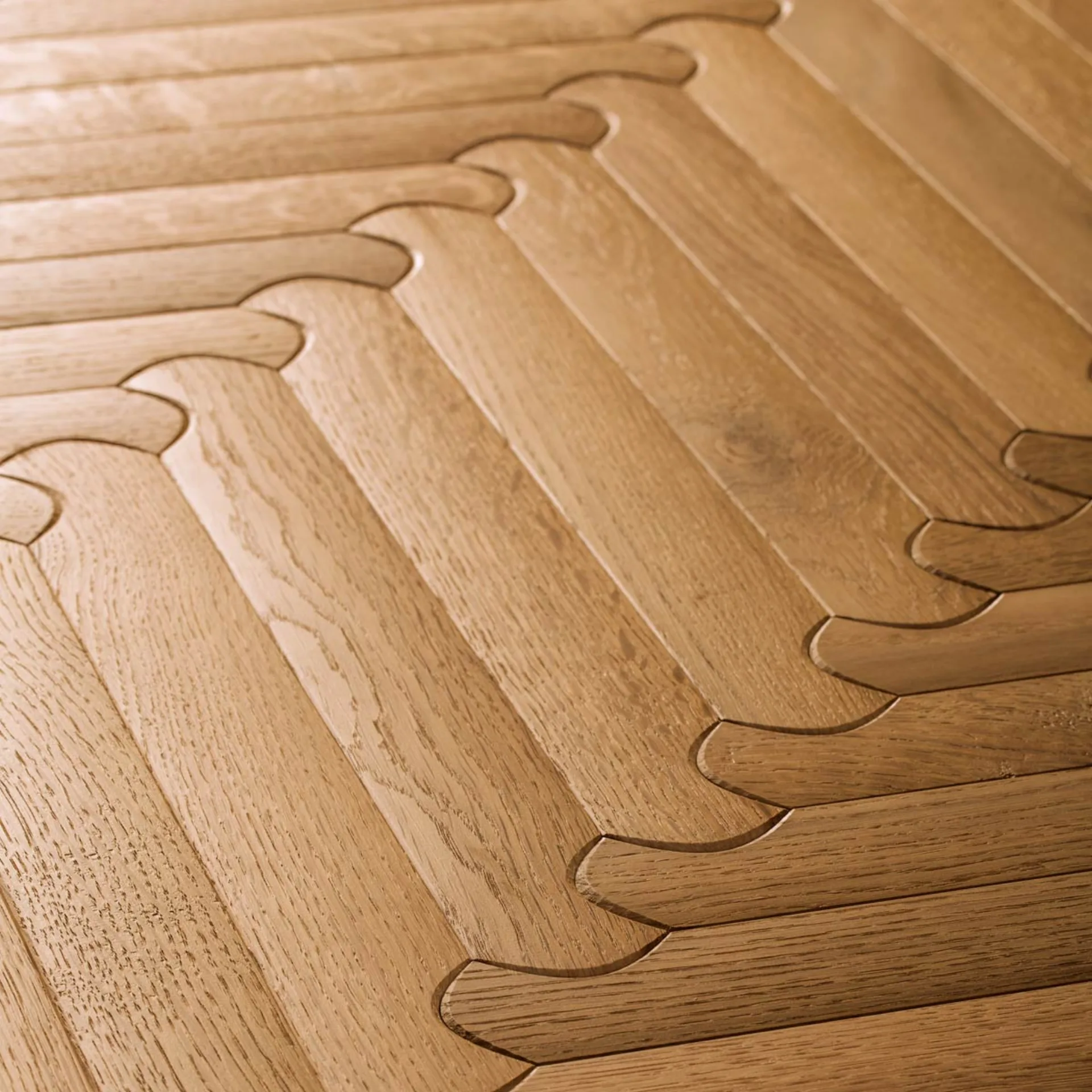
- Biscuit: engineered oak with a rounded, bevelled edge and a slight bombé across the face, laid in herringbone, diagonal or full length.
- Forêt: end-grain oak in six patterns, mounted on planks.
- Opus: an end-grain oak mosaic of pre-assembled tiles with no visible repeat.
- Élément: one end-grain oak chevron component, set in many arrangements.
- Cube: end-grain oak blocks in an open, even grid, made from solid offcuts.
- Slide: modular oak panels composed into geometric layouts, in four colourways.
- Undici: oak parquet with decoration laser-engraved into the grain.
To compare them laid in a room, use the floor visualiser.
Living with a wood floor
Grit does most of the damage to a wood floor, so mats at the entrances and a regular sweep or vacuum matter more than any product. Clean with a barely damp mop and a cleaner suited to the finish, put felt pads under furniture, and wipe spills promptly. Water left standing is the real enemy, especially at the edges of boards. An engineered floor can be laid in a kitchen with sensible care, while a bathroom needs more thought and the maker’s approval.
A solid floor can be sanded back and refinished many times, and an engineered floor as often as its wear layer allows. Oiled floors can often be refreshed in worn areas without sanding at all. Oak also changes with light, mellowing slowly toward warmer tones, and moving a rug now and then evens out the difference. Dogs and cats will mark any floor over time. A brushed or textured surface and an oil finish that can be refreshed locally make the marks easier to live with, and trimmed nails help.
Sourcing and sustainability
A floor is one of the longest-lived things you put into a room, so where the timber came from deserves the same attention as how it looks. Ask for the certificate and check it, ask which species it is and where it grew, and ask how long the floor will stay down before it needs replacing. Our guide to sustainable wood flooring sets out the certification schemes, the law and the pros and cons of each timber.
Specification considerations
The decisions that shape a wood floor are few but consequential: construction type (solid or engineered), species and grade, width and thickness, surface treatment (oiled, lacquered, waxed or left unfinished), and pattern. Each affects both how the floor performs and how it looks, and a handful of them, once made, cannot be undone without lifting the floor and starting again. They reward being made early, and made deliberately.
- Specify engineered construction where underfloor heating is installed, and get the maker’s written approval for any other construction
- Consider subfloor height early, solid wood requires more depth than engineered
- Wide boards read as more luxurious but show more movement in variable humidity
- Oil finishes are easier to repair in situ; lacquer gives a harder, more uniform surface
- Follow the maker’s acclimatisation guidance before installation, usually a few days in the room, and test the subfloor for moisture first
- Ask for the wear layer thickness and the core construction in writing
- Judge shade and sheen on a sample in the room’s own light
Questions we are asked
What is the difference between herringbone and chevron flooring?
Herringbone sets rectangular boards with square-cut ends at right angles to each other, so the end of one board meets the side of the next and the pattern zigzags. Chevron cuts the board ends at an angle so they meet in a continuous point, like an arrow, with a clean line down the middle of each V. Chevron reads as cleaner and more directional, and it is less forgiving of a careless joint. Hungarian point is the traditional name for the pointed layout and is often used as another name for chevron. You can compare them laid in a room in the floor visualiser.
What is parquet?
Parquet is wood laid in a geometric pattern, such as herringbone, chevron or Versailles, rather than in long parallel planks. It can be made in engineered or solid timber, and it is almost always fully bonded to the subfloor.
Is engineered wood flooring better than solid?
Neither is better in every room. Engineered boards stay flatter through changes in heat and humidity, so they suit underfloor heating, wide boards and open-plan rooms, and with a generous wear layer they last for decades. Solid wood suits settled interiors without underfloor heating and can be sanded back many times. The full comparison sets out the reasons.
How is wood flooring installed?
The building is closed in and held at living conditions, the subfloor is tested flat and dry, the boards are acclimatised in the room, and the floor is bonded, floated or nailed according to its format. Pattern floors are bonded and set out from the centre line, with a movement gap hidden at the edges. The installation guide goes through each step.
Can wood flooring go over underfloor heating?
Yes, when it is specified for it: engineered construction, fully bonded, a floor surface that never exceeds 27°C, a subfloor tested dry and a gradual warm-up. Our guide to wood flooring over underfloor heating sets out the figures and the order of work.
How long does a wood floor last?
A well-kept solid oak floor can last a century or more, because each sanding cuts back to fresh wood. An engineered floor lasts as long as its wear layer allows: as a rule of thumb, a wear layer of 4 to 6 mm allows several sandings over decades, while a thin one can be spent after a single pass.
Should I choose an oil or a lacquer finish?
Oil gives a matt, tactile surface that can be refreshed and repaired locally, and it suits living rooms and bedrooms. Lacquer gives a harder, sealed surface that suits kitchens, hallways and busy rooms. The guide to wood floor finishes compares them side by side.
How much does bespoke wood flooring cost?
It depends on the collection, the construction, the pattern, the area and the finish, so every floor is quoted individually against your plans and finishes schedule. Samples come first, so the specification is agreed before the boards are made. See our pricing and quotation page.
Can I see a floor in my room before I choose?
Yes. The floor visualiser lays any of the patterns in a room photograph, or over a photograph of your own room, in your choice of timber and shade. Colour on a screen is only a guide, so we confirm every floor on a physical sample.
Is wood flooring sustainable?
It can be, if the timber is legal, traceable, not threatened and long-lived. Ask for the certificate and check it, ask which species it is and where it grew, and ask how long the floor will stay down. See our guide to sustainable wood flooring.
A good floor is a quiet thing. You stop noticing it within a week of moving in, and that is exactly the point — it simply holds the room together, warm and steady underfoot, while everything else takes the eye. We are glad to advise at any stage of a project, and to send samples you can lay out in the real light of the room before anything is decided. Contact us to talk it through.